


Listen to the article
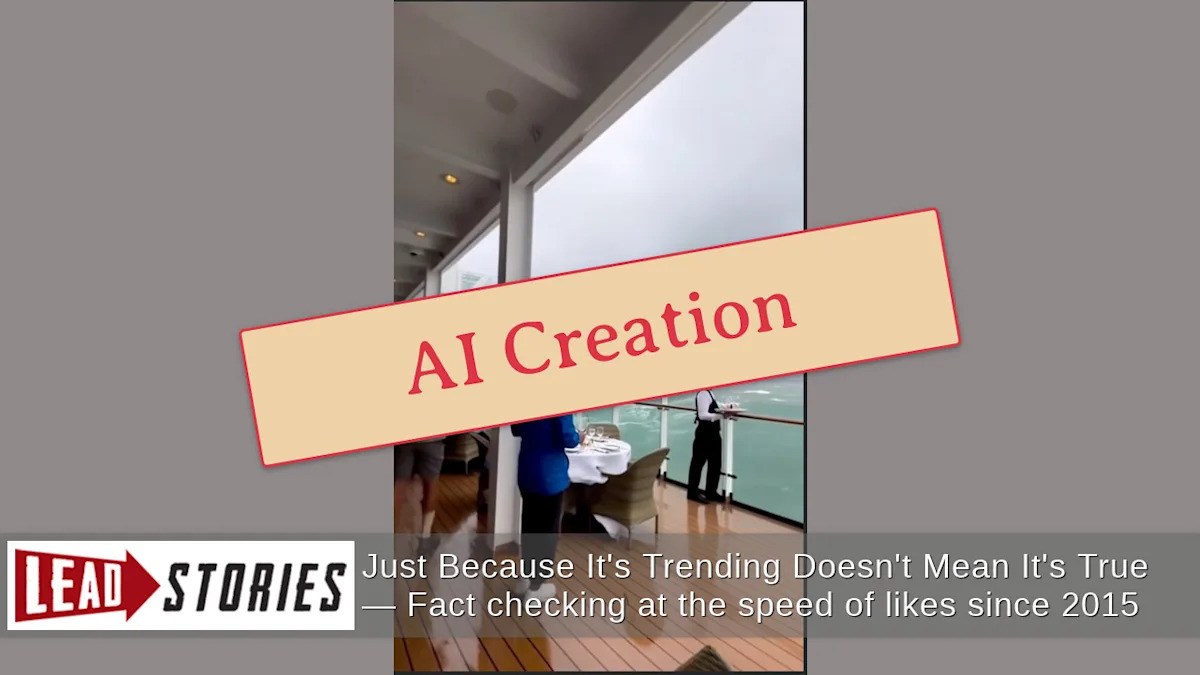
A massive wave crashing over a cruise ship named “Venessa” in the Pacific Ocean has captured attention on social media, but maritime experts confirm the dramatic footage is entirely artificial.
The video, which began circulating widely after being shared by Instagram account @nautical.daily on November 15, shows what appears to be a towering rogue wave engulfing a cruise ship’s deck during what the post claimed was “a severe storm in the Pacific Ocean.”
However, investigation into the footage’s origin reveals it was created using artificial intelligence technology, not captured during an actual maritime incident. The original source of the video is TikTok account @endlessstoriespictures, which explicitly labels its content as AI-generated in its bio: “An AI creating AI videos.”
The original TikTok post included hashtags clearly identifying the content as fabricated, including #aivideo, #cgi, #fiction, and #cinematicai. The description reads: “Rogue wave impact caught on deck – the moment the sea turned violent,” but the accompanying tags make it evident this is a creative simulation, not documentation of a real event.
Maritime safety experts note that an actual rogue wave of this magnitude striking a cruise vessel would constitute a significant maritime incident, likely resulting in extensive coverage across mainstream news outlets and industry publications. No such incident involving a cruise ship named “Venessa” has been reported by legitimate news sources or maritime authorities.
A comprehensive search of maritime databases, news archives, and cruise industry reports reveals no record of a cruise vessel with the name “Venessa” experiencing such a catastrophic wave encounter in the Pacific Ocean or elsewhere. Major cruise operators confirm no vessels in their fleets bear this name.
Dr. Eleanor Harrington, an oceanographer specializing in extreme wave phenomena at the Pacific Marine Research Institute, explains why the video immediately raised red flags among experts. “While rogue waves are real oceanic phenomena that can reach extraordinary heights, the behavior of the water in this video defies fluid dynamics. The way it moves and crashes over the ship displays characteristics inconsistent with actual wave physics, even in extreme conditions.”
The circulation of such convincing AI-generated disaster content highlights growing concerns about misinformation in the digital age. Maritime safety organizations worry that such videos could unnecessarily alarm travelers or family members of those currently at sea if mistaken for actual events.
Cruise industry representative Marcus Jensen from the International Cruise Line Association notes that modern cruise ships are engineered with sophisticated stabilization systems and weather-monitoring technologies specifically designed to avoid such dangerous conditions. “Today’s cruise vessels typically alter course or adjust schedules when severe weather is forecasted. The safety protocols in place make scenarios depicted in this simulation extremely unlikely.”
This is not the first instance of AI-generated disaster content gaining traction online. Digital media literacy experts have observed an increase in realistic-looking but fabricated emergency scenarios across platforms, often garnering millions of views before being identified as artificial.
Social media platforms continue to grapple with how to address synthetic media that, while labeled as artificial by its creators, may be reshared without those disclaimers, potentially causing public confusion or alarm.
The incident serves as a reminder of the importance of verifying sources and examining context clues when encountering dramatic footage online, particularly as AI technology makes distinguishing between authentic and generated content increasingly challenging for the average viewer.
Fact Checker
Verify the accuracy of this article using The Disinformation Commission analysis and real-time sources.

12 Comments
This is a concerning example of how AI can be used to create false narratives. While the technology is advancing, we need stronger safeguards to protect against the malicious use of deepfakes and other manipulated media.
This illustrates the power and risks of deepfake technology. While AI can create very realistic-looking videos, it’s crucial to be skeptical and fact-check before assuming any viral content is genuine.
I’m impressed by the maritime experts’ ability to quickly identify this viral video as an AI-generated fabrication. It’s a good reminder that we should always verify the source and authenticity of online content before sharing or believing it.
I appreciate the Disinformation Commission’s thorough fact-checking on this viral video. It’s a good example of how AI can be misused to generate misleading content, and the importance of critical thinking online.
Kudos to the maritime experts for quickly debunking this rogue wave video as an AI-generated fabrication. It’s important to have trusted sources to verify the authenticity of sensational online content.
The use of AI to create fictional maritime incidents is a troubling development. While the technology is advancing, we need robust fact-checking and media literacy efforts to prevent the spread of misinformation.
Glad to see the maritime experts were able to quickly identify this viral video as an AI-generated fabrication. It’s a good reminder that we should always approach viral content with a critical eye.
Agreed. The proliferation of deepfake technology is a serious concern, and we’ll need robust fact-checking and media literacy efforts to combat the spread of misinformation online.
This raises interesting questions about the future of AI and how it could be used to manipulate visual media. It’s a complex issue with implications for everything from news to entertainment.
Absolutely. As the technology advances, we’ll need to be increasingly vigilant about verifying the authenticity of online content, especially anything that seems sensational or unbelievable.
The use of AI to create fictional maritime incidents is concerning. While the technology is advancing, we need better safeguards to prevent the spread of misinformation masquerading as real events.
Interesting to see how AI can generate such convincing (but ultimately false) maritime footage. It’s a good reminder to always verify the source and authenticity of viral videos before sharing or believing them.