


Listen to the article
Recent social media posts have circulated a document purporting to announce significant increases in petrol and diesel prices, but government officials have confirmed the document is a fabrication designed to mislead the public.
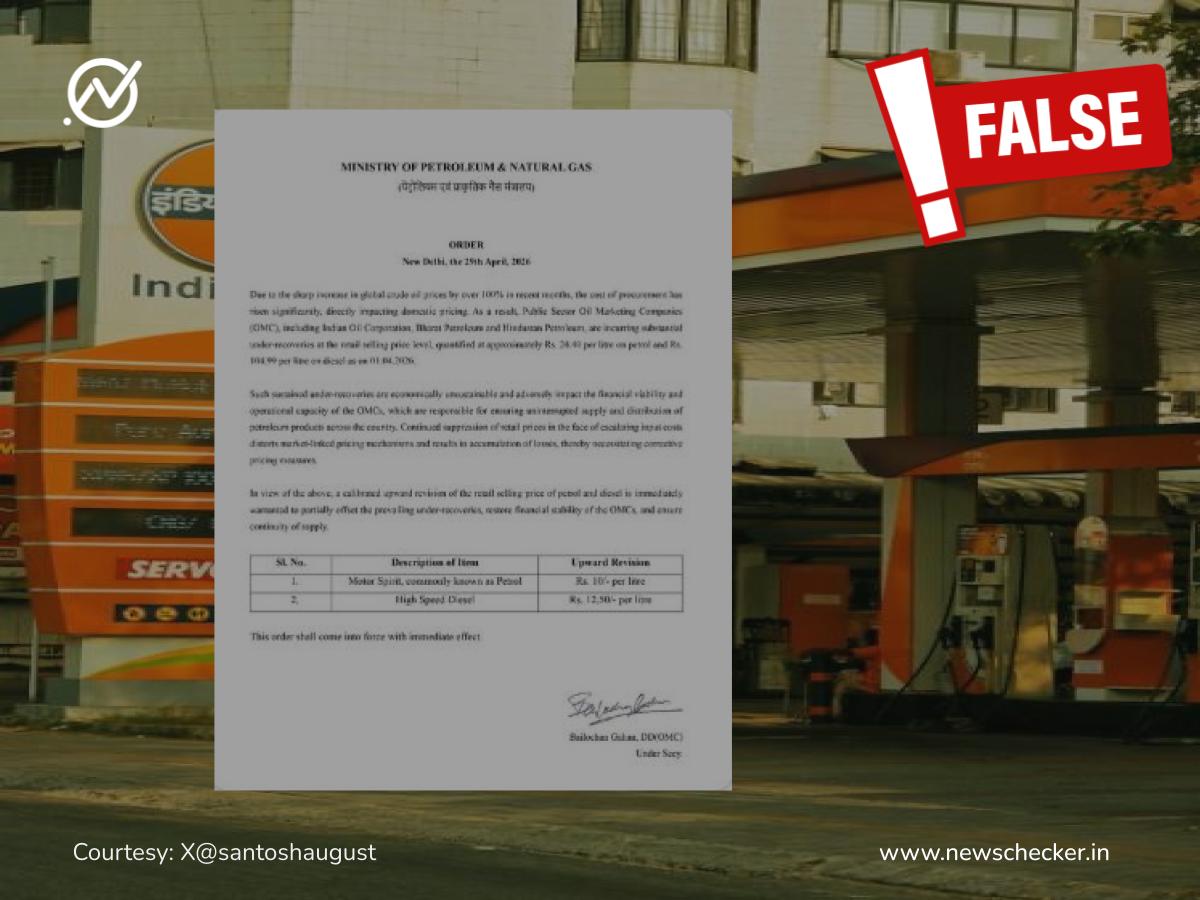
The counterfeit order, which claimed to be issued by the Ministry of Petroleum and Natural Gas on April 29, 2026, falsely stated that petrol prices would rise by ₹10 per liter and diesel by ₹12.50 per liter. According to the fake document, these increases were necessary due to rising global crude oil prices.
A comprehensive search of official government communications revealed no such price hike announcement. The Ministry’s website and social media channels contain no reference to any recent fuel price revisions, contradicting claims made in the viral document.
“This document circulating on social media platforms regarding fuel price increases is completely fabricated,” a ministry spokesperson told reporters when asked about the viral claims. “No such directive has been issued by the Ministry of Petroleum and Natural Gas.”
The fabricated order contains several telltale signs of inauthenticity. Notably, it lacks standard formatting elements typically found in official government communications, including an order number and proper ministerial address. The date placement also deviates from established government document templates.
The government’s official fact-checking body, PIB Fact Check, publicly debunked the claim on its social media platforms. In an unusually direct response that underscores the seriousness with which authorities view such misinformation, the Ministry of Petroleum and Natural Gas reposted this clarification through its official channels.
“Spreading such misinformation can cause unnecessary public panic and market volatility,” noted an energy sector analyst who spoke on condition of anonymity. “Fuel price changes have significant ripple effects throughout the economy, so false information about major price hikes can be particularly damaging.”
Fuel price sensitivity remains high among Indian consumers, with previous legitimate increases often triggering public debate about inflation concerns. India, which imports approximately 85% of its crude oil requirements, has seen retail fuel prices become a politically charged issue, particularly during election seasons.
The timing of this misinformation coincides with fluctuations in global oil markets, which may have made the false claims seem plausible to some readers. Crude oil benchmarks have experienced volatility in recent weeks, though not to the extent that would justify the dramatic price increases claimed in the fake order.
Digital misinformation experts note that doctored government orders represent an increasingly common tactic used to spread false information. Such documents exploit the inherent trust many citizens place in official communications.
For consumers concerned about fuel prices, authorities recommend consulting only official government sources and established news outlets for accurate information. The Ministry maintains updated pricing information on its website, and any significant policy changes would be announced through formal channels.
As of publication time, retail fuel prices remain unchanged, and no imminent increases have been announced by authorized government representatives or oil marketing companies. Authorities continue to monitor social media for similar misleading claims and urge the public to verify information before sharing.
Fact Checker
Verify the accuracy of this article using The Disinformation Commission analysis and real-time sources.

7 Comments
Interesting to see how disinformation can spread so quickly online. It’s important to always verify claims, especially around sensitive topics like fuel prices. Glad the ministry was quick to debunk this fabricated document.
Fabricated documents like this are becoming increasingly common. It’s important for people to develop a critical eye and verify claims, especially around important topics like fuel prices. Good on the ministry for the quick response.
It’s disappointing to see false information like this gain traction on social media. But I’m encouraged that the authorities were proactive in addressing the issue. Staying informed and verifying claims is so important these days.
Sad to see yet another example of misinformation being spread online. Kudos to the ministry for promptly debunking this fake order. Fact-checking is so vital these days to combat the tide of false claims.
This is a clear case of someone trying to stir up panic and confusion. I’m glad the ministry was able to swiftly dismiss the fabricated document and set the record straight. Vigilance against misinformation is crucial.
This is a good reminder to be cautious about viral messages, especially ones making big claims. Fact-checking is crucial to prevent the spread of misinformation. Kudos to the ministry for setting the record straight.
Absolutely. It’s worrying how easily false information can circulate these days. Glad the authorities were proactive in addressing this particular case.