


Listen to the article
After weeks of high-stakes negotiations, the United States and China appear to be nearing a comprehensive trade agreement that could reshape economic relations between the world’s two largest economies. Sources familiar with the discussions indicate that both sides have made significant concessions, potentially ending years of escalating tariffs and trade tensions.
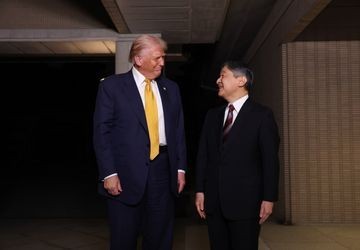
The breakthrough follows President Donald Trump’s recent diplomatic tour through Asia, where trade discussions were a central focus during his visits to Japan and meetings with Chinese officials on the sidelines of regional summits. Trump’s stop in Tokyo last week, where he met with Japanese Emperor Naruhito at the Imperial Palace, was part of a broader strategy to strengthen alliances in the region while negotiating with China from a position of collective strength.
“We’re very close to a deal that works for American workers,” said a senior White House official who requested anonymity to discuss sensitive negotiations. “The president has been clear that any agreement must address structural issues in our trading relationship with China.”
The potential agreement, which could be announced within days, reportedly includes significant Chinese commitments to purchase American agricultural products, energy resources, and manufactured goods. In exchange, the United States would roll back some tariffs imposed during previous rounds of trade conflict that began in 2018.
Market analysts suggest the deal could provide much-needed stability for global supply chains that have been disrupted by years of trade uncertainty and more recently by pandemic-related challenges.
“What we’re potentially seeing is the beginning of a new chapter in U.S.-China economic relations,” said Dr. Eleanor Ramirez, an international trade expert at Georgetown University. “But the details matter enormously. Previous agreements have fallen short of addressing core American concerns about intellectual property protection and forced technology transfers.”
The stakes could hardly be higher. Bilateral trade between the U.S. and China exceeded $690 billion last year, with American companies heavily invested in Chinese manufacturing and Chinese investors holding over $1 trillion in U.S. government debt.
For American consumers, the trade conflict has meant higher prices on thousands of imported goods, from electronics to clothing. A U.S. Chamber of Commerce analysis estimated that tariffs have cost the average American household more than $1,200 annually since their implementation.
Agricultural states have been particularly impacted by Chinese counter-tariffs. Iowa soybean farmers, for instance, saw exports to China drop by more than 75% during the height of the trade war, though some recovery has occurred under interim agreements.
“Our members have weathered a perfect storm of trade disruption and pandemic challenges,” said Jennifer Holman, spokesperson for the American Farm Bureau Federation. “A stable, predictable trading relationship with China would be welcome news for rural America.”
The potential agreement comes as both countries face domestic economic pressures. The U.S. is battling persistent inflation and slowing growth, while China confronts a property sector crisis and declining foreign investment.
Critics, however, warn that the deal may fail to address fundamental issues. “We’ve seen this movie before,” said Senator Mark Warner (D-VA), who chairs the Senate Intelligence Committee. “Promises of Chinese purchases that never materialize, while structural problems like industrial subsidies and market access barriers remain unresolved.”
Business leaders have expressed cautious optimism. “After years of uncertainty, any progress toward normalizing trade relations would help companies plan for the future,” said Thomas Wilson, CEO of the U.S.-China Business Council. “But the agreement needs enforcement mechanisms with real teeth.”
The timing is significant, coming just days before major regional summits in Asia. After his Japan visit, President Trump is scheduled to attend the Asia-Pacific Economic Cooperation (APEC) meetings in South Korea, where the potential agreement could be formally announced.
As markets await official confirmation, one thing is clear: the outcome of these negotiations will ripple through global supply chains, financial markets, and diplomatic relations for years to come.
Fact Checker
Verify the accuracy of this article using The Disinformation Commission analysis and real-time sources.

18 Comments
The mining and energy sectors have a lot riding on how this US-China trade situation plays out. Key resources like copper, lithium, and uranium are central to the global economy and energy transition, so the implications could be significant.
Absolutely, the stakes are high. This deal could reshape supply chains, investment flows, and competitive dynamics in crucial commodity markets for years to come.
I’m a bit skeptical that this deal will truly resolve the deep-seated issues between the US and China when it comes to trade. Structural differences and strategic competition are still major factors that could undermine the longevity of any agreement.
That’s a fair point. The broader geopolitical tensions may make it challenging to maintain a durable trade truce long-term.
This potential US-China trade deal sounds like it could have major implications for commodity markets and mining companies. I’m curious to see what the details end up being and how it might impact global supply chains and prices for key minerals and metals.
You’re right, the details will be crucial. Mining and metals are such a critical part of the global economy, so this deal could have a big ripple effect.
Commodity markets have been on a rollercoaster due to the US-China trade war. I hope this potential deal can inject some much-needed stability and predictability, even if it doesn’t resolve all the underlying tensions.
Agreed, some level of stability would be welcome, even if it’s not a perfect or permanent solution. Volatility has been very disruptive for companies across the commodities sector.
Reducing trade tensions between the world’s two largest economies is certainly a positive development. Hopefully this deal can help bring more stability and predictability to commodity markets that have been dealing with a lot of volatility.
Agreed, stability in trade relations is so important for commodity producers and consumers alike. Less uncertainty should be welcome news.
It’s interesting to see the US trying to leverage regional alliances like Japan to gain negotiating leverage over China. Trade wars have geopolitical dimensions that go beyond just the economic interests at stake.
You make a good point. The broader strategic dynamics between the US, China, and America’s regional partners will shape how this all plays out.
As an investor in mining and metals, I’ll be closely watching how this deal impacts commodity prices and the outlook for key resources like copper, lithium, and uranium. It could create both risks and opportunities for companies in those sectors.
Absolutely, the implications for specific commodities and industries will be really important to monitor. This could reshape the competitive landscape in meaningful ways.
From what I understand, a big sticking point has been China’s alleged unfair practices around intellectual property, technology transfer, and industrial subsidies. Any deal will need to credibly address those structural issues to be meaningful.
Exactly, the structural reforms China makes, or doesn’t make, in those areas will be a crucial test of whether this agreement is truly substantive.
With trillions of dollars and the global economic order at stake, I hope US and Chinese negotiators can find a way to reach a comprehensive, durable, and mutually beneficial agreement. Easing trade frictions would be a win for everyone.
Yes, a pragmatic and constructive outcome that works for both sides would be ideal. Resolving this dispute is crucial for the health of the global economy.