


Listen to the article
AI-Generated Video Falsely Depicts Trump-Clinton Encounter
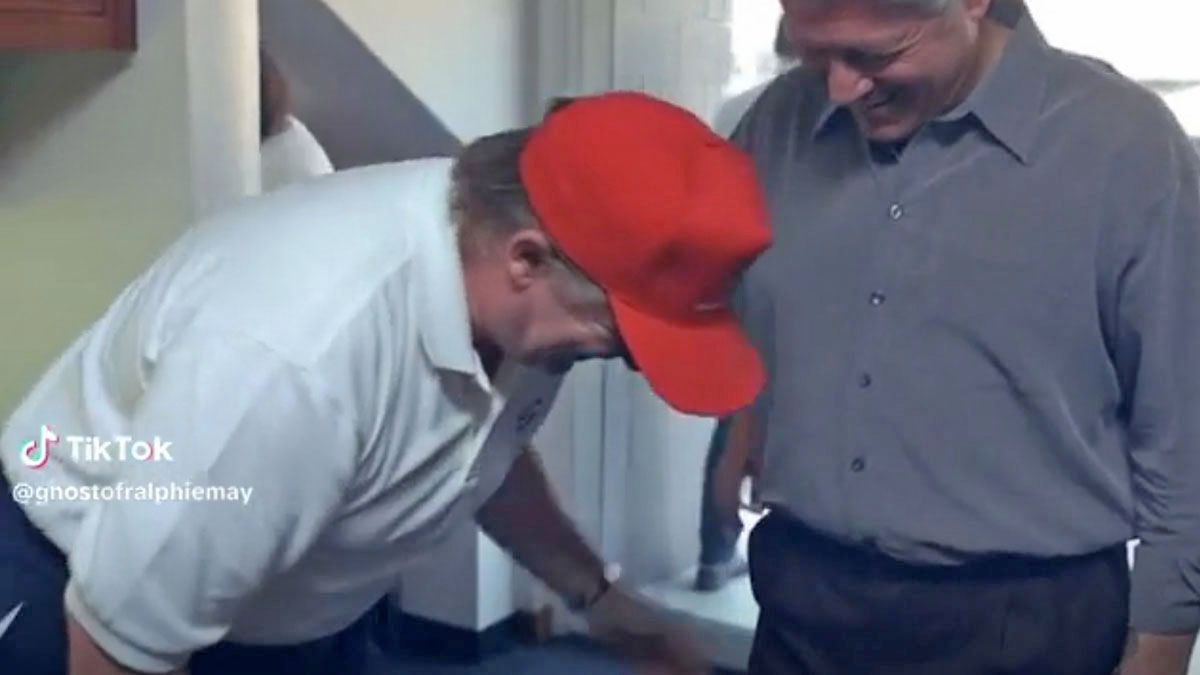
A fabricated video purporting to show former President Donald Trump kneeling and kissing former President Bill Clinton’s crotch has been circulating widely across social media platforms, misleading thousands of viewers who believed the footage was authentic.
The video, which first gained significant traction after being posted on Reddit on November 16, 2025, quickly accumulated over 88,000 engagement points before moderators removed it for violating the subreddit’s “No Politics” rule. The Reddit user who shared the clip, u/Future_PeterSchiff, claimed they had found it “on a Russian discord server,” further fueling speculation about its origin.
Forensic analysis confirms the video was created using artificial intelligence technology. The creator employed an AI tool to animate a genuine still photograph from September 9, 2000, captured during the U.S. Open tennis tournament in Flushing Meadows, New York. The authentic image shows Trump with his hand appearing—from the camera angle—to be positioned near Clinton’s midsection, creating the visual basis for the deceptive manipulation.
William Vasta, the White House photographer who took the original picture, explained the innocent context behind the image in a statement to Snopes: “I didn’t see any inappropriate contact there. Trump was simply signaling to others in the room to gather for a group photo that included him, his guests, and Clinton. What you’re seeing in the still photo is just an outtake between handshakes and gestures.”
Vasta emphatically denied the existence of any video footage from this moment, stating: “There was no video of this moment. Any clips circulating on social media this week are fake. They used my still image to create them.”
The William J. Clinton Presidential Library and Museum has confirmed the authenticity of the original photograph, which was released in 2016 following a Freedom of Information Act request. The photo was part of a larger collection documenting the event, which also included images featuring future First Lady Melania Trump, who was Trump’s girlfriend at the time.
The timing of the fake video’s circulation appears significant, coming just days after the U.S. House Committee on Oversight and Government Reform released approximately 23,000 documents related to deceased sex offender Jeffrey Epstein. Among these materials were emails that Democrats on the committee highlighted, including one claiming Trump “knew about the girls” and another stating Trump “spent hours” at Epstein’s house with a sex-trafficking victim.
White House Press Secretary Karoline Leavitt dismissed these emails, telling Snopes, “The Democrats selectively leaked emails to the liberal media to create a fake narrative to smear President Trump.”
Another released email has drawn particular attention in connection with the fake video. In this message, Mark Epstein (Jeffrey’s brother) suggested that his brother ask former White House adviser Steve Bannon “if Putin has the photos of Trump blowing Bubba,” using language referring to oral sex. Although some social media users speculated “Bubba” referred to Clinton, Mark Epstein explicitly denied this, stating: “For the avoidance of doubt, the reference to ‘Bubba’ in this correspondence is not, in any way, a reference to former President Bill Clinton.”
The fake Trump-Clinton video is not an isolated incident. A similar AI-generated clip showing Trump repeatedly patting Clinton’s crotch at the same event has also been circulating across Facebook, Instagram, Threads, and X, further blurring the line between reality and fabrication.
This incident highlights the growing challenge of distinguishing authentic media from AI-generated content, particularly in politically charged contexts where such manipulations can quickly spread misinformation and inflame partisan tensions.
Fact Checker
Verify the accuracy of this article using The Disinformation Commission analysis and real-time sources.

9 Comments
While the technology behind this deepfake is impressive, the intention to mislead the public is deeply concerning. We must remain vigilant and rely on authoritative, fact-based information to avoid falling for AI-generated disinformation.
It’s alarming to see how easily AI can be used to fabricate video evidence and spread misinformation. This highlights the need for robust digital forensics tools and media literacy education.
I agree, this case demonstrates the dangers of AI-powered deepfakes. Policymakers and tech companies need to work together to develop effective solutions to address this growing threat.
It’s disturbing to see how advanced AI technology can be misused to fabricate evidence and mislead the public. This underscores the importance of strengthening media literacy and developing robust detection tools.
Deploying AI to create false videos is a troubling development. This case highlights the urgent need for better regulation, digital forensics, and public education to combat the spread of misinformation.
Agreed. Policymakers must act quickly to address the risks posed by AI-generated deepfakes before they can cause more harm to democratic discourse and public trust.
Wow, this is a concerning example of how AI can be used to create convincing fake footage. It’s a good reminder to always fact-check information, especially when it seems too sensational or provocative to be true.
Absolutely, the potential for AI-generated deepfakes to mislead the public is worrying. Rigorous fact-checking and media literacy are crucial to combat the spread of disinformation.
This is a prime example of why we must be extremely cautious about content we see online, even if it appears to be from credible sources. Fact-checking and critical thinking are essential in the age of AI-generated fakes.