


Listen to the article
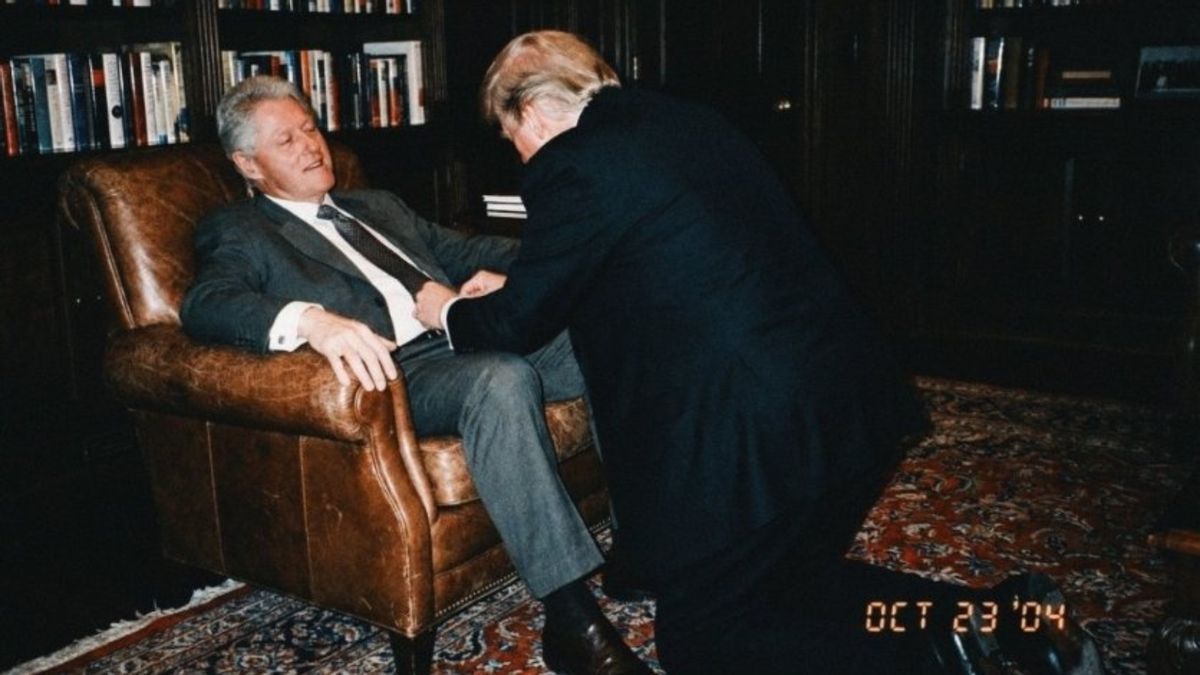
Social media platforms have been flooded with a purported photograph showing former President Donald Trump kneeling before Bill Clinton in what appears to be a sexually suggestive position. However, a thorough investigation reveals this image to be fabricated, despite claims by some users that it passed artificial intelligence detection tests.
The image began circulating in November 2025, shortly after Trump signed legislation forcing the release of files related to convicted sex offender Jeffrey Epstein. The timing appears deliberate, as it follows revelations about an email from Mark Epstein to his brother Jeffrey, which referenced “photos of Trump blowing Bubba” – widely interpreted as referring to Clinton, though Mark Epstein has reportedly denied this connection.
The photograph in question supposedly shows a man with Trump’s distinctive hairstyle kneeling on a carpeted floor before Clinton, who sits smiling in a leather armchair while the kneeling figure appears to unbuckle Clinton’s belt. The image carries a timestamp of October 2004 and appears to be set in a library.
Several social media posts claimed AI-detection tools verified the image’s authenticity. When Snopes ran the image through multiple detection programs, results were inconsistent. Hive Moderation flagged it as likely AI-generated, while AI or Not and SightEngine suggested it was probably authentic. This contradictory outcome highlights the current limitations of AI-detection technology, which researchers have shown to be unreliable.
More telling evidence comes from Google’s Gemini chatbot, which identified SynthID watermarks covering more than half the image – digital markers specifically embedded in AI-generated content created through Google’s tools.
Beyond technical analysis, the historical context also discredits the image. In October 2004, Clinton was recovering from heart bypass surgery performed just weeks earlier in September. On October 24 – just one day after the alleged photograph was supposedly taken – Clinton was documented giving an interview to Diane Sawyer from his home in Chappaqua, New York. The following day, he appeared at a campaign rally in Philadelphia supporting Democratic presidential candidate John Kerry.
Visual inspection reveals numerous inconsistencies that point to manipulation. The carpet pattern under the kneeling figure is inconsistent, the book titles in the background are illegible, and there’s a noticeable absence of natural shadows beneath the furniture and subjects. Additionally, the hand anatomy of the Trump figure shows distortion, with the ring finger positioned at an anatomically improbable angle.
This isn’t the first attempt to create compromising imagery of these two public figures. Snopes previously debunked a miscaptioned photograph claiming to show Trump inappropriately touching Clinton at the 2000 U.S. Open, as well as an AI-manipulated video that animated a still photo to make it appear Trump was kissing Clinton’s crotch.
The fabricated nature of this image underscores the growing challenge of digital misinformation in the political landscape. Advanced AI image generation tools have made it increasingly difficult for the public to distinguish authentic photographs from sophisticated fakes, particularly when distributed alongside claims of having passed authentication tests.
Had such a photograph legitimately existed, it would undoubtedly have become major news given the prominence of both men and the compromising nature of the scene. No credible news sources have ever reported such an encounter, and reverse-image searches fail to locate any authentic source for the photograph before its recent appearance on social media platforms.
As digital forensic specialists continue examining the image, this case serves as a reminder of the importance of critical media consumption in an era where visual evidence can be convincingly manufactured.
Fact Checker
Verify the accuracy of this article using The Disinformation Commission analysis and real-time sources.

10 Comments
While I’m not surprised to see this kind of manipulation, it’s still disappointing. The ability to fabricate images that appear convincing is a real challenge for maintaining truth and transparency. I hope the Commission continues its efforts to expose these kinds of deceptions.
Me too. Disinformation campaigns can have far-reaching consequences, especially when they target public figures. Vigilance and fact-checking are essential to combat the spread of these doctored images and the narratives they try to push.
This is a concerning development, but I’m glad the Disinformation Commission was on top of it. We need to be vigilant about the proliferation of these types of doctored images, which can have serious consequences. Kudos to the investigators for their thorough work.
I agree. The timing of this image release, right after the Epstein files were made public, suggests a deliberate attempt to mislead and distract. It’s crucial that we all remain skeptical of unverified claims, especially those with potential political motivations.
It’s really troubling to see this kind of disinformation campaign targeting public figures. The timing and the subject matter suggest a clear political agenda. I’m glad the Disinformation Commission was able to expose the fabrication, but it’s a stark reminder of the need for robust fact-checking and media literacy.
Absolutely. The proliferation of these doctored images highlights the importance of having trusted, independent organizations like the Disinformation Commission to investigate and debunk false narratives. It’s crucial that we all stay informed and skeptical of unverified claims, no matter how convincing they may seem.
Interesting, it seems like a classic case of misinformation spreading on social media. I’m glad the authorities investigated and debunked this fabricated image. We need to be very careful about verifying the authenticity of online content these days.
Absolutely. With the rise of AI-powered photo manipulation, it’s becoming increasingly difficult to discern real from fake. Fact-checking is crucial to combat the spread of disinformation.
This is a good reminder of the importance of critical thinking and verifying information, even when it seems to come from authoritative sources. The use of AI to create convincing fakes is a growing concern that we all need to be aware of. Thanks for the thorough investigation, Disinformation Commission.
Agreed. As technology advances, the ability to manipulate media will only become more sophisticated. We must remain vigilant and cultivate a healthy skepticism towards online content, no matter how convincing it may appear.