


Listen to the article
Fake Louvre Heist Video Targets Ukrainian Billionaire in Disinformation Campaign
A sophisticated disinformation campaign falsely linking Ukraine to the theft of priceless Louvre jewelry has gained significant traction across global social media platforms, an investigation has revealed.
The fabricated story, which has amassed millions of views in multiple languages, claims that jewels stolen from the Louvre Museum in Paris during an October 2025 heist worth €88 million were discovered in the possession of Ukrainian billionaire Timur Mindich, described as a close associate of President Volodymyr Zelenskyy.
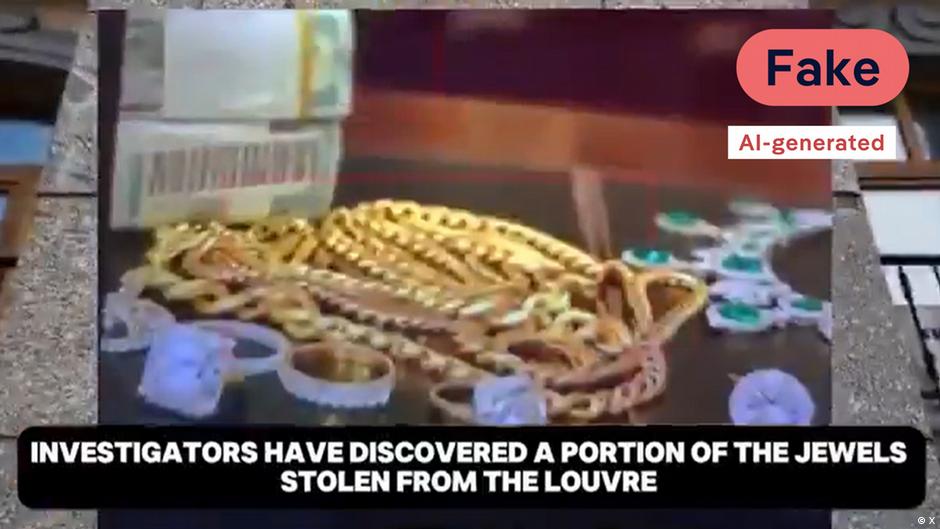
A video purporting to be from Ukraine’s National Anti-Corruption Bureau (NABU) spread rapidly across social platforms, garnering 2.4 million views in English and French versions, and 1.6 million views in German. The content has also infiltrated Russian-language networks, suggesting a potential geopolitical dimension to the misinformation.
NABU officials responded swiftly when contacted about the video, categorically denying any connection to the content. “The video is fake and a product of either pro-Kremlin propaganda or someone who wants to spread disinformation,” a spokesperson told reporters.
Multiple technical analyses confirm the fraudulent nature of the content. The narration, while in American-accented English, contains unnatural speech patterns and mispronunciations of key terms including “Louvre,” “euros,” and “Volodymyr.” When subjected to forensic audio analysis by the Fraunhofer Institute, results indicated a 71.3% probability that the voiceover was generated by artificial intelligence.
Visual evidence further exposes the deception. A detailed comparison between the necklace shown in the video and authenticated photos of Empress Marie-Louise’s emerald necklace from the Louvre’s collection reveals numerous discrepancies. The fabricated image includes a prominent gold clasp absent from the original piece. More tellingly, the genuine necklace features a specific configuration of 12 small round emeralds, five octagonal emeralds, five square emeralds, and ten drop-shaped pendants, while the version shown in the video displays approximately 17 round stones with nine pendants of noticeably different shapes.
Additional forensic details further undermine the video’s authenticity. The diamond petals surrounding small emeralds in the original necklace number five per stone, while the counterfeit version shows only four. Certain sections of the jewelry appear blurred or fused in a manner consistent with AI image manipulation. When analyzed through specialized detection tools, one image from the video was flagged as AI-generated with 99% confidence.
This incident highlights the growing sophistication of digital disinformation campaigns, particularly those potentially aimed at undermining Ukrainian political figures and institutions. The timing coincides with reports of corruption scandals in Kyiv, suggesting an opportunistic attempt to capitalize on existing political tensions.
The widespread dissemination of this content across multiple language markets demonstrates the continued vulnerability of social media platforms to coordinated disinformation efforts. Despite obvious technical flaws that expert analysis can identify, such content can reach millions of viewers before being debunked.
The actual Louvre jewelry theft case remains unsolved, with no connection established to Ukraine or the named billionaire. Law enforcement agencies continue to investigate the authentic heist while digital security experts track the origins of this sophisticated disinformation campaign.
This case exemplifies the evolving challenges facing fact-checkers, journalists, and platforms in an era where AI-generated content increasingly blurs the line between authentic reporting and fabricated narratives designed to sway public opinion or damage international relations.
Fact Checker
Verify the accuracy of this article using The Disinformation Commission analysis and real-time sources.

11 Comments
It’s disappointing to see the Louvre theft being used as fodder for a disinformation campaign. While the loss of these valuable artifacts is tragic, the attempt to falsely link it to Ukraine is a cynical and transparent ploy. We must remain vigilant against such manipulation.
Agreed, the geopolitical angle here is deeply concerning. It’s a clear attempt to tarnish Ukraine’s reputation and sow discord. Rigorous fact-checking and public awareness are essential to combat these kinds of sophisticated influence operations.
Interesting story, but it’s concerning to see such an elaborate disinformation campaign targeting Ukraine. I hope the authorities can get to the bottom of this and uncover the true origins of the fake video.
Agreed, it’s worrying that these kinds of sophisticated hoaxes are spreading so rapidly online. Fact-checking and media literacy are crucial to combat such blatant misinformation.
This seems like a classic case of geopolitical mudslinging. While the theft of such valuable artifacts is troubling, the attempt to falsely link it to Ukraine is a clear manipulation tactic. We need to be vigilant against these kinds of influence operations.
You’re right, this has all the hallmarks of a disinformation campaign. It’s vital that the public remains skeptical of unverified claims, especially when they play into existing political tensions.
The fact that the fake video has garnered millions of views across multiple languages is quite concerning. It shows the scale and speed at which misinformation can spread these days. I hope the authorities can trace the source and hold the perpetrators accountable.
The scale and sophistication of this disinformation campaign is really quite remarkable. It’s a stark reminder of the need for robust fact-checking and media literacy efforts to combat the spread of false narratives online. Kudos to the investigators for uncovering this manipulation.
Absolutely, this is a concerning example of how geopolitical tensions can be exploited through the strategic use of misinformation. Maintaining a critical eye and verifying claims is crucial in an era of information overload.
This is a troubling example of how bad actors can exploit social media to amplify false narratives. The sophistication of this campaign is worrying, as it seems designed to sow discord and distract from the real issues. Fact-checking will be crucial to counter these kinds of tactics.
This is a troubling development, as it demonstrates the reach and impact of disinformation campaigns. The fact that the fake video has gained such traction across multiple languages is quite alarming. I hope the authorities can track down the source and hold the perpetrators accountable.