


Listen to the article
Saudi Arabia has not denounced support for Donald Trump, contrary to viral claims circulating online. An investigation has revealed that social media posts suggesting a dramatic shift in Saudi-U.S. relations are based on misleading captions attached to unrelated footage.
The false claim originated from an Instagram post by user “THE VOXVERITAS GLOBAL,” which featured a video clip with a caption claiming: “Saudi Arabia says it cannot fully support Trump anymore, Leaders suggest Trump should focus on his own problems first, A big change in Saudi–U.S. relations after many years. Seen as a strong and surprising political move. Some call it a ‘historic U-turn’ by Saudi Arabia.”
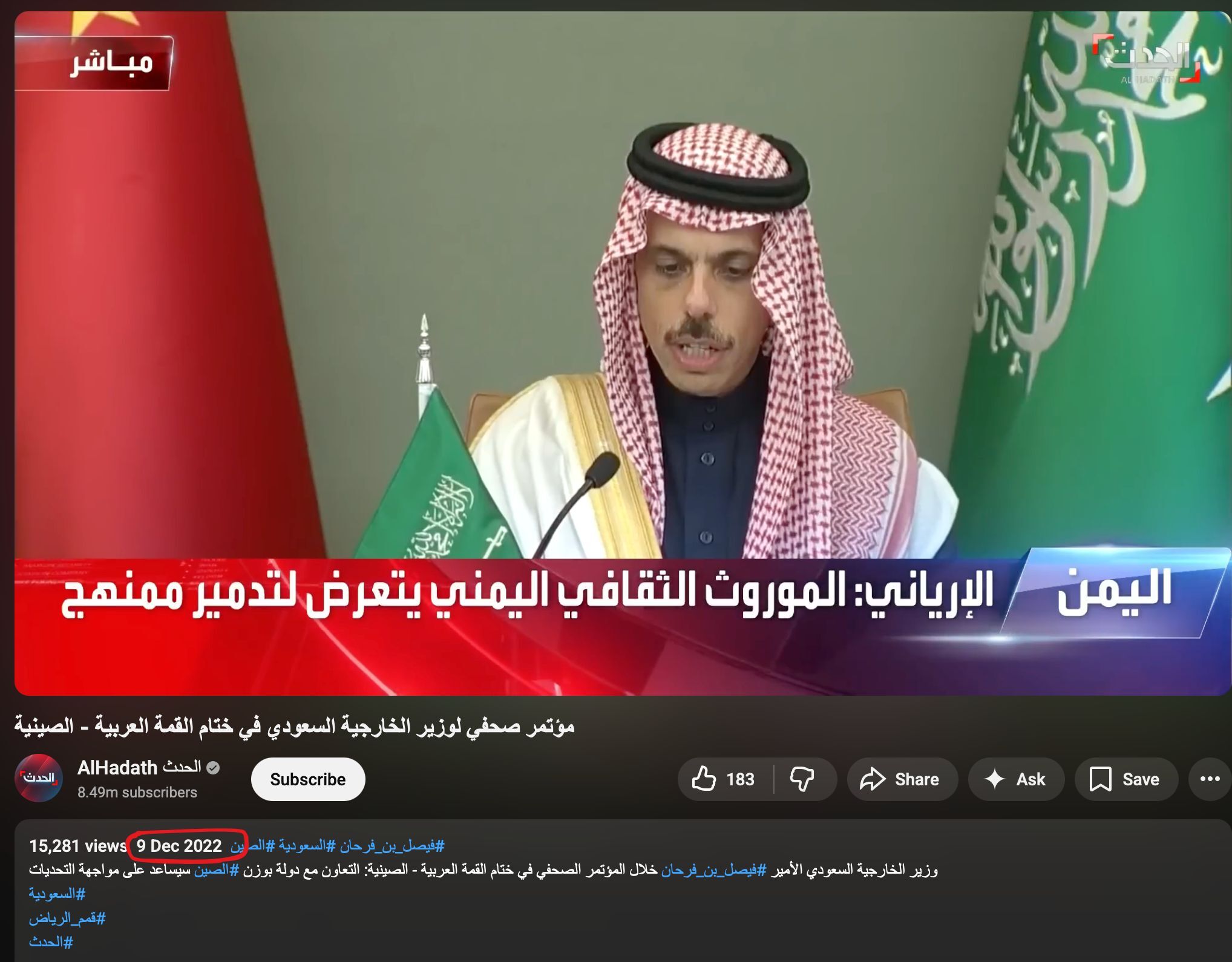
However, the video itself contains no such statement. In the footage, Saudi Foreign Minister Prince Faisal bin Farhan Al Saud is actually discussing broader Saudi foreign policy principles, stating: “The Kingdom of Saudi Arabia, and as far as I know, all the Arab countries, does not put its policies based on the interests of others, it puts its policies based on its own interests. And we will follow our interests, and we will continue to follow our policies based on those interests, regardless of the points of view.”
Further investigation revealed that the video is not current but dates back to December 2022. It shows a press conference held at the King Abdul Aziz International Conference Center in Riyadh following the China-Arab States Summit and China-Gulf Cooperation Council Summit. The timing is significant as Joe Biden, not Donald Trump, was the U.S. president at that time.
The complete footage of the press conference, available from Saudi news channels Al Saudiya and Al-Hadath, confirms that Prince Faisal made no mention of Donald Trump or any change in Saudi Arabia’s position toward the former U.S. president. Instead, the Foreign Minister spoke about Saudi Arabia’s approach to international relations more generally, noting that the kingdom seeks beneficial relationships with both Western and Eastern partners.
“The common benefits are not only for us with China, but for us with America, and for us with others. And we seek to follow our interests, and we find our interests in the West and in the East, and wherever we find them, we will work to achieve them,” the Foreign Minister stated in the footage.
This misleading claim comes at a time of heightened interest in U.S.-Saudi relations as the U.S. presidential election approaches. Saudi Arabia remains a crucial American ally in the Middle East, and its relationships with U.S. political figures often draw significant attention from international observers and media.
The false narrative has gained substantial traction online, spreading across multiple social media platforms including Instagram, Facebook, Twitter (now X), and TikTok. Each platform has seen numerous shares of the same misleading content, contributing to the rapid dissemination of the misinformation.
The spread of such false claims highlights the ongoing challenge of disinformation in international politics, where out-of-context video clips can be repurposed with misleading captions to suggest diplomatic shifts that haven’t occurred. As the U.S. election season intensifies, experts anticipate more such mischaracterizations of international relationships and policy positions.
For users encountering such claims online, this case demonstrates the importance of seeking original sources and complete context before accepting assertions about significant shifts in international relations, particularly when they appear designed to provoke strong reactions during politically sensitive periods.
Fact Checker
Verify the accuracy of this article using The Disinformation Commission analysis and real-time sources.

8 Comments
It’s important to verify claims about foreign policy shifts, especially when they originate from questionable sources. The Saudi foreign minister’s actual comments seem to focus on Saudi independence, not a dramatic U-turn away from the US.
This story highlights the need to be cautious about unverified claims, even if they align with our preconceptions. Rigorous fact-checking is essential to avoid spreading misinformation, regardless of the political implications.
Well said. Maintaining objectivity and nuance is crucial when reporting on sensitive geopolitical issues.
The report provides a valuable lesson in media literacy and the importance of critically evaluating sources, especially on social media. Fact-checking is key to cutting through the noise and getting to the truth.
Absolutely. Discernment is critical in an age of rampant misinformation. This highlights the importance of responsible journalism.
Fact-checking is crucial to separate truth from fiction, especially in a highly polarized media landscape. This report demonstrates the value of investigating the context and sources behind viral social media claims.
This story highlights the nuances in Saudi-US relations. While the countries have historically been close allies, it’s prudent for Saudi Arabia to pursue its own interests rather than blindly supporting any one leader or administration.
Saudi Arabia’s measured approach to foreign relations is understandable given the complexities of geopolitics. Maintaining strong ties with the US while pursuing its own national interests is a delicate balancing act.