


Listen to the article
RSS Chief’s Army Comments Debunked: AI-Generated Deepfake Spreads False Claims
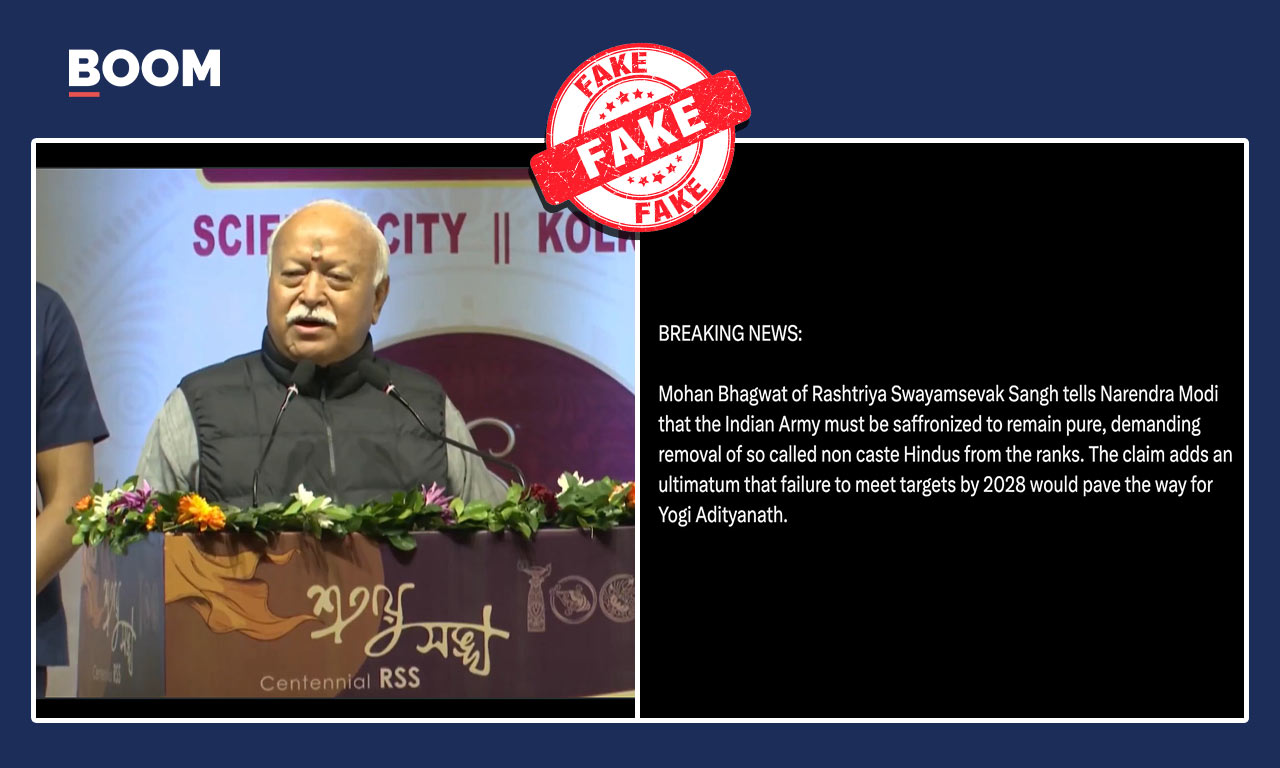
A viral video purportedly showing Rashtriya Swayamsevak Sangh (RSS) chief Mohan Bhagwat calling for the “saffronisation” of the Indian Army has been confirmed as digitally altered, according to an investigation by fact-checking organization BOOM.
The manipulated clip, which has been circulating on social media platforms, falsely depicts Bhagwat demanding the removal of “non-caste Hindus” from military ranks and issuing an ultimatum to Prime Minister Narendra Modi. Analysis reveals the audio is entirely fabricated using artificial intelligence technology.
The deceptive video was shared on Twitter (X) by the account @InsiderWB with an inflammatory caption claiming Bhagwat had threatened that failure to implement such changes by 2028 would “pave the way for Yogi Adityanath” to replace Modi. This account has previously been identified by fact-checkers for disseminating digitally altered videos of senior Indian defense officials and promoting false, pro-Pakistan narratives.
When subjected to AI deepfake detection tools, the voice in the video received an authenticity score of just 11 out of 100 from Hiya Deepfake Voice Detector, strongly indicating artificial manipulation. Researchers located the original footage, published by CNN-News18 on December 21, 2025, which shows Bhagwat speaking against the same visual backdrop but with entirely different content.
The original speech contained no references to “saffronisation” of the armed forces or any statements critical of Prime Minister Modi, confirming the viral clip was fabricated to create false controversy.
This incident highlights the growing sophistication of AI-generated deepfakes targeting India’s military and political leadership. Such manipulated media poses significant challenges in an era where digital content can be seamlessly altered to mimic authentic speeches and statements from public figures.
The RSS, a Hindu nationalist organization with close ideological ties to India’s ruling Bharatiya Janata Party (BJP), frequently finds itself at the center of politically charged misinformation campaigns. As one of India’s most influential cultural organizations, statements attributed to its leadership carry particular weight in the country’s political discourse.
Military neutrality remains a foundational principle of the Indian Armed Forces, which have historically maintained distance from political and ideological movements. False claims suggesting attempts to reshape the military along religious or caste lines are particularly sensitive in India’s diverse, multi-faith society.
Digital disinformation targeting civil-military relations has become increasingly common in South Asian geopolitics, with state and non-state actors attempting to exploit social divisions or create false narratives about institutional biases.
Media literacy experts warn that deepfake technology has advanced to a point where detection requires specialized tools, making it increasingly difficult for average citizens to distinguish between authentic and manipulated content. The proliferation of such sophisticated forgeries threatens to undermine public trust in legitimate news sources and authentic statements from public figures.
The incident underscores the critical importance of verification before sharing politically sensitive content, particularly during periods of heightened tension or approaching elections when disinformation campaigns typically intensify.
Indian security analysts have noted that such fabricated content often aims to drive wedges between different arms of the government or to portray civilian leadership as interfering with military affairs – narratives that serve the strategic interests of external actors seeking to sow domestic discord.
Fact Checker
Verify the accuracy of this article using The Disinformation Commission analysis and real-time sources.

9 Comments
This is a concerning case of digital manipulation. I appreciate the efforts by fact-checkers to identify the video as an AI-generated deepfake. It’s a good reminder to be cautious about unverified information, especially on sensitive topics like national security.
The reports clarifying that the RSS chief’s comments were fabricated are reassuring. It’s a good thing the fact-checkers were able to identify the video as an AI-generated deepfake. We need to be vigilant about the increasing use of such technology to spread disinformation.
I’m glad the reports were able to debunk the false claims about the RSS chief’s comments. It’s important to rely on credible sources and fact-checking to verify information, especially when it comes to sensitive topics like the military. Spreading misinformation can have serious consequences.
Absolutely. The use of deepfake technology to create false narratives is a worrying trend that we need to address. It’s crucial that we remain vigilant and trust only verified information from reputable sources.
This is a concerning case of digital manipulation. I appreciate the fact-checking efforts to debunk the false claims. It’s a good reminder to be cautious about unverified information, especially on sensitive issues like national security.
Agreed. The spread of misinformation can have serious consequences, so it’s essential that we remain vigilant and rely on reputable sources to stay informed.
Interesting development. I’m glad the reports clarified that the RSS chief’s comments were fabricated using AI technology. It’s important to be vigilant about the spread of misinformation, especially when it involves sensitive topics like the military.
Yes, the use of deepfake technology to create false narratives is concerning. It’s crucial that we rely on credible sources and fact-checking to verify information, rather than blindly accepting viral social media claims.
The reports clarifying the fabricated nature of the RSS chief’s comments are reassuring. It’s important that we rely on credible sources and fact-checking to stay informed, rather than falling victim to the spread of misinformation. We need to be vigilant about the increasing use of deepfake technology to create false narratives.