


Listen to the article
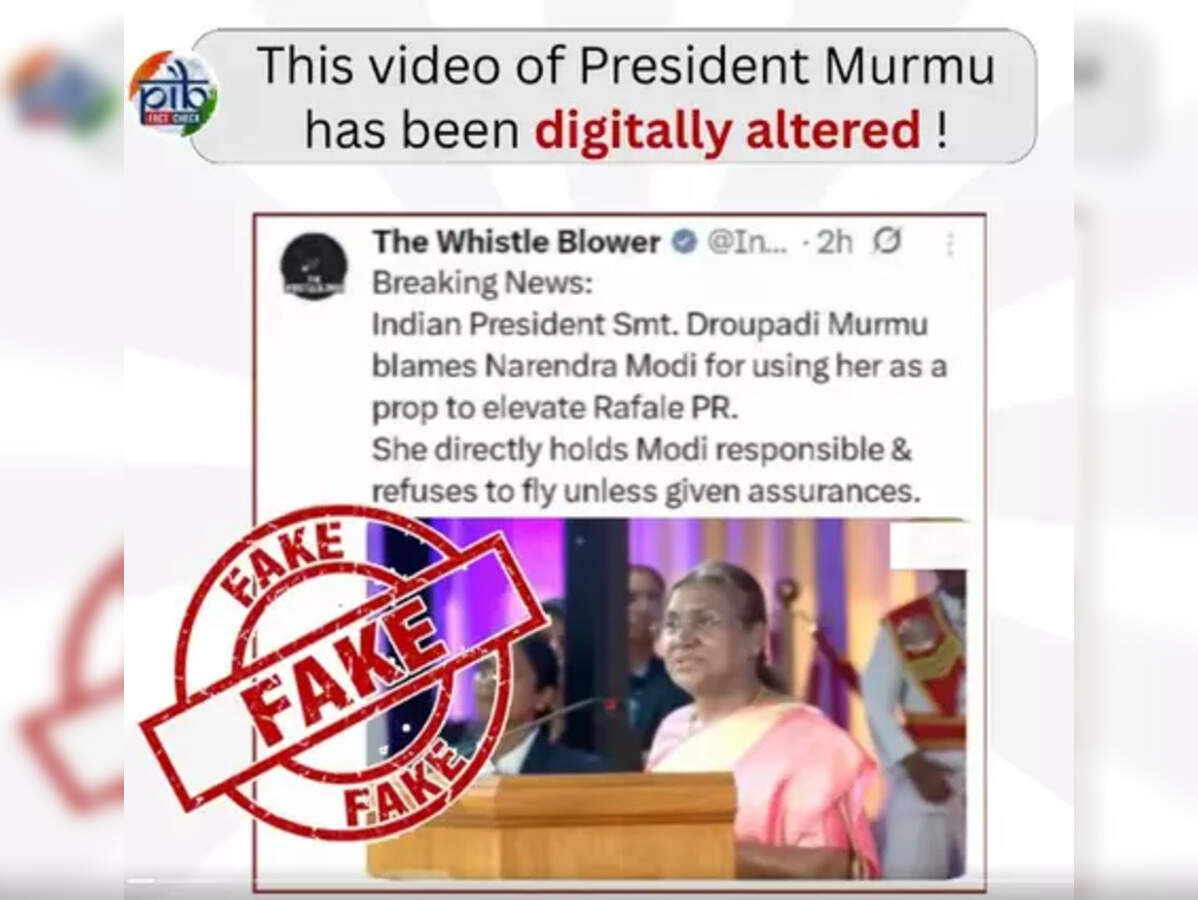
Pakistani propaganda accounts have been caught spreading a digitally-altered video of President Droupadi Murmu, according to PIB Fact Check, India’s official government fact-checking unit. The manipulated footage, flagged on Wednesday, falsely claims that Prime Minister Narendra Modi is using the President as a “prop” to promote Rafale fighter jets.
The government agency issued a clear warning on social media platform X (formerly Twitter), stating that the video has been digitally altered with malicious intent. The fabricated clip features an AI-generated voice mimicking President Murmu’s speech patterns, making inflammatory claims about alleged “blackmail” by the Modi government.
In the doctored footage, the voice impersonating President Murmu can be heard making serious allegations: “I want to request the citizens of our country that Modi Ji’s Hindutva government blackmailed me and ordered me to sit in Rafale… If anything happens to me, Modi Ji and his Hindutva politics will be responsible.”
PIB Fact Check categorically denied these claims, emphasizing that “The President of India has NOT made any such statement.” The agency confirmed the video was artificially generated and distributed specifically to mislead the Indian public and potentially damage diplomatic relations.
As part of its debunking effort, PIB Fact Check provided a link to the authentic, unedited video of the President to help citizens identify the differences between the genuine footage and the manipulated version.
The Rafale fighter jet has been a significant defense acquisition for India. The Indian Air Force formally inducted the first batch of Rafale fighter jets from France in September 2020 as part of a ₹59,000 crore deal for 36 aircraft signed in 2016. The jets have enhanced India’s air combat capabilities significantly, especially amid ongoing regional tensions.
This incident represents a concerning trend of sophisticated disinformation campaigns targeting high-level Indian officials. It comes at a time when relations between India and Pakistan remain strained over various issues including territorial disputes and cross-border terrorism allegations.
The PIB has urged citizens to remain vigilant and report similar misinformation through official channels. They’ve established dedicated reporting mechanisms, including a WhatsApp number (+91 8799711259) and email address (factcheck@pib.gov.in) to combat such disinformation campaigns.
This is not an isolated incident. Earlier this week, PIB Fact Check identified another AI-manipulated video featuring Union Finance Minister Nirmala Sitharaman. That fabricated content falsely showed the Finance Minister promoting a fraudulent “investment programme” with outlandish promises of returns — ₹60,000 within 24 hours and monthly earnings of ₹10 lakh.
“A video on Facebook falsely shows Union Finance Minister @nsitharaman promoting an investment program that promises easy daily income. The Finance Minister or the Government of India has NOT launched or endorsed any such scheme,” PIB Fact Check explained in their official statement addressing that separate incident.
The agency has advised citizens to be especially cautious of “get-rich-quick traps” and to verify information before taking financial decisions or sharing content online. They’ve also provided a simple guide to identifying manipulated videos by watching for telltale signs such as distorted lip movements, mismatched voice synchronization, inconsistent backgrounds, or fake logos.
As AI technology becomes more sophisticated, the challenge of distinguishing genuine content from fabricated material grows increasingly complex. Government agencies worldwide are scrambling to develop more robust verification systems to combat this emerging threat to information integrity and national security.
Fact Checker
Verify the accuracy of this article using The Disinformation Commission analysis and real-time sources.

10 Comments
This is a concerning case of AI-generated misinformation targeting India’s president. Spreading false claims undermines democratic institutions and public trust. I’m glad the government swiftly debunked this fabricated video.
This incident highlights the need for robust media literacy and fact-checking capabilities to combat the rising threat of deepfakes and synthetic media. Governments must stay proactive in identifying and debunking such manipulated content.
Attempting to manipulate a president’s speech using AI is a blatant attempt to undermine democratic institutions. I’m glad the Indian government moved quickly to debunk this fabricated video and reassure the public.
Manipulated media can be a powerful tool for spreading propaganda. It’s important for authorities to quickly identify and refute such malicious content to prevent the spread of disinformation. Fact-checking efforts are crucial in these situations.
Doctoring a president’s speech to make inflammatory claims is a serious abuse of technology. I hope the perpetrators behind this can be held accountable. Maintaining the integrity of public discourse is vital for a healthy democracy.
Fabricating a president’s statements through AI-generated audio is a concerning tactic that undermines trust in public institutions. I commend the Indian government for their swift response in debunking this misinformation.
While the capabilities of AI continue to advance, it’s crucial that we remain vigilant against its potential misuse. Fact-checking and public awareness campaigns are essential to combat the spread of manipulated content.
It’s disheartening to see how easily AI technology can be abused to undermine public trust and sow division. I commend the Indian authorities for swiftly addressing this case of fabricated presidential statements. Maintaining truth and transparency is vital.
This case serves as a stark reminder of the need for robust safeguards and ethical guidelines around the use of AI technology. Preventing the malicious use of synthetic media should be a top priority for policymakers.
Impersonating a head of state to spread falsehoods is a concerning tactic. I’m glad the Indian government was prompt in issuing a clarification and denouncing this AI-manipulated video. Vigilance against misinformation is crucial.