


Listen to the article
Indian authorities have exposed a coordinated disinformation campaign originating from Pakistani propaganda accounts that includes deepfake videos of senior military officials and fabricated claims about India’s involvement in naval operations against Iran.
The Press Information Bureau (PIB) Fact Check unit issued alerts on Monday addressing multiple false narratives circulating on social media platforms. In a post on X (formerly Twitter), the government’s official fact-checking handle refuted claims that Vice Chief of Navy Sanjay Vatsayan had assisted in an attack on an Iranian ship under orders from Defence Minister Rajnath Singh, and that Naval Chief Admiral Dinesh Kumar Tripathi was planning to resign as a result.
“These allegations are completely baseless,” the PIB statement declared, labeling the posts as “fake” and part of a broader disinformation effort targeting India. The agency urged citizens to rely exclusively on official government sources for accurate information.
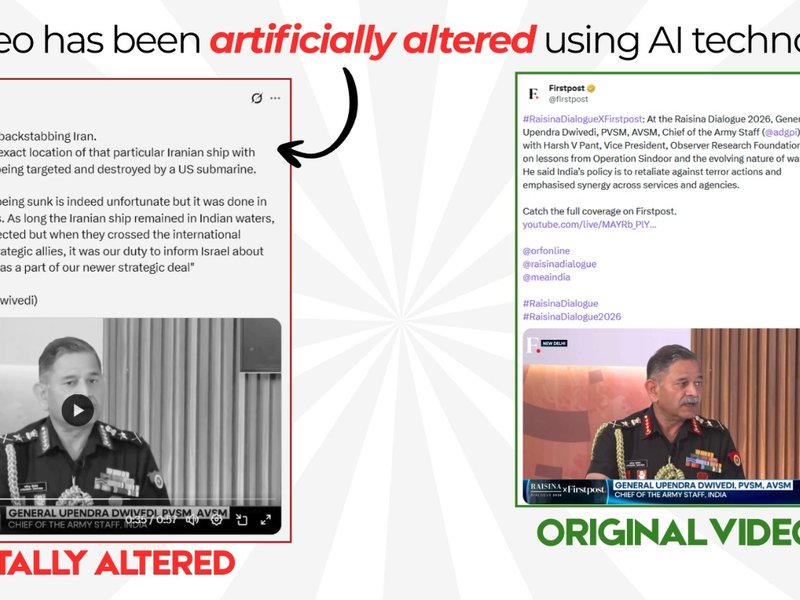
In a particularly concerning development, PIB also identified an AI-generated deepfake video of Army Chief General Upendra Dwivedi circulating widely online. The manipulated video falsely portrayed General Dwivedi claiming that India, as a strategic ally of Israel, had provided intelligence about an Iranian ship’s location in international waters as part of a “newer strategic deal.”
“Beware! This is an AI-generated deepfake video shared to mislead the public,” the fact-checking unit warned. To counter the misinformation, PIB shared a link to the original, unaltered footage of General Dwivedi’s remarks from the Raisina Dialogue 2026 interaction.
This incident highlights the growing sophistication of digital disinformation campaigns targeting India’s defense establishment and foreign policy. Deepfake technology uses artificial intelligence to create convincing but fabricated videos of real people saying things they never actually said. Security experts have long warned about the potential of such technology to disrupt diplomatic relations and spread confusion during geopolitically sensitive situations.
The timing of these fake narratives appears calculated to strain India’s relations with Iran, with whom India maintains important strategic and economic ties, particularly through projects like the Chabahar Port development. By falsely suggesting Indian collusion with Israel against Iranian interests, the disinformation campaign attempts to drive a wedge between New Delhi and Tehran.
India’s Ministry of Defence has not issued additional statements beyond the PIB fact checks, but security analysts note that such propaganda efforts often intensify during periods of regional tension or ahead of significant diplomatic engagements.
The PIB has established dedicated channels for citizens to report suspicious content, including a WhatsApp helpline (+91 8799711259) and an email address (factcheck@pib.gov.in). “If you come across such dubious content, please report it immediately,” the fact-checking unit urged.
This incident follows previous government warnings about the increasing use of deepfakes and AI-manipulated content to spread propaganda. In recent months, Indian authorities have stepped up efforts to combat digital misinformation, particularly as the technology to create convincing fakes becomes more accessible.
Cybersecurity experts emphasize that critical media literacy—the ability to verify sources and question the authenticity of sensational content before sharing—remains the most effective defense against such disinformation campaigns. As deepfake technology continues to evolve, distinguishing genuine from fabricated content will require increased vigilance from both authorities and the public.
Fact Checker
Verify the accuracy of this article using The Disinformation Commission analysis and real-time sources.

18 Comments
The use of deepfake technology to fabricate videos of military leaders is a worrying trend. This highlights the need for robust fact-checking and media literacy efforts to help people identify manipulated content.
Yes, the proliferation of deepfakes is a serious threat that requires vigilance. Kudos to the PIB for quickly exposing this propaganda campaign and reaffirming the importance of relying on official government sources.
This disinformation campaign from Pakistan is a serious concern. I’m glad the Indian government is taking proactive steps to expose these fabricated claims and deepfake videos. Fact-checking initiatives are crucial for upholding the truth and safeguarding democratic institutions.
Absolutely. The PIB’s swift response in debunking these false narratives is commendable. Maintaining transparency and relying on official sources is essential for combating the spread of misinformation, especially during sensitive geopolitical situations.
This is a concerning trend of adversaries using advanced tech like deepfakes to spread misinformation. Glad the Indian authorities are on top of it and providing accurate information from official sources. Fact-checking is crucial to counter these kinds of threats.
Absolutely, maintaining public trust in official information is critical. Glad to see the government taking a proactive stance to address these false narratives.
The use of deepfake technology to target senior military officials is a worrying development. I appreciate the Indian government’s efforts to quickly identify and refute these fabricated claims. Fact-checking and media literacy are critical tools in the fight against coordinated disinformation campaigns.
Agreed. The PIB’s actions in exposing this propaganda effort from Pakistan are commendable. Upholding the integrity of information and public trust in official sources is crucial for maintaining national security and democratic stability.
Interesting how the Indian government is quickly debunking these deepfake videos. Seems like a coordinated disinformation campaign targeting their military leadership. Good to see the authorities taking action to expose the propaganda.
Kudos to the Indian government for swiftly exposing this disinformation campaign. Deepfakes are a serious challenge, but it’s heartening to see the authorities actively working to debunk the propaganda.
It’s good to see the Indian government taking such a proactive approach to addressing the spread of disinformation, including the use of advanced techniques like deepfakes. Maintaining public trust in official sources is crucial during these times.
Wow, this is a concerning case of disinformation and propaganda. It’s good to see the Indian authorities swiftly debunking these fake claims and deepfake videos. Maintaining public trust in official sources is critical during these information wars.
Absolutely. Spreading misinformation undermines democratic institutions. I’m glad the government is taking action to counter these malicious efforts and keep the public informed.
The use of AI-generated deepfake videos to target senior military officials is a troubling development. Kudos to the Indian authorities for quickly identifying and refuting these false claims. Maintaining information integrity is crucial during these geopolitical tensions.
Absolutely. The government’s fact-checking efforts are essential for countering misinformation and preserving public trust in official sources. Vigilance against deepfakes and coordinated propaganda campaigns is vital for national security.
The use of deepfake videos to target military leadership is a worrying development. Kudos to the Indian authorities for their diligent fact-checking and efforts to inform the public. Transparency and credible information are essential to counter these tactics.
It’s disturbing to see the scale of this coordinated disinformation effort originating from Pakistan. Fact-checking initiatives like the PIB’s are essential for combating the spread of false narratives and maintaining public trust.
I agree, this is a concerning example of cross-border information warfare. The government’s swift response in debunking the fabricated claims and deepfake video is commendable.