


Listen to the article
Viral Video of Pakistani Leader Tearing UN Document Misrepresented Online
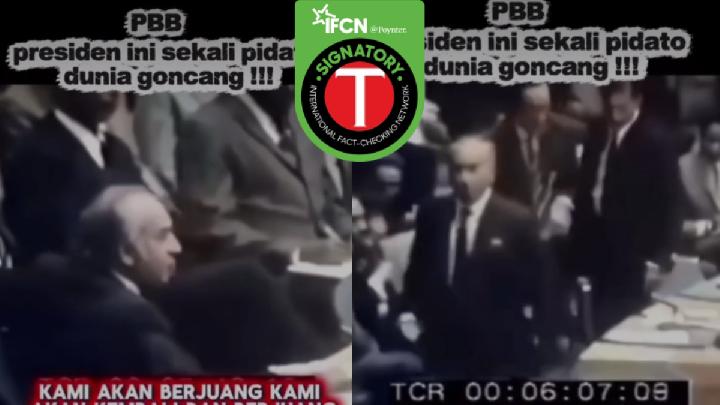
A viral video circulating across multiple social media platforms has misrepresented a historical moment involving former Pakistani leader Zulfikar Ali Bhutto. The footage, which has appeared on Instagram, Facebook, TikTok, and YouTube, falsely claims to show Bhutto tearing up United Nations documents in protest against restrictions on Pakistan’s nuclear weapons program.
In the dramatic 32-second clip, Bhutto is seen delivering an impassioned speech, tearing a document, and storming out of a meeting room. Captions accompanying the video in Indonesian claim it depicts a “historic video of Pakistani President Zulfikar Ali Bhutto tearing up a document because Pakistan should not have nuclear weapons.”
However, fact-checking by Tempo has revealed this characterization is misleading. The footage actually captures Bhutto during a December 15, 1971 UN Security Council meeting that addressed the India-Pakistan conflict, not nuclear weapons development.
When the video’s audio was transcribed using OpenAI’s Whisper application, Bhutto’s actual words revealed a different context: “Your decision will not bind us. You can decide what you like. My country calls me. Why should I waste my time in the Security Council? I will not be the one who reprehensibly surrenders part of my country.”
At the time of this meeting, Bhutto was serving as Pakistan’s Deputy Prime Minister and Foreign Minister, not as President. According to the Pakistan People’s Party (PPP), which later posted the video on YouTube, the document Bhutto tore up wasn’t an official UN treaty but his own speaking notes.
The historical context surrounding this incident is significant. The UN meeting occurred during a period of severe domestic conflict in Pakistan that had erupted into civil war on March 26, 1971. East Pakistan (now Bangladesh) was fighting for independence from the central government in West Pakistan, with India providing training and arms to support the East Pakistani rebels.
This complex geopolitical situation was complicated by geography, with India’s territory physically separating East and West Pakistan. The conflict escalated into open warfare between Pakistan and India, resulting in millions of casualties and creating a refugee crisis.
At the UN Security Council meeting, Bhutto vehemently opposed the partition of East Pakistan. Despite his protests, Pakistan surrendered to India on December 16, 1971, just one day after the filmed speech. East Pakistan subsequently achieved independence and was renamed Bangladesh.
The New York Times coverage from the period confirms that nuclear weapons were not the subject of Bhutto’s dramatic protest. The UN’s own archives include similar images of Bhutto walking away from the December 15, 1971 meeting, further corroborating that the discussion concerned the India-Pakistan territorial conflict rather than nuclear armament.
While Bhutto did later play a significant role in Pakistan’s nuclear weapons program after becoming President (1971-1973) and then Prime Minister, this particular video does not depict his advocacy for nuclear development.
This fact-checking investigation highlights the importance of verifying historical context when viewing dramatic political footage, especially when shared across social media with potentially misleading captions. The mischaracterization of this historical moment demonstrates how easily visual evidence can be detached from its original context and repurposed to support alternate narratives.
Fact Checker
Verify the accuracy of this article using The Disinformation Commission analysis and real-time sources.

10 Comments
Interesting fact check on the viral video of the Pakistani president. It’s important to understand the actual context behind historical events and not jump to conclusions based on misleading clips.
That’s a good point. Verifying the details and proper context is crucial, especially when it comes to sensitive political and security matters.
This highlights the need for thorough journalism and fact-checking, rather than blindly spreading unverified claims on social media. It’s easy for misinformation to spread, so it’s good to see the facts being set straight.
Absolutely. Fact-checking is so important to combat the rise of misinformation, especially around complex geopolitical issues like nuclear nonproliferation.
This is a good reminder that we can’t always trust viral videos or social media posts at face value. Fact-checking is crucial to understanding the truth behind these sorts of political and historical events.
Agreed. It’s important to be discerning consumers of information, especially on sensitive topics like nuclear weapons policies. Reliable sources and rigorous fact-checking are key.
While the original viral video may have seemed dramatic, I’m glad to see the real context behind Bhutto’s actions at the UN meeting. Nuance and accuracy are so important when discussing nuclear non-proliferation.
Absolutely. Jumping to conclusions based on brief, out-of-context clips can lead to the spread of misinformation. Fact-checking is crucial for understanding the full picture.
The UN nuclear weapons ban is a complex and controversial topic. While I’m curious to learn more, I’m glad this fact check provides clarity on what actually happened in that historic meeting.
Yes, it’s good to see the nuances and proper context explained. Discussions around nuclear policy require careful analysis, not just sensational clips.