


Listen to the article
Energy Department’s COVID Origins Assessment Draws Controversy, No Definitive Proof
A recent assessment by the U.S. Department of Energy suggesting that COVID-19 most likely originated from a laboratory leak has reignited debate over the pandemic’s origins, despite the fact that it offers no definitive proof and contradicts the position of most U.S. intelligence agencies.
The Energy Department now joins the FBI in favoring the lab-leak hypothesis, but both agencies remain outnumbered. Four other intelligence entities plus the National Intelligence Council continue to assess that a natural spillover from animals to humans is the more plausible explanation, while other agencies, including the CIA, remain undecided.
Critically, the Energy Department’s updated position comes with “low confidence,” indicating their analysis is based on limited information. According to national intelligence guidelines, a low confidence assessment means the information used “is scant, questionable, fragmented, or that solid analytical conclusions cannot be inferred from the information.”
Despite these significant limitations, social media posts have mischaracterized the assessment as confirmation that COVID-19 definitely originated in a Wuhan laboratory. One Instagram post wrongly claimed the Energy Department “confirms COVID came from a Wuhan lab leak,” while others falsely stated the U.S. government had “finally admitted” a lab origin.
“There is not a consensus right now in the U.S. government about exactly how COVID started,” said John Kirby, National Security Council coordinator for strategic communications, at a recent White House briefing.
The U.S. intelligence community remains united on certain aspects: none believe the virus was developed as a biological weapon, and most assess it was not genetically engineered. The divided assessment on origins reflects the lack of conclusive evidence rather than any smoking gun for either hypothesis.
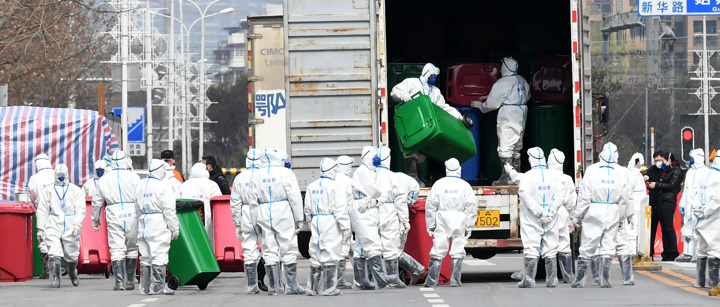
Scientific research published in Science in July 2022 strongly suggests the Huanan Seafood Wholesale Market in Wuhan was the pandemic’s epicenter. Analysis of early COVID-19 cases showed they clustered around the market, even those with no known direct link to it. Environmental samples from the market tested positive for the virus, particularly in areas where vendors sold live mammals susceptible to SARS-CoV-2, including raccoon dogs.
Even more compelling, genomic analysis indicates that two slightly different lineages of SARS-CoV-2 emerged in late 2019 through separate zoonotic events. Multiple spillover events would be difficult to reconcile with a laboratory origin scenario.
“The scientific literature contains essentially nothing but original research articles that support a natural origin of this virus pandemic,” explained Michael Worobey, head of the ecology and evolutionary biology department at the University of Arizona and co-author of the Science papers.
Angela Rasmussen, a virologist who studies emerging pathogens at the University of Saskatchewan, noted that despite three years of global investigation, no evidence has materialized showing the Wuhan Institute of Virology possessed a SARS-CoV-2 progenitor. Meanwhile, evidence supporting animal-to-human transmission at the Huanan market “has continued to stack up.”
China’s lack of transparency has complicated efforts to definitively determine the virus’s origins. The 2021 intelligence community report stated that “China’s cooperation most likely would be needed to reach a conclusive assessment,” but noted that “Beijing continues to hinder the global investigation, resist sharing information, and blame other countries.”
As the debate continues, the scientific consensus leans toward natural origins similar to previous coronavirus outbreaks like SARS and MERS. However, without more cooperation from China and additional evidence, the exact pathway of how SARS-CoV-2 first infected humans may remain uncertain.
Fact Checker
Verify the accuracy of this article using The Disinformation Commission analysis and real-time sources.

6 Comments
The conflicting assessments from intelligence agencies are concerning. This is a crucial issue that demands thorough, dispassionate investigation to uncover the truth, wherever it may lead. Rushed or politicized conclusions could be very damaging.
This is a complex and contentious topic. I appreciate the government agencies trying to unravel the origins, but it’s concerning they remain divided on such a critical question. More definitive evidence seems necessary before drawing firm conclusions.
I share the frustration over the lack of definitive proof on the COVID-19 origins. This is a complex scientific and geopolitical puzzle that requires careful, objective analysis. Rushing to judgment helps no one.
As an observer, I’m curious to see how this debate unfolds. The implications for public health, geopolitics, and trust in institutions are enormous. Rigorous, impartial analysis is sorely needed to provide clarity.
The lab-leak hypothesis is intriguing, but the lack of consensus among intelligence agencies is troubling. I hope they can put politics aside and focus on finding the facts through rigorous, unbiased investigation.
Agreed. The scientific process should be allowed to play out without undue political influence. Transparency and open discourse are key to building public trust in the findings.