


Listen to the article
Fact-Check Reveals Trump’s State of the Union Claims Often Misleading
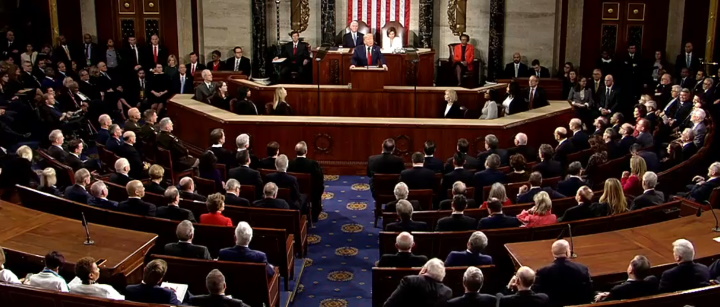
President Donald Trump’s 2020 State of the Union address contained numerous claims about economic achievements and policy successes that were misleading, exaggerated, or lacked important context, according to a comprehensive fact-check analysis.
The president’s speech, delivered on February 4—one day before his expected acquittal in the Senate impeachment trial—painted a picture of unprecedented economic success under his administration. However, data shows many of the positive trends he highlighted began during previous administrations.
Trump described his administration as having “launched the great American comeback” after “years of economic decay.” In reality, the economy was already experiencing steady growth in output, jobs, and incomes before he took office.
While Trump boasted that “our economy is the best it has ever been,” GDP growth actually slowed to 2.3% in 2019, down from 2.9% in 2018—a figure also achieved in 2015 during the Obama administration. Most economists predict further slowing to around 1.9% in 2020, according to the Wall Street Journal’s monthly survey of business and university economists.
The president’s claims about job creation also required context. Trump stated, “Since my election, we have created 7 million new jobs,” taking credit for jobs created after the election but before he took office. The actual figure is closer to 6.7 million jobs in the 35 months after his inauguration—a slower pace than the nearly 8 million jobs created in the 35 months before he took office.
On unemployment, Trump correctly noted historically low rates, including for women. The overall unemployment rate stood at 3.5% in December, and the women’s unemployment rate had indeed reached its lowest point in almost 70 years. However, both rates had been steadily declining for years before Trump took office.
The president made particularly questionable claims about wage growth, stating: “After decades of flat and falling incomes, wages are rising fast.” In reality, wages have increased under multiple administrations. During Obama’s last four years, average weekly earnings for production and nonsupervisory workers rose 4.9%. Under Trump’s tenure so far, those wages have increased by 2.6%.
Michigan Governor Gretchen Whitmer, delivering the Democratic response, made her own error on wages, claiming they “have stagnated while CEO pay has skyrocketed.” While executive compensation has indeed grown more rapidly than average wages over the long term, wages overall have been rising.
Trump’s claims about border wall construction also required clarification. While he stated that “we have now completed over 100 miles” of wall, U.S. Customs and Border Protection data shows that approximately 99 of those miles replaced existing barriers, with only about one mile constructed in locations where no barriers previously existed.
The president’s statements about energy production similarly overstated his administration’s impact. The U.S. became the world’s largest producer of natural gas in 2009, and took the top spot for petroleum production in 2013—both well before Trump took office.
On healthcare, Trump made an “iron-clad” promise to “always protect patients with preexisting conditions,” despite having supported Republican health plans that would weaken the Affordable Care Act’s protections and backing a lawsuit that could eliminate those protections entirely.
Financial claims also contained exaggerations. While Trump said stock markets have “soared 70 percent” since his election, the S&P 500 was actually up 45.2% since his inauguration, with similar gains for the Dow Jones Industrial Average. His claim that 401(k)s have increased “60, 70, 80, 90, and 100% and even more” represents outliers rather than typical experiences.
As the 2020 election approaches, the contrast between the president’s portrayal of his economic achievements and the more complicated reality underscores the importance of factual analysis in evaluating political claims.
Fact Checker
Verify the accuracy of this article using The Disinformation Commission analysis and real-time sources.

14 Comments
The mining and commodities sectors have seen some volatility lately, so it’s valuable to get a clear-eyed assessment of the state of the economy rather than political rhetoric. Factual analysis is important for investors to make informed decisions.
Absolutely, fact-checking is essential when it comes to economic and policy claims, especially in sensitive sectors like mining and energy. Reliable information is critical for market participants to navigate the landscape effectively.
The mining and energy sectors are closely tied to broader economic trends, so it’s important to have a clear, fact-based understanding of the overall picture. This analysis seems to provide a more nuanced perspective than the President’s rhetoric.
Absolutely. Nuance and context are critical when it comes to evaluating economic performance, especially in industries like mining and energy that are so heavily influenced by macroeconomic factors. Fact-checking is a valuable service for keeping the discourse grounded in reality.
This fact-check aligns with my understanding that economic performance has been relatively steady, with some ups and downs, rather than a dramatic turnaround. It’s important to look at the full picture and not cherry-pick data to fit a political agenda.
Agreed. Objective analysis is key, especially on complex issues like the economy. Narratives that oversimplify or exaggerate the facts can be misleading. A balanced, data-driven approach is essential for understanding the true state of affairs.
Interesting to see a fact-check of the President’s State of the Union address. While there have been some positive economic trends, it’s important to look at the full context and data rather than just the headline figures. Curious to hear more expert analysis on the nuances here.
Agree, context and nuance are key when assessing economic performance. The data seems to show a more mixed picture than the President’s rosy portrayal. Will be interesting to see how this is received and debated.
As an investor in the mining and commodities space, I appreciate the value of fact-checking claims about economic performance. It’s important to look beyond the political rhetoric and understand the nuanced, data-driven realities that are shaping the landscape. This analysis seems to provide a helpful counterpoint to the President’s assertions.
I agree. For those of us with a vested interest in the mining, commodities, and energy sectors, it’s critical to stay informed with objective, fact-based assessments rather than relying on partisan spin. This fact-check seems to offer a more balanced and insightful perspective on the economic trends that are relevant to our industries.
I’m skeptical of claims of unprecedented economic success, given the complex, long-term factors that influence macroeconomic performance. It’s prudent to look past the political spin and dig into the underlying data and trends. Curious to see a more objective analysis.
Well said. It’s important to maintain a critical eye and not get caught up in overly simplistic narratives, especially when it comes to something as multifaceted as the state of the economy. Fact-checking is a valuable service in these polarized times.
While there have been some positive economic indicators during the current administration, it’s important not to overstate the case or ignore the role of longer-term trends and external factors. This fact-check seems to provide a more balanced and insightful perspective.
Well said. It’s easy to get caught up in political narratives, but maintaining objectivity and looking at the full picture is crucial, especially for those of us with a stake in the mining, commodities, and energy sectors. This fact-check appears to offer a more measured and informative analysis.