


Listen to the article
Misleading Image of ‘India Out’ Protest Spreads Online, Falsely Linked to Recent Bangladesh Events
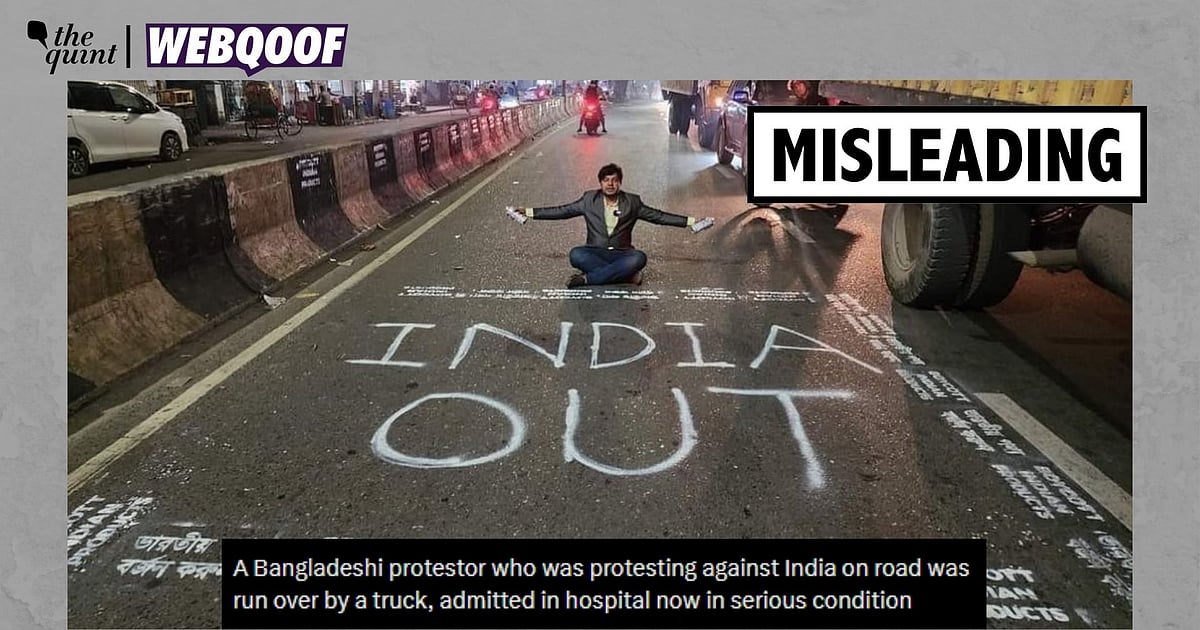
A misleading image showing a man sitting on a road with “India Out” written on it has gained significant traction across social media platforms, with claims erroneously connecting it to recent protests in Bangladesh.
The viral image, which shows a lone protester sitting on pavement marked with anti-India slogans, was shared by a premium X (formerly Twitter) account named ‘@FrontalForce’ with the caption: “A Bangladeshi protestor who was protesting against India on road was run over by a truck, admitted in hospital now in serious condition.”
The post rapidly accumulated over 300,000 views on X, spreading the narrative that the image depicted a recent incident amid ongoing political tensions in Bangladesh. Similar claims have appeared across multiple social media channels, amplifying the misleading narrative.
However, fact-checking reveals the image dates back to at least February 2024, several months before the current wave of protests in Bangladesh. The deliberate mischaracterization of the timing suggests an attempt to inflame regional tensions by connecting it to current events.
This incident highlights the growing challenge of misinformation surrounding South Asian geopolitics, particularly regarding India-Bangladesh relations. The account that shared the viral post, ‘@FrontalForce’, has previously been identified for disseminating false information on multiple occasions, raising questions about coordinated efforts to spread divisive content.
The “India Out” slogan has historical significance in the region, appearing periodically during times of diplomatic tension between India and its neighbors. Similar slogans have been seen in protests across the Maldives, Nepal, and parts of Bangladesh, often reflecting complex regional dynamics and sentiments about India’s influence in South Asia.
Bangladesh has experienced political upheaval in recent months, with student-led protests evolving into broader demonstrations against government policies. While India-Bangladesh relations have faced occasional strains, particularly regarding issues such as water sharing, border security, and regional influence, the viral image does not represent current protest activities.
Media literacy experts point to this case as an example of how isolated incidents can be repurposed and recontextualized to fit developing narratives. “What we’re seeing is the weaponization of old content to create false impressions about current events,” notes Dr. Samina Khan, a digital media researcher specializing in South Asian information ecosystems. “This pattern becomes particularly dangerous during periods of political instability.”
Social media platforms have implemented various measures to combat misinformation, including labeling systems and fact-checking partnerships. However, premium or verified accounts can sometimes bypass these safeguards, lending unwarranted credibility to misleading content. The viral post accumulated significant engagement before being identified as misleading, demonstrating the challenges in real-time fact-checking.
Regional experts emphasize that accurate information is crucial for diplomatic stability in South Asia. “Misinformation about protests or anti-India sentiment can inflame nationalistic responses and complicate already delicate diplomatic relations,” explains foreign policy analyst Rajiv Mehta. “The circulation of such misleading content serves no constructive purpose in regional dialogue.”
As Bangladesh navigates its current political situation, accurate reporting remains essential for both domestic understanding and international engagement. The viral image, divorced from its original context and falsely presented as current, represents a concerning trend in information manipulation that can impact public perception and policy discussions.
Fact-checkers recommend that social media users verify the source and timing of images before sharing content related to developing situations, particularly those involving international relations or political protests. Critically evaluating claims, especially from accounts with a history of sharing misinformation, represents an important first line of defense against the spread of misleading narratives.
Fact Checker
Verify the accuracy of this article using The Disinformation Commission analysis and real-time sources.

8 Comments
Interesting to see the spread of this misleading image across social media. It’s important to fact-check claims like these and avoid amplifying potentially inflammatory narratives, especially around sensitive regional issues.
Agreed, maintaining accurate information and context is crucial, especially on topics that could stoke tensions. Fact-checking helps prevent the spread of misinformation.
Glad to see this image was debunked as an old, misleading one. Social media can be a powerful tool, but also needs vigilance to prevent the spread of false or manipulated information, especially around geopolitical issues.
Absolutely, verifying sources and context is so important on social media these days. Fact-checking helps cut through the noise and misinformation.
This is a good reminder of the need to be cautious about viral images and claims, especially when they seem designed to inflame regional tensions. Fact-checking is essential to maintain accuracy and context.
This case highlights the importance of verifying the context and timing of images and claims, rather than just reacting to the surface-level narrative. Fact-checking helps maintain journalistic integrity.
It’s concerning to see how quickly misinformation can spread on social media, even around sensitive geopolitical issues. Rigorous fact-checking is crucial to counter the proliferation of false narratives.
Agreed, the speed and scale at which misinformation can travel online is alarming. Diligent fact-checking and media literacy are key to combating the problem.