


Listen to the article
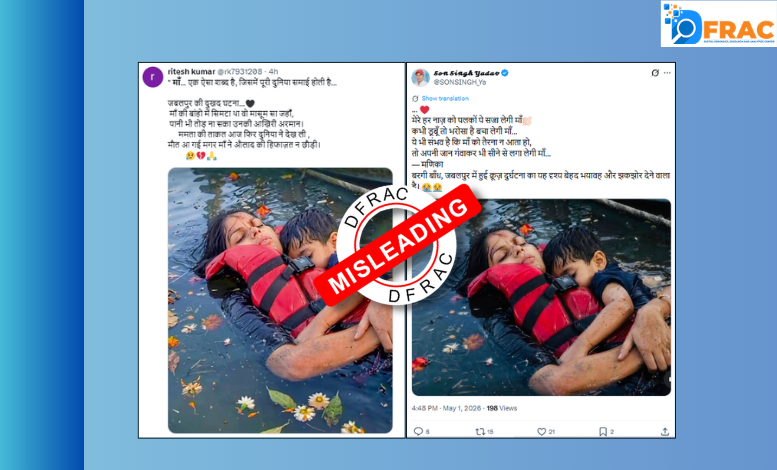
The tragic boat accident at Bargi Dam in Jabalpur, Madhya Pradesh, has sparked widespread attention, with rescue operations saving many lives while others were unfortunately lost. Amid the incident’s aftermath, a purportedly related image has gained significant traction on social media, showing a mother wearing a life jacket clutching her child in water.
The emotional image has circulated with captions emphasizing maternal sacrifice, including one that read: “Mother… a word that encompasses the entire world… In the tragic incident of Jabalpur, that innocent world was tucked away in a mother’s arms; even the water could not break her final wish. The world has once again witnessed the power of maternal love—death arrived, but the mother did not let go of her child’s protection.”
However, an investigation by the Digital Fact-Checking and Research Analysis Centre (DFRAC) has determined the viral image is not connected to the Jabalpur cruise accident. This conclusion is supported by an official statement from the Jabalpur Collector’s office, which explicitly stated on social media: “This photo is either AI-generated or from another source. It has no connection to the Bargi cruise accident.”
Further technical analysis strengthens this finding. When subjected to AI detection software, the image showed strong indicators of artificial creation. The platform Hive Moderation assessed the image as having a 96.2% probability of being AI-generated, while another detection tool, decopy.ai, categorized it as 100% AI-generated.
The Bargi Dam incident represents one of several boat accidents that have occurred in India in recent years, highlighting ongoing safety concerns at tourist destinations. Located approximately 40 kilometers from Jabalpur city, Bargi Dam is a popular recreational spot on the Narmada River. The reservoir, created by one of the first completed projects of the Narmada Valley Development Plan, attracts numerous visitors, particularly during summer months.
Local authorities have initiated an investigation into the causes of the accident. Early reports suggest that weather conditions and potential overcrowding may have been contributing factors, though officials have not released final conclusions.
The circulation of AI-generated images purporting to depict real disasters represents a growing challenge for emergency responders, journalists, and the public. Such fabricated content can complicate rescue and relief operations by spreading misinformation and creating false narratives around tragic events.
Social media platforms have struggled to contain the rapid spread of such content, particularly when it evokes strong emotional responses. The powerful imagery of maternal protection depicted in this fabricated photo resonated with many users who shared it without verification, demonstrating how AI-generated content can rapidly gain traction during crisis situations.
The Madhya Pradesh state government has announced compensation for the victims’ families and is reviewing safety protocols for tourist boats operating in reservoirs and dams across the state. Officials have called for heightened vigilance regarding the spread of misinformation during disasters.
This incident underscores the importance of critical media consumption and fact-checking, especially during emergencies when accurate information becomes crucial. As AI-generated content becomes increasingly sophisticated and difficult to identify, verifying information through official channels remains essential.
Fact Checker
Verify the accuracy of this article using The Disinformation Commission analysis and real-time sources.

11 Comments
A powerful image, to be sure, but not one that accurately reflects the Jabalpur tragedy. I appreciate the local authorities taking the time to clarify the facts and dispel any false connections. In times of crisis, we must be vigilant about separating truth from fiction, no matter how compelling the narrative.
Well said. Fact-checking and transparency are crucial, especially when emotions are running high. It’s good to see the local authorities taking a proactive approach to setting the record straight.
A heartbreaking situation in Jabalpur, to be sure. But I appreciate the local authorities taking the time to clarify that the viral image is not related to this specific tragedy. In times of crisis, it’s crucial that we remain vigilant about separating fact from fiction, no matter how emotionally resonant the latter may be.
Absolutely. Maintaining accuracy and integrity in the face of tragedy is paramount. The Jabalpur Collector’s office has done a commendable job of upholding those principles.
A heartbreaking situation in Jabalpur, no doubt. But I’m glad the local authorities have been upfront about the viral image not being connected to this tragedy. In the age of social media, it’s so important that we verify information before amplifying it, no matter how compelling the narrative may be. Kudos to the Jabalpur Collector’s office for their diligence.
While the viral image is undoubtedly powerful, I’m glad the local authorities have been transparent about its lack of connection to the Jabalpur incident. In the age of misinformation, it’s so important that we rely on verified facts, even when they may not align with the narratives we find most compelling. Kudos to the Jabalpur Collector’s office for their diligence.
This is a tragic incident, though the viral image appears to be unrelated. It’s good the authorities have clarified the facts to avoid spreading misinformation. Maternal love and sacrifice in the face of disaster is an eternal human story, but we must be careful about attributing such powerful images without verification.
While the viral image is certainly evocative, I’m glad the authorities have been upfront about its lack of connection to the Jabalpur incident. In the age of social media, it’s so important to verify information before amplifying it, no matter how compelling the narrative may be. Kudos to the Jabalpur Collector’s office for their diligence.
Tragic events often bring out strong emotions, and it’s understandable why this particular image would resonate. However, it’s crucial that we verify information before sharing it, to avoid spreading misinformation. The Jabalpur Collector’s office has made it clear this image is not related to the incident, and we should respect that.
Tragic events can bring out strong emotions and a desire to latch onto powerful imagery, but it’s crucial that we maintain a commitment to the facts. I appreciate the Jabalpur Collector’s office taking the time to clarify that the viral image is not related to this specific incident. In times of crisis, accuracy and transparency should be our guiding principles.
I’m glad the local authorities have been quick to correct the record on this viral image. It’s important to get the facts right, especially in the aftermath of a disaster like this. While the image is compelling, its connection to the Jabalpur incident seems tenuous at best.