


Listen to the article
Balochi Dance Video Falsely Linked to Cricket Celebrations, Investigation Reveals
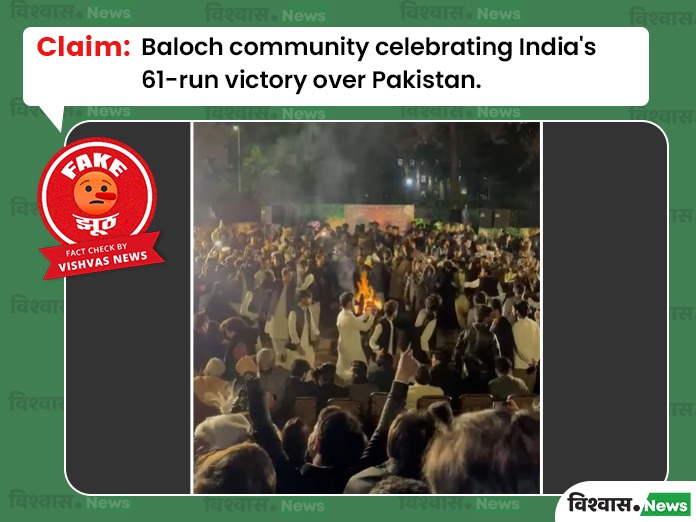
A video circulating on social media purportedly showing members of the Baloch community celebrating India’s victory over Pakistan in a recent T20 World Cup match has been debunked as false, according to an investigation by fact-checking organization Vishvas News.
The footage, which shows a crowd celebrating and dancing around a fire in the streets, was widely shared following India’s 61-run victory over Pakistan in Colombo on February 15, 2026. Social media users claimed the video depicted Baloch people celebrating Pakistan’s defeat as a political statement related to the region’s independence movement.
However, careful verification has established that the video predates the cricket match by several weeks. It actually shows students performing a traditional Balochi dance called “Chaap” during a cultural festival at Government College University (GCU) in Lahore, Pakistan, in January 2026.
The investigation began with a reverse image search of key frames from the viral video. This led to identical footage uploaded to YouTube on January 24, 2026, by a channel called “Balochistan.com,” which clearly identified the location as GCU Lahore. Further corroboration came from an Instagram post by “GCU Youth” on January 26, explicitly describing the content as a “Balochi cultural dance” performed during a university festival.
“Since the video was already public in January 2026, it is chronologically impossible for it to be a reaction to the T20 World Cup match held on February 15,” the investigation concluded.
Pakistani journalist Adil Ali, contacted by Vishvas News to verify the footage, confirmed that the video shows a Balochi dance performed at a university in Lahore prior to the cricket match.
The misleading claim appears to have gained significant traction after being shared by Facebook user ‘Anshika Thakurain,’ who has approximately 14,000 followers. The post claimed: “India’s resounding victory over Pakistan in the T20 World Cup created a festive atmosphere not only in India but also in Balochistan… members of the Baloch community were seen dancing, swaying to the beats of drums, and waving the tricolor.”
While some legitimate media outlets including News18 and Times Now did report on general celebrations in parts of Balochistan following India’s cricket victory on February 16, this specific viral video has been taken out of context and misrepresented.
The incident highlights the ongoing challenge of misinformation in the digital age, particularly around emotionally charged events such as sporting contests between rival nations. Relations between India and Pakistan remain sensitive, and content that suggests political implications of sporting outcomes often spreads rapidly across social media platforms.
Balochistan, Pakistan’s largest province by area, has a complex political history with separatist movements active in the region for decades. This context likely contributed to the rapid spread of the video, as it aligned with existing narratives about anti-Pakistan sentiment in the region.
The case demonstrates the importance of verifying content before sharing, particularly when claims involve geopolitically sensitive regions. Digital forensic techniques such as reverse image searches and chronological verification remain essential tools in combating misinformation in today’s media landscape.
Vishvas News concluded its fact-check by definitively labeling the claim as false, stating: “The viral video is not from after the India-Pakistan T20 match. The footage is from a cultural festival at a university in Lahore held in January 2026, featuring a traditional dance known as ‘Balochi Chaap.’ It has no connection to the cricket match or Pakistan’s defeat in Colombo.”
Fact Checker
Verify the accuracy of this article using The Disinformation Commission analysis and real-time sources.

6 Comments
It’s disappointing to see misleading information spread so quickly on social media. Fact-checking is crucial to ensure the public has accurate information, especially around sensitive political issues like this.
This is a good reminder that we need to be cautious about viral videos and social media claims. Taking the time to verify the facts is crucial, especially on topics related to regional political tensions.
While the original video may have seemed convincing, I’m glad the investigation was able to uncover the true context. It’s important we don’t let emotions or biases cloud our judgment when assessing online content.
Fact-checking is essential to maintain trust in the media and combat the spread of misinformation. This case shows how even seemingly straightforward videos can have misleading backstories.
I appreciate the diligent investigation that revealed the true origins of this video. It’s important we don’t jump to conclusions and instead verify claims, no matter how provocative they may seem.
Agreed. Spreading misinformation, even unintentionally, can do real harm. Fact-checking efforts like this help counter the spread of disinformation.