


Listen to the article
Russian Classifieds Site Debunks Claims of Louvre Stolen Jewels Listing
A false rumor spread rapidly across social media claiming that priceless jewels stolen during the October 2025 Louvre heist had appeared for sale on a Russian online marketplace. The claim, which gained significant traction on X (formerly Twitter) and Facebook, has been definitively debunked by Avito, the Russian classifieds platform where the suspicious listing briefly appeared.
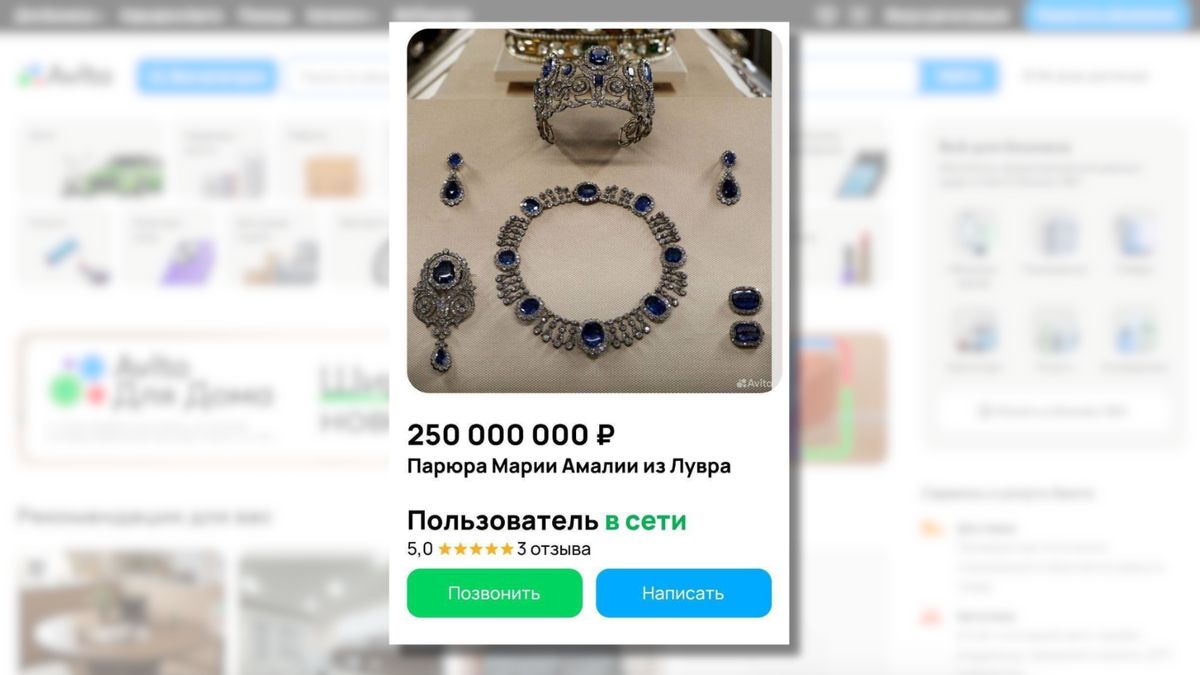
The listing in question advertised “Parure of Marie Amalie from the Louvre” with a price tag of 250 million rubles (approximately $3 million). It purportedly offered a complete jewelry set including a crown, necklace, earrings, and three brooches, accompanied by an image of the jewels displayed in their museum setting.
Avito moved swiftly to address the situation, releasing a statement on October 21 confirming the listing was merely a prank. “People with critical thinking skills understand that this is just a prank. We hope that most people do,” the company wrote on its Telegram channel. Avito confirmed it had deleted the listing and blocked the user responsible.
The incident underscores the chaos and speculation surrounding the high-profile heist that shocked the art and museum world just days earlier. On October 19, thieves executed a brazen daytime robbery at the Louvre’s prestigious Apollo Gallery, making off with nine pieces from France’s crown jewels collection.
Laure Beccuau, head of the Paris Prosecutors Office, has valued the eight missing pieces at approximately 88 million euros (roughly $102 million). French authorities have recovered only one item so far—a crown that investigators believe the thieves dropped or discarded during their escape.
Several factors made the Avito listing immediately suspect to experts. The advertisement claimed to offer Queen Marie-Amélie’s complete parure, a matching set of jewelry. However, according to the French Ministry of the Interior, thieves took only three items from this collection: a tiara, a necklace, and a single earring. The complete set advertised could not possibly have been available.
Furthermore, the image used in the listing was traced to a 2016 photograph showing the jewelry displayed inside the Louvre’s Apollo Gallery—clearly a stock image rather than a photo of items in the seller’s possession.
Art theft experts have noted that selling such recognizable stolen treasures presents significant challenges for criminals. Arthur Brand, a Dutch art detective interviewed by the BBC, expressed concern that the stolen items might be “long gone,” potentially broken down into smaller pieces to facilitate smuggling out of France and to obscure their origin.
The investigation by French authorities continues at full speed. The Paris Police Prefecture’s Brigade de Répression du Banditisme is leading efforts to recover the missing jewels and apprehend those responsible. INTERPOL has added the stolen items to its Stolen Works of Art Database, further complicating any potential sale on legitimate markets.
The October heist represents one of the most significant museum thefts in recent European history. The Apollo Gallery, known for its opulent display of royal treasures, remains temporarily closed while investigators work to understand how thieves managed to breach security at one of the world’s most visited and closely guarded museums.
As the investigation unfolds, art security experts suggest that high-profile heists of this nature often lead to increased protective measures across major museums worldwide, as institutions reassess their vulnerability to similar brazen daytime robberies.
Fact Checker
Verify the accuracy of this article using The Disinformation Commission analysis and real-time sources.

5 Comments
Interesting that this hoax gained so much traction on social media. I guess the lure of stolen Louvre jewels was too tempting for some to resist. Kudos to Avito for debunking the claim and removing the listing.
This is a good reminder to always verify claims, especially when it comes to high-profile crimes and lost treasures. It’s easy for misinformation to spread like wildfire these days. Kudos to the fact-checkers for getting to the bottom of this.
What a bizarre prank to pull off. Trying to pass off stolen Louvre artifacts on a classifieds site – the audacity! I’m curious to know more about the individual behind this hoax and what their motivation was. Anyway, good on Avito for shutting it down.
While the thought of Louvre jewels on a Russian classifieds site is intriguing, I’m glad this turned out to be a hoax. Trying to profit off stolen art is a serious offense. Glad Avito was on top of it.
Ah, so the Louvre heist was just a prank after all. Seems some people have a twisted sense of humor when it comes to priceless artifacts. Glad Avito acted quickly to shut down the fake listing.