


Listen to the article
Old Nuclear Test Footage Falsely Labeled as Iranian IRGC Test
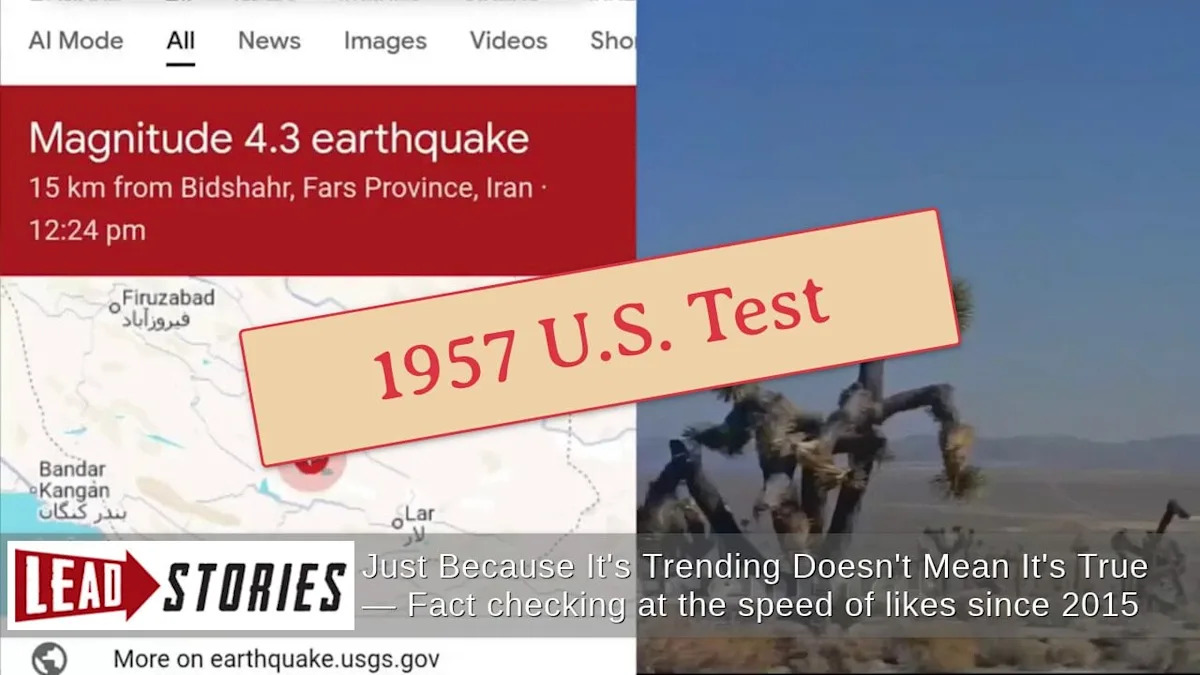
A video clip circulating on social media purporting to show a nuclear test conducted by Iran’s Islamic Revolutionary Guard Corps (IRGC) has been definitively debunked as misleading content. The footage, which was shared on X (formerly Twitter) by user @rkmtimes on March 3, 2026, actually shows a U.S. nuclear test conducted nearly seven decades ago in Nevada.
Digital forensic analysis reveals the video bears the distinctive watermark of YouTube channel @atomcentral, which posted the historical footage in January 2023. The original video depicts the Plumbbob Fizeau atomic bomb test conducted in the Nevada desert in 1957 as part of Operation Plumbbob, a series of nuclear tests carried out by the United States during the Cold War.
The misleading social media post featured the caption: “JUST IN🇮🇷❌🇺🇸🔥 A #Nuclear test has carried out by Iranian IRGC, A magnitude 4.3 earthquake has struck the Gerash region in southern Fars province at a depth of 10 km.”
The post attempted to connect an actual seismic event in Iran with the falsely labeled nuclear test footage. The United States Geological Survey (USGS) did record an earthquake in Iran’s Fars Province on March 3, 2026, measuring 4.4 magnitude, with an epicenter approximately 15 kilometers from Bidshar. However, there is no scientific evidence linking this seismic activity to nuclear testing.
This misinformation emerges during a period of heightened international tension regarding Iran’s nuclear program. Iran has faced extensive international sanctions and scrutiny over its nuclear activities, though the country has consistently maintained its program is for peaceful energy purposes. The International Atomic Energy Agency (IAEA) continues to monitor Iran’s nuclear facilities under various inspection agreements, although concerns about potential undeclared sites remain a point of contention.
False claims about nuclear tests can have serious geopolitical implications, potentially inflaming tensions between nations and causing unnecessary public alarm. Nuclear testing is strictly regulated under international treaties, including the Comprehensive Nuclear-Test-Ban Treaty (CTBT), which bans all nuclear explosions worldwide. While Iran has signed but not ratified the CTBT, any confirmed nuclear test would represent a major escalation and violation of international norms.
Seismologists regularly distinguish between earthquakes caused by natural tectonic activity and those resulting from nuclear detonations based on distinctive wave patterns and other technical indicators. The USGS categorized the Iran event as a natural earthquake occurring along known fault lines in the region.
This is not the first instance of historical nuclear test footage being misattributed to current events or different countries. The widespread availability of declassified Cold War-era nuclear test videos on platforms like YouTube has made them convenient material for those seeking to spread misinformation.
Media literacy experts emphasize the importance of verifying sources before sharing dramatic footage, particularly when it involves sensitive geopolitical claims. Simple verification methods, such as reverse image searches or checking for watermarks, can often quickly reveal the true origin of misleading content.
As tensions persist in the Middle East and questions about nuclear proliferation remain prominent in international discourse, distinguishing between factual reporting and misinformation becomes increasingly vital for informed public understanding of complex geopolitical issues.
Fact Checker
Verify the accuracy of this article using The Disinformation Commission analysis and real-time sources.

16 Comments
This is a good example of how historical footage can be taken out of context and used to spread false narratives. Thorough investigation and digital forensics were needed to trace the origins and expose the truth.
Absolutely, context is everything when it comes to media content. Glad the real source of this footage has been uncovered.
This highlights the importance of critical thinking and not automatically believing everything we see online, especially when it comes to sensitive geopolitical issues. Fact-checking is essential to maintain trust in information sources.
Absolutely, a healthy dose of skepticism is warranted these days. Glad to see this misinformation was swiftly identified and corrected.
I’m glad to see this old footage properly attributed to the US nuclear test program rather than falsely connected to a current event in Iran. Rigorous fact-checking is crucial to uphold the integrity of reporting, especially on such sensitive topics.
You make a good point. Fact-checking and proper attribution are essential to ensure the public has accurate information, rather than misleading narratives.
Interesting to see the debunking of this misleading video. Fact-checking is crucial to prevent the spread of misinformation, especially around sensitive topics like nuclear tests. I’m glad the origins of this footage have been clearly identified.
You’re right, fact-checking is so important these days to combat the flood of misinformation online. Good to see this old footage properly attributed.
Interesting to see how old footage can be repurposed and presented as misinformation. I appreciate the thorough investigation that went into tracing the origins of this video and debunking the false claims. Fact-checking is so important in today’s media landscape.
You’re right, context is everything when it comes to evaluating information online. Good to see the real source of this footage has been identified.
It’s concerning to see how easily misinformation can spread, even around serious topics like nuclear tests. I appreciate the diligent work to debunk this false claim and set the record straight.
Yes, the ability to fact-check and verify information is crucial in today’s media landscape. Kudos to the researchers for getting to the bottom of this.
It’s concerning to see how easily old footage can be repurposed and presented as misinformation. I appreciate the diligent work to trace the origins of this video and debunk the false claims. Fact-checking is so important in the digital age.
Agreed, the ability to verify the source and context of media content is crucial. Well done to the researchers for getting to the bottom of this.
This serves as a good reminder to always be critical consumers of information, especially when it comes to sensitive topics like nuclear activity. I’m glad the true origins of this footage have been identified and the misleading claims debunked.
Absolutely, a healthy dose of skepticism is warranted these days. Kudos to the fact-checkers for their diligence in setting the record straight.