


Listen to the article
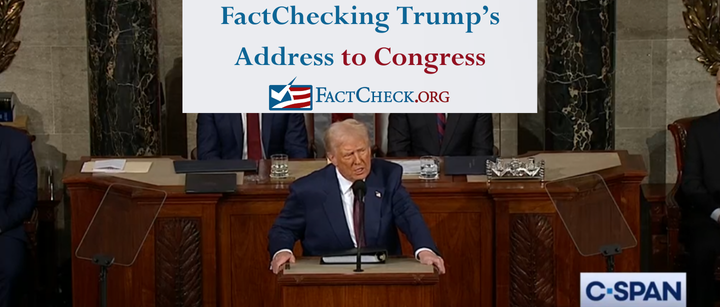
In a recent fact-checking effort, FactCheck.org has released a comprehensive video analysis of President Donald Trump’s address to a joint session of Congress, highlighting several claims that merit scrutiny.
The video, produced by the organization’s Social Media Manager Josh Diehl, meticulously examines statements made during the former president’s March 4 speech, identifying multiple instances where Trump’s assertions diverged from established facts.
According to FactCheck.org’s analysis, Trump made numerous claims that fall into categories of exaggeration, misleading statements, or assertions lacking sufficient evidence. Among these were statements about uncovering fraud in government spending programs, including Social Security, which the fact-checkers found to be overstated.
The fact-checking team also flagged Trump’s comparisons between U.S. and European aid to Ukraine. These statements, when examined against actual aid figures and commitments, appeared to misrepresent the proportional contributions of American and European allies in supporting Ukraine during its ongoing conflict with Russia.
Another area of contention involved Trump’s characterization of the economy when he first took office. The fact-checkers noted that his portrayal did not align with economic indicators and data from that period, painting a more dire picture than economic statistics supported.
The analysis extended to environmental claims as well. Trump’s statements regarding power plant closures were found to lack important context about the energy sector’s ongoing transition and the market forces driving changes in America’s power generation infrastructure.
Additional scrutiny was applied to the former president’s assertions about fentanyl trafficking across the U.S.-Canada border. While fentanyl smuggling remains a serious concern for U.S. law enforcement, the fact-checkers indicated that Trump’s specific claims about the Canadian border route oversimplified the complex pathways through which this deadly substance enters the country.
In a particularly unusual claim, Trump made statements about the Panama Canal that FactCheck.org identified as problematic. The organization noted that this was part of a pattern, as many of these mischaracterizations have appeared in previous speeches and public statements by the former president.
This fact-checking effort reflects the ongoing challenge of verifying political rhetoric in an era of information abundance. FactCheck.org’s work highlights the importance of subjecting high-profile political statements to rigorous analysis, especially when they come from former presidents who maintain significant public influence.
The organization emphasized that interested viewers can find more detailed analysis in their full article, “FactChecking Trump’s Address to Congress,” which expands on the video presentation with additional context and supporting evidence.
FactCheck.org, which operates as a project of the Annenberg Public Policy Center, maintains a commitment to nonpartisan analysis of political statements across the spectrum. The organization points out its independence from commercial interests, noting that it does not accept advertising revenue and instead relies on grants and individual donations to support its work.
This approach to fact-checking reflects broader trends in journalism, where specialized organizations have developed expertise in verifying claims made by public figures. Such efforts have become increasingly important in helping citizens navigate political discourse and evaluate the accuracy of statements made by current and former government officials.
For those seeking additional information beyond the video presentation, the full article on FactCheck.org provides a more detailed examination of each claim and the evidence used to evaluate its accuracy.
Fact Checker
Verify the accuracy of this article using The Disinformation Commission analysis and real-time sources.

7 Comments
It’s good to see non-partisan organizations like FactCheck.org scrutinizing political rhetoric and holding leaders accountable, regardless of party affiliation. This type of analysis helps inform the public.
Fact-checking is crucial for maintaining a well-informed electorate. While political rhetoric can be persuasive, it’s vital that we examine the underlying facts and data to get a clear picture of the truth.
Interesting to see a fact-checking analysis of Trump’s statements. It’s important to scrutinize political claims, even from high-profile figures, to ensure the public has accurate information.
I agree, fact-checking is crucial for holding leaders accountable and preventing the spread of misinformation. It will be informative to see the specifics of what was exaggerated or misrepresented.
I appreciate the effort to fact-check Trump’s claims, as it’s important to have an objective assessment of the accuracy of statements made by public figures. Looking forward to seeing the specific details uncovered by the analysis.
This video analysis seems like a thorough and unbiased look at Trump’s congressional address. I’m curious to learn more about the details of the claims that were found to be misleading or lacking evidence.
Yes, the fact-checkers’ findings on Trump’s statements about government spending programs and comparisons of US and European aid to Ukraine will be interesting to examine further.