


Listen to the article
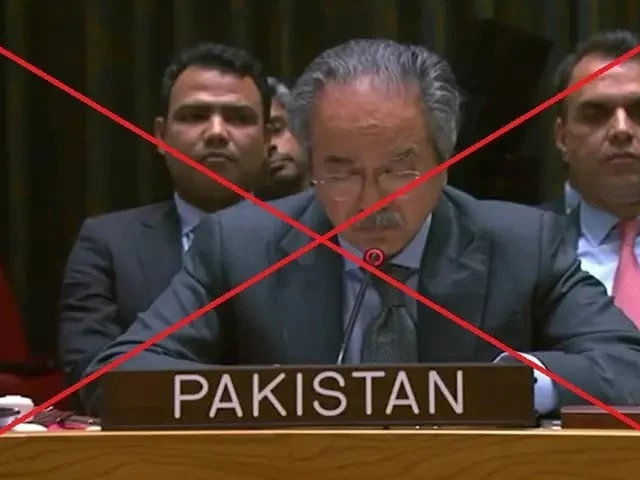
In a flurry of social media activity this week, a video purportedly showing Pakistani Ambassador Asim Iftikhar Ahmad delivering a forceful rebuke to Israel at a recent UN Security Council session has gone viral. The clip, which shows the ambassador criticizing Israeli actions in Gaza and Palestinian territories, has garnered millions of views across various platforms.
The video began circulating widely on Tuesday when a Turkish user on X (formerly Twitter) shared it with a caption stating: “The Pakistani ambassador, showing Israel its place at the UN General Assembly, said the following: ‘Israel is an occupier and a brigand that plays the victim card, violates UN resolutions, and practices state terrorism in Gaza and even on Palestinian lands’.” This post alone gathered nearly 500,000 views.
The clip quickly gained traction among high-profile figures, including American political commentator Jackson Hinke, whose repost attracted 365,000 views and 26,000 likes. Former Pakistani Human Rights Minister Shireen Mazari also shared the video, praising it as “an excellent response by Pakistan stated without histrionics in a logical, understated but powerful statement.”
Journalists further amplified the video’s reach, with Matiullah Jan’s post generating 1.1 million views under the caption: “Israel’s Iron Dome didn’t see this coming from Pakistan.” Digital media outlet Pakistan Connect shared the clip on Instagram, where it received 19,000 views.
The timing seemed significant, as Pakistan has recently stepped into a mediator role in the ongoing Middle East conflicts. The South Asian nation successfully brokered a ceasefire between the United States, Israel and Iran on April 8, 2026, and hosted the first round of Washington-Tehran talks on April 11-12, though these ended without resolution.
However, a fact-check investigation reveals that the viral video is not from recent events but dates back to September 2025, making it completely unrelated to current diplomatic efforts.
A reverse image search uncovered the original YouTube video posted by Pakistan’s UN mission on September 15, 2025, titled “Pakistan hits back: Rejects Israel’s unrelated smears during Qatar debate.” Comparison between this original footage and the viral clip confirms that the latter shows only the first 5:37 minutes of the ambassador’s complete speech.
The actual context of the ambassador’s remarks stemmed from a September 9, 2025 incident when Israel targeted Hamas leaders in Doha, Qatar, killing five Hamas members and a Qatari security officer. This attack prompted international condemnation, including from Gulf states allied with the United States.
During that Security Council session, Israeli Ambassador Danny Danon referenced Osama bin Laden’s killing in Pakistan to justify Israel’s actions in Doha, provoking Ambassador Ahmad’s strong response that called the comparison “unacceptable” while criticizing Israel for deflecting attention from its own violations of international law.
Multiple news outlets, including Dawn and Capital TV, covered this diplomatic exchange in September 2025, confirming its occurrence well before current events. Dawn published a report dated September 12, 2025, with the headline “Pakistan, Israel trade barbs at UNSC over attack in Doha,” further establishing the correct timeline.
While Pakistan has indeed maintained a consistent stance calling for peace at the UNSC and criticizing Israeli actions in Gaza, Iran, and Lebanon during the current conflicts, the viral video represents an older diplomatic exchange being recirculated without proper context.
The misattribution of this footage highlights the challenges of information verification in today’s fast-paced social media environment, where compelling content can rapidly spread without proper contextual framing, especially during periods of heightened geopolitical tensions.
Fact Checker
Verify the accuracy of this article using The Disinformation Commission analysis and real-time sources.

6 Comments
This serves as a helpful reminder to be cautious about amplifying or sharing content, even if it aligns with one’s views. Verifying the facts and context is essential to avoid inadvertently spreading disinformation.
This fact-check underscores the importance of not just blindly accepting and sharing viral content, no matter how compelling it may seem. Taking the time to properly research the facts is key.
This highlights the need to be cautious about automatically trusting and amplifying sensational social media content, even when it aligns with one’s views. Fact-checking is crucial to avoid spreading misinformation.
The UN ambassador’s speech may have been powerful, but if it predates the current conflict, sharing it out of context could be misleading. It’s admirable that the commission is taking the time to properly investigate these claims.
Interesting fact-check on this viral video. It’s good to see the context clarified, as it’s important to verify the accuracy of such viral social media clips before sharing them widely.
It’s good to see the Disinformation Commission taking the time to investigate this viral video and provide context. Fact-checking helps combat the spread of misinformation, which is increasingly important in today’s digital landscape.