


Listen to the article
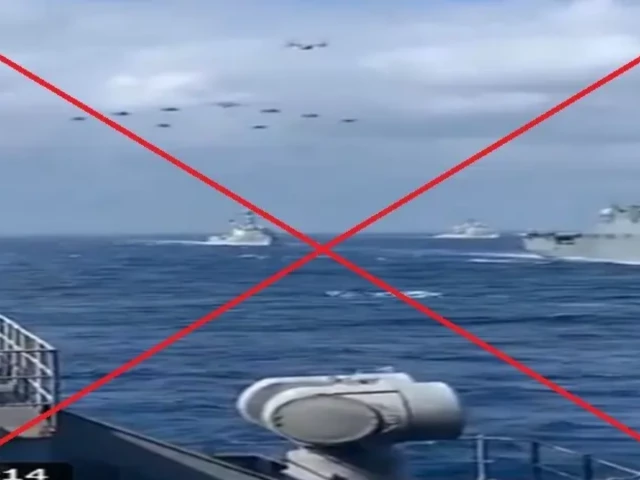
False Viral Video Claims to Show US Navy Blockade of Iran
A video widely circulating on social media since Monday allegedly showing US Navy ships blockading the Strait of Hormuz amid rising tensions with Iran has been proven false. The footage, which garnered millions of views across multiple accounts on X (formerly Twitter), actually predates the current conflict by nearly four years.
The misleading video began spreading rapidly after the US military announced a blockade of Iranian ports and coastal areas earlier this week. According to military officials, ships will still be permitted to transit the Strait of Hormuz if they are traveling between non-Iranian ports.
A detailed fact-check conducted by iVerify Pakistan revealed the video originated no later than May 2022, confirming it has no connection to current geopolitical developments. The investigation traced the footage back to a Facebook post dated May 13, 2022, which appears to have been initially shared by a naval aviator in the US Navy.
The misinformation spread quickly across X, with one pro-Israeli user claiming: “Iran wanted to close the Strait of Hormuz to pressure Trump. But Trump personally took on the task, closing it for them. He even closed it on them! My friend, war is an art.” This post alone received 1.6 million views.
Another account falsely attributed the information to Reuters, claiming: “US naval blockade of Iran has officially begun after the military moved to restrict ships entering and exiting Iranian ports, marking a major escalation in tensions.” This post accumulated 755,000 views, with numerous other accounts subsequently amplifying the false claim.
The viral spread of this misinformation comes at a particularly sensitive moment in US-Iran relations. Diplomatic efforts by Pakistan recently led to a two-week ceasefire agreement on April 8, following weeks of escalating hostilities that began with US-Israeli strikes on February 28, 2026. These strikes had quickly developed into a broader regional conflict.
Pakistan emerged as a key diplomatic mediator in securing this temporary ceasefire, facilitating crucial communication between Washington and Tehran. These efforts culminated in the marathon 21-hour Islamabad Talks on April 11, which unfortunately ended without a lasting resolution.
The failure of these negotiations prompted the United States to implement the blockade of Iranian ports that began Monday, representing a significant escalation in the ongoing tensions. The Strait of Hormuz holds immense strategic importance as roughly 20% of global oil shipments pass through this narrow waterway between Iran and Oman.
Misinformation surrounding such geopolitically sensitive events can potentially inflame tensions and create public confusion. The rapid spread of this outdated footage highlights the challenges in maintaining accurate information flows during international crises.
The Strait of Hormuz has long been a flashpoint in US-Iran relations, with Tehran occasionally threatening to block the crucial maritime passage during previous periods of heightened tensions. Any actual blockade or military action in this region would have significant implications for global energy markets and international shipping.
As the situation continues to develop, international observers remain watchful of both military movements in the region and the potential for renewed diplomatic engagement between the two nations.
Fact Checker
Verify the accuracy of this article using The Disinformation Commission analysis and real-time sources.

10 Comments
This is a timely reminder of the need to be cautious and critical when consuming information, especially on sensitive geopolitical topics. The detailed investigation into the origins of this video highlights the importance of robust fact-checking to prevent the spread of false narratives.
Exactly. In the digital age, it’s crucial that we all strive to be more discerning consumers of information. Fact-checking and source verification should be standard practice, especially when it comes to claims that could have real-world consequences.
The ability to trace the origins of this misleading video is a testament to the importance of investigative journalism. Debunking such claims is crucial for maintaining public trust and preventing the escalation of international conflicts. Well done to the fact-checkers on this case.
Agreed. Fact-checking and source verification are essential skills in an age of rampant misinformation. Kudos to the team that was able to track down the true origins of this viral video and set the record straight.
It’s important to fact-check viral videos and social media claims, especially around sensitive geopolitical issues like this. Spreading misinformation, even inadvertently, can escalate tensions. I’m glad this footage was traced back to an older source and debunked.
You’re right, verifying the accuracy of information is crucial, especially when it involves military and diplomatic matters. Fact-checking helps prevent the spread of false narratives.
I’m glad to see that the misinformation in this viral video was swiftly debunked through thorough investigation. Maintaining factual accuracy and preventing the spread of false narratives is vital, particularly in sensitive geopolitical contexts. Well done to the fact-checkers on this case.
Absolutely. The ability to trace the origins of this misleading video and conclusively disprove its claims is a testament to the importance of rigorous fact-checking. Kudos to the team for their diligence in upholding journalistic integrity.
This highlights the need for caution when consuming online content, even from seemingly credible sources. While the video may have looked convincing, the comprehensive investigation revealed its true origins. Responsible reporting is essential to avoid fueling geopolitical tensions.
Absolutely. In the age of social media, it’s all too easy for misinformation to go viral. Rigorous fact-checking is the best way to maintain transparency and prevent the spread of false claims, even if they initially appear plausible.