


Listen to the article
Viral Video Falsely Attributed to Dubai, Iran Missile Strikes Amid Middle East Tensions
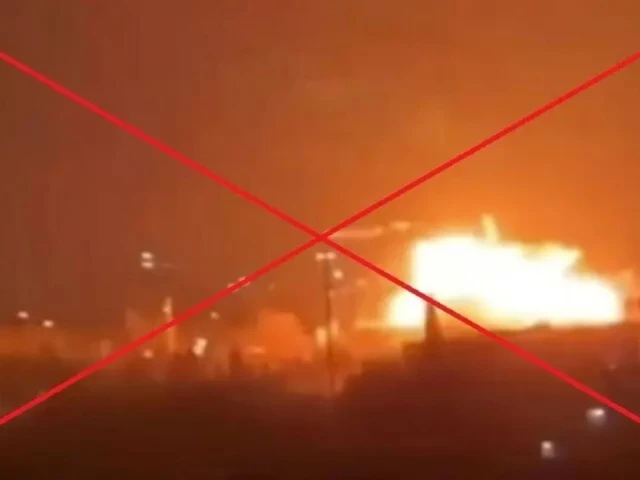
Misinformation about alleged missile strikes in Dubai and Iran spread rapidly across social media platforms this week, as users shared an outdated video with fabricated claims amid heightened regional tensions.
Multiple social media accounts, particularly those appearing to support Iran based on their posting history, circulated footage on X (formerly Twitter) since May 7, making contradictory assertions about its origin. Some claimed it showed Iranian strikes on Dubai, while others presented it as American attacks on Iranian targets.
An investigation by iVerify Pakistan has conclusively determined these claims to be false. The video in question actually depicts a Ukrainian missile attack on Russia’s Black Sea fleet in Sevastopol from March 23, 2024 – more than a month before the alleged Middle Eastern incidents.
One pro-Iranian account shared the video claiming: “Breaking Now: UAE having ‘Glasshouse’ throws stones. Iran responds to Dubai in an unbelievable way after the UAE’s adventures in striking Qeshm.” This post alone garnered over 204,000 views. Another similar post attracted 70,000 views with the caption: “Urgent now: Iran responds to Dubai in an unbelievable way.”
The same footage was simultaneously being shared with contradictory narratives. Some users claimed it showed U.S. military airstrikes on Iran’s Bandar Abbas port and Qeshm Island, with one such post accumulating more than 92,000 views.
These false claims emerged against the backdrop of genuine regional tensions. On May 4, the United Arab Emirates reported being targeted by Iranian strikes, including an attack on its Fujairah energy hub that wounded three Indian nationals. UAE authorities stated their air defense systems had engaged multiple ballistic missiles, cruise missiles, and drones launched from Iran.
However, Iran’s Islamic Revolutionary Guards Corps (IRGC) issued a statement on May 5 categorically denying any such action: “Iran’s forces have not carried out any missile or drone operations against the UAE in recent days. If any action had been taken, we would have announced it firmly and clearly.”
The fact-checkers at iVerify Pakistan conducted reverse image searches and keyword analysis that traced the footage to legitimate news coverage by British media outlets including The Telegraph and On Demand News. Both had published the video on March 24, 2024, clearly identifying it as showing Ukrainian strikes on Russian naval assets.
Ukraine’s TV channel Freedom also used the same footage in their March 24 reporting, confirming it showed “successful combat operations against Russian Black Sea Fleet facilities in Sevastopol.” According to Ukrainian military sources, approximately ten explosions were heard in Sevastopol on March 23, targeting Russia’s 810th Marine Brigade base in Kozacha Bay.
The misattributed video gained significant traction amid the complex geopolitical situation in the Middle East. The post alleged that U.S. and Israeli forces had launched a war against Iran on February 28, resulting in Iran closing the Strait of Hormuz – a vital route for global oil and gas exports – while American forces imposed a blockade on Iranian ports.
This case illustrates the challenges of information verification during periods of international tension, when social media can rapidly amplify misleading content. The identical footage being simultaneously presented as both Iranian attacks on the UAE and American strikes on Iran demonstrates how visual content can be weaponized to support contradictory narratives.
Social media users are advised to verify information through multiple credible sources before accepting claims about international conflicts, particularly when they involve dramatic visual content that could easily be taken out of context.
Fact Checker
Verify the accuracy of this article using The Disinformation Commission analysis and real-time sources.

7 Comments
This is a timely reminder of the importance of verifying the source and accuracy of online content, especially when it relates to geopolitical events. Fact-checking is crucial to counter the spread of misinformation.
Thanks for providing the context around this video. It’s concerning to see how quickly unverified claims can gain traction on social media. Fact-checking is crucial to combat the spread of disinformation.
The ability to correctly identify the true origin of this video is impressive. Fact-checking efforts like this help maintain trust in the information we consume online.
This highlights the need for caution when consuming online content, especially during times of heightened geopolitical tensions. Verifying the source and accuracy of information is key to avoiding the propagation of false narratives.
It’s good to see the origin of this video being clarified. Misinformation surrounding military conflicts can have serious consequences, so proper verification is essential.
This is an interesting fact check. It’s important to verify the origins of viral videos, as misinformation can spread rapidly online. Glad the investigation could determine the true source of this footage.
I appreciate the detailed investigation that went into verifying the source of this viral video. It’s a valuable example of the importance of rigorous fact-checking, especially in the context of sensitive geopolitical events.