


Listen to the article
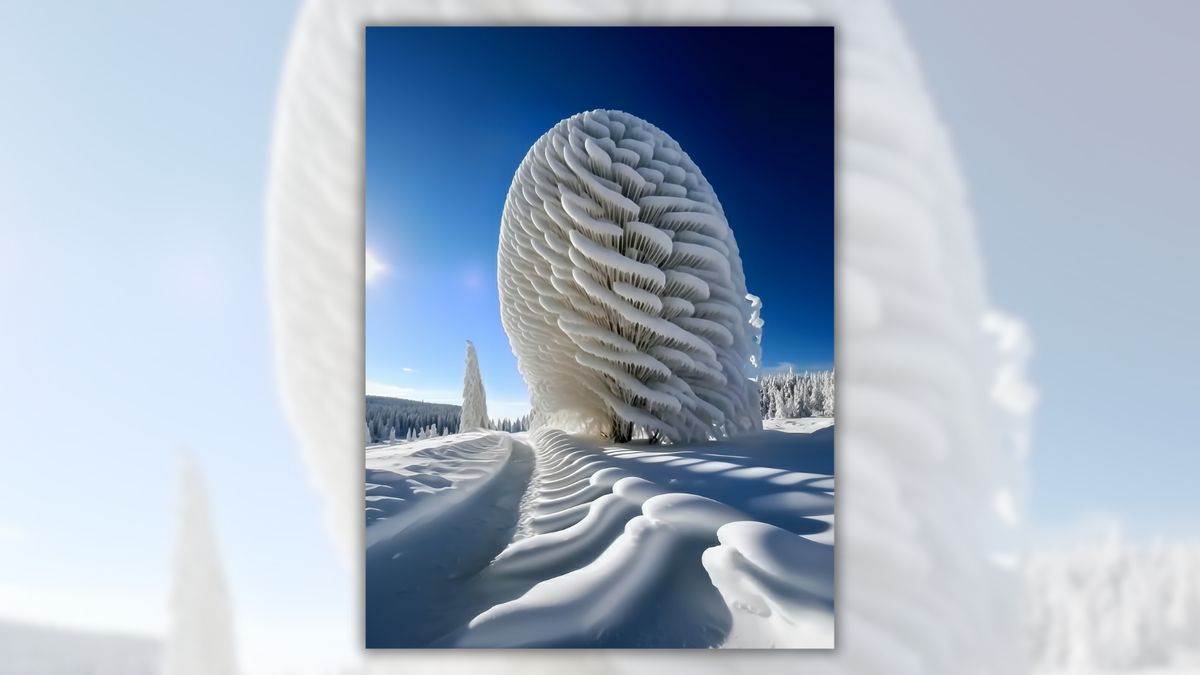
In a wave of winter-themed social media posts, an image claiming to show a tree in Alaska encased in ice has captured widespread attention across platforms, with users marveling at what was described as “a natural ice sculpture carved solely by the Alaskan winter.” However, digital forensic analysis reveals this striking image is entirely artificial.
The photograph, which depicts a tree with an unusual fungi-like ice formation, began circulating on Facebook, X (formerly Twitter), and Instagram in November 2023. While many viewers were captivated by its otherworldly beauty, others questioned its authenticity—and for good reason.
Several telltale signs expose the image as an AI-generated creation. Most notably, the branches at the bottom of the tree blur together unnaturally, a common artifact in AI-rendered images. Additionally, some ice tendrils appear disconnected from the main structure, defying physical laws of ice formation.
Lighting inconsistencies throughout the image further betray its artificial origins. Shadows don’t align with a consistent light source, and their shapes fail to accurately represent the spaces between branches. Perhaps most revealing is the absence of light reflection on the snow and ice surfaces—a physical impossibility in natural conditions, as snow is highly reflective.
Upon closer examination, faint black grid lines are visible around the tree’s edges, suggesting a structural framework was used in the image’s generation but not completely removed in the final rendering.
The image appears to have originated from a Facebook account called “Ethereal Earth,” which describes itself as a “digital creator” focused on “jaw-dropping views.” The page’s introduction includes a telling disclaimer that some images “may be depictions with sole purpose of sparking interest in Earth and especially nature” and uses the hashtag “artwork”—subtle acknowledgments that not all content is authentic.
When contacted about the image’s authenticity, Ethereal Earth had not responded at the time of reporting.
Digital forensic investigations support the conclusion that this is not a genuine photograph. A reverse-image search found no instances of the image before mid-November 2023, and no photographer was credited in any posts. The absence of shares from reputable nature or photography outlets further suggests it lacks authenticity.
Technical analysis using Hive Moderation, an AI-detection platform, determined with 99.5% confidence that the image was artificially generated. While such detection tools aren’t infallible, this high confidence rating, combined with the visual anomalies, provides compelling evidence of the image’s artificial origins.
This incident highlights a growing trend of AI-generated nature imagery being presented as authentic photographs on social media. Similar cases include fabricated images of a wolf protecting piglets from a mountain lion and a goose and bald eagle sharing a nest—both debunked after gaining significant traction online.
As AI image generation technology becomes increasingly sophisticated, distinguishing between authentic and artificial imagery grows more challenging. Experts recommend scrutinizing unusual or spectacular nature images for inconsistencies in physics, lighting, and texture—particularly when no credible photographer or source is cited.
The spread of such convincing but fabricated imagery raises important questions about digital literacy in an era where AI can create increasingly realistic-looking but entirely fictional depictions of our natural world.
For those wishing to verify suspicious nature photographs before sharing, digital literacy resources offer guidance on identifying common signs of AI generation, including unnatural blurring, lighting inconsistencies, and physically impossible elements.
Fact Checker
Verify the accuracy of this article using The Disinformation Commission analysis and real-time sources.

11 Comments
It’s fascinating how advanced AI technology has become, able to create such a convincingly realistic-looking scene. However, the lack of physical accuracy is a clear giveaway that this is not a genuine ice-encased tree.
Fascinating, this image seems too perfect to be real. I wonder what kind of technology was used to create such a convincing artificial ice sculpture?
Yes, the attention to detail is quite impressive. It’s a shame the image is not genuine, but I appreciate the insights into the technical analysis behind the deception.
Interesting to see how AI-generated imagery can be so convincing, yet still fall short of capturing the true physical nuances of a natural scene. Appreciate the thorough debunking of this viral image.
The lighting and branch inconsistencies are clear giveaways that this is an artificial creation, not a natural phenomenon. It’s a shame, as the image is quite visually striking.
You’re right, the technical flaws expose the illusion. Still, it’s an impressive feat of AI-generated imagery, even if not a true representation of nature.
While the image is visually striking, the technical flaws highlighted in the investigation make it clear this is an artificial creation, not a natural phenomenon. Good to know the truth behind the viral sensation.
Appreciate the thorough fact-checking here. It’s important to be skeptical of viral images, especially those that seem a bit too fantastical. Good to know the true origins of this one.
Absolutely, maintaining a critical eye when evaluating online content is crucial. Glad the investigation was able to uncover the AI-generated nature of this image.
Kudos to the digital forensic analysis that uncovered the true nature of this viral image. It’s a good reminder to always approach sensational online content with a healthy dose of skepticism.
The attention to detail in this AI-generated image is quite impressive, but the inconsistencies in lighting and physics give away its artificial nature. Good to have the facts straight on this viral sensation.