


Listen to the article
Viral Video of Trump and Clinton Proven to be AI-Generated Fake
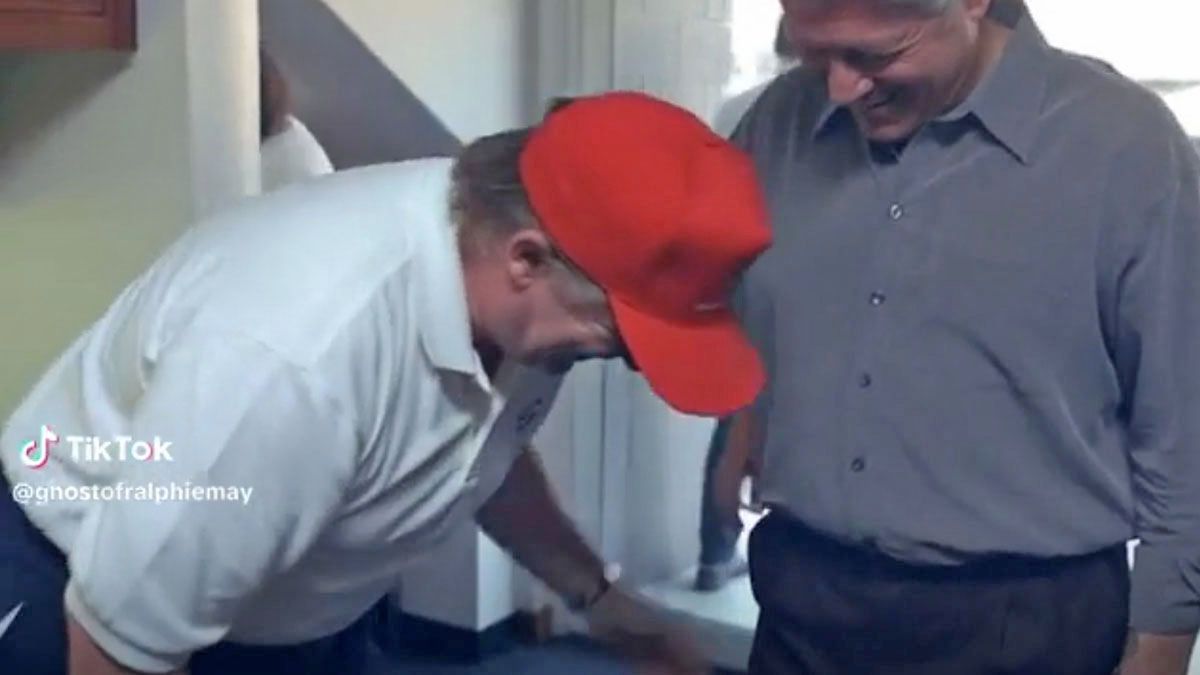
A video circulating widely on social media purportedly showing former President Donald Trump kneeling and kissing former President Bill Clinton’s crotch has been definitively determined to be fabricated using artificial intelligence, according to multiple sources familiar with the imagery.
The manipulated clip, which gained significant traction after being posted on Reddit’s r/TikTokCringe subreddit on November 16, garnered over 88,000 engagement points before moderators removed it for violating the forum’s “no politics” rule. The user who posted it, u/Future_PeterSchiff, claimed it had been shared on “a Russian discord server,” further fueling speculation about its origins.
Investigation reveals the video was created by using an AI tool to manipulate an authentic still photograph taken at the U.S. Open tennis tournament in Flushing Meadows, New York, on September 9, 2000. The original image shows Trump smiling with his hand appearing—due to the camera angle—to be positioned in front of Clinton’s crotch.
William Vasta, the White House photographer who captured the original still image, confirmed to fact-checkers that no inappropriate contact occurred during the event.
“I didn’t see any inappropriate contact there,” Vasta explained. “Trump was simply signaling to others in the room to gather for a group photo that included him, his guests, and Clinton. What you’re seeing in the still photo is just an outtake between handshakes and gestures.”
Vasta emphasized that no video footage of this moment exists, stating: “Any clips circulating on social media this week are fake. They used my still image to create them.”
The photograph’s authenticity and context have been further verified by Herbert Ragan, an archivist with the William J. Clinton Presidential Library and Museum, who confirmed the date, location, and photographer in correspondence with fact-checkers.
The falsified video emerged amid heightened public interest following the November 12 release of approximately 23,000 documents related to deceased sex offender Jeffrey Epstein. The U.S. House Committee on Oversight and Government Reform made these documents public after receiving them from Epstein’s estate.
Adding to the controversy, Democrats on the House Oversight Committee released three emails, including one suggesting Trump “knew about the girls” and another from Epstein to his confidant Ghislaine Maxwell claiming Trump “spent hours” with a sex-trafficking victim at Epstein’s house.
White House Press Secretary Karoline Leavitt responded to these developments, telling reporters, “The Democrats selectively leaked emails to the liberal media to create a fake narrative to smear President Trump.”
One particularly inflammatory email from Mark Epstein, Jeffrey Epstein’s brother, referenced asking former White House adviser Steve Bannon “if Putin has the photos of Trump blowing Bubba,” suggesting a sexual act. While some social media users interpreted “Bubba” as referring to Clinton, Mark Epstein explicitly denied this connection in a statement to The Advocate on November 16: “For the avoidance of doubt, the reference to ‘Bubba’ in this correspondence is not, in any way, a reference to former President Bill Clinton.”
The original AI-manipulated video has spawned similar fabricated content, including another digitally altered clip showing Trump repeatedly patting Clinton on his crotch at the same U.S. Open setting. These manipulated videos have spread across multiple platforms including Facebook, Instagram, Threads, and X.
The incident highlights the growing challenge of distinguishing between authentic and AI-generated content in political discourse, especially during periods of heightened political tension. Digital forensics experts continue to warn about the increasingly sophisticated nature of such fabrications and their potential to mislead public opinion.
Fact Checker
Verify the accuracy of this article using The Disinformation Commission analysis and real-time sources.

10 Comments
It’s concerning how easily manipulated media can spread and gain traction online. I’m glad the truth about this fabricated video has been brought to light. Verifying sources is so important, especially for sensitive political content.
Agreed, maintaining media integrity is crucial in our digital age. This case highlights the need for heightened scrutiny and diligence when it comes to viral content.
Thanks for the detailed fact-check on this video. It’s a good reminder that not everything we see online is real, especially when it comes to sensational political claims. Careful verification is essential to avoid spreading misinformation.
Absolutely, it’s important to be skeptical of eye-catching but unverified content, no matter how juicy it may seem. Kudos to the investigators for setting the record straight on this AI-generated forgery.
This seems like a classic case of misinformation and digital forgery. I’m glad the real origins of the video were traced and exposed. It’s a good reminder to be cautious about viral content, especially related to politics.
Absolutely, fact-checking is essential these days to combat the proliferation of fake news and AI-generated hoaxes. Kudos to the investigators for getting to the bottom of this.
Interesting, it’s good to see fact-checking efforts to verify the authenticity of viral content. Manipulated media can be so misleading, it’s important to be vigilant about these types of AI-generated fakes.
Definitely, it’s crucial to double-check sources and not spread unverified claims, even if they seem juicy. Maintaining credibility is key.
Fascinating to see the behind-the-scenes on how this manipulated video was created using AI tools. It’s a sobering example of the potential for digital deception. Fact-checking efforts like this are crucial for maintaining public trust.
Agreed, the proliferation of fake media is a major challenge. Rigorous verification is essential to combat the spread of misinformation, especially around sensitive political topics.