


Listen to the article
AI Detection Confirms Video of Italian Prime Minister Snubbing Netanyahu is Fake
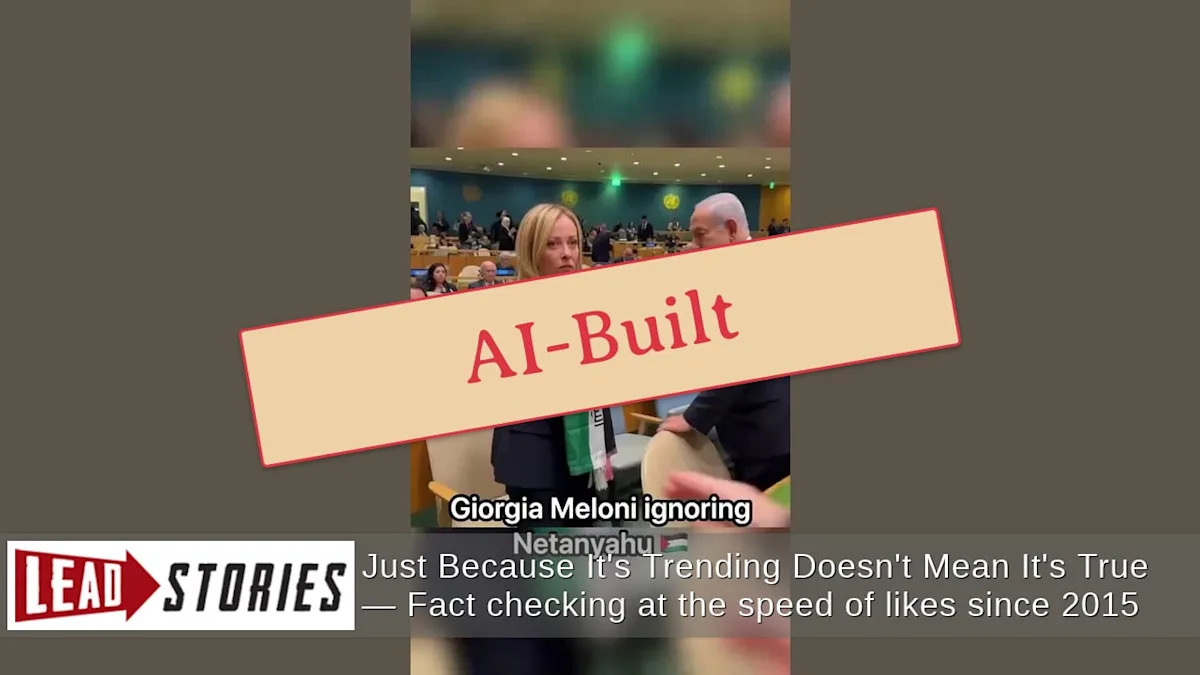
A video purportedly showing Italian Prime Minister Giorgia Meloni ignoring and walking away from Israeli Prime Minister Benjamin Netanyahu at the United Nations has been confirmed as artificially generated content, according to multiple verification methods.
The fabricated video began circulating on social media in late April when user @MrImranPk posted it on X (formerly Twitter). The clip quickly gained traction among users who believed it showed a genuine diplomatic slight amid heightened international tensions over the ongoing Israel-Hamas conflict.
However, analysis using the Hive Moderation AI-Generated Content Detection tool determined with 92.7% confidence that the video was artificially created. This sophisticated detection system, which evaluates visual inconsistencies and patterns typical of synthetic media, provided strong evidence against the video’s authenticity.
Further examination revealed critical architectural discrepancies in the supposed UN setting. The fake clip depicts the United Nations General Assembly Hall with a UN seal prominently displayed on a wall where no such emblem exists in the actual chamber. This detail alone provides compelling evidence of fabrication, as the real General Assembly Hall has a distinctly different layout and design that is well-documented through official UN imagery and virtual tours.
A thorough search of reputable news archives, including Google News and Yahoo! News, yielded no results for any incident matching the description of the video. Had such a politically charged encounter occurred between the leaders of Italy and Israel at the United Nations, it would have generated substantial media coverage across international news platforms.
The timing of this fabricated content coincides with a period of complex diplomatic relations between European nations and Israel. Italy, under Meloni’s leadership, has maintained generally supportive ties with Israel while also calling for humanitarian considerations in Gaza. The circulation of such synthetic media appears designed to suggest diplomatic fractures that do not actually exist.
This incident highlights the growing sophistication of AI-generated media and its potential to mislead public perception on geopolitical matters. As artificial intelligence tools become more accessible, distinguishing between authentic and fabricated content becomes increasingly challenging for average social media users.
Media literacy experts have repeatedly warned about the proliferation of synthetic media in political contexts. Dr. Claire Wardle, co-founder of the Information Futures Lab at Brown University, has described this phenomenon as “particularly dangerous during periods of international tension, when even small misrepresentations can inflame existing conflicts.”
For verification purposes, the United Nations offers extensive documentation of its General Assembly Hall, including a 360-degree virtual tour on its official YouTube channel and comprehensive imagery on its website. These resources provide reliable reference points against which to evaluate purported footage from UN proceedings.
As AI-generated content continues to proliferate across social platforms, fact-checking organizations and digital literacy advocates emphasize the importance of scrutinizing viral political content, especially videos showing dramatic diplomatic encounters that seem designed to provoke emotional responses.
This fabricated video of Meloni and Netanyahu represents a concerning trend in disinformation that leverages artificial intelligence to create convincing but entirely fictional political narratives.
Fact Checker
Verify the accuracy of this article using The Disinformation Commission analysis and real-time sources.

14 Comments
The fact that this video was detected as AI-generated content is a testament to the progress being made in synthetic media detection. Kudos to the verification team for their thorough investigation.
Exactly. The ability to quickly and accurately identify manipulated media is a critical capability in the fight against online misinformation.
Interesting to see the advanced AI detection tools used to verify the authenticity of this video. Glad they were able to identify it as fabricated content and prevent the spread of misinformation.
Agreed, it’s crucial to have robust systems in place to fact-check and debunk this type of synthetic media. Helps maintain trust in online information.
It’s reassuring to see that advanced AI-based detection tools were able to identify this video as a fake. Proactive fact-checking is key to combating the spread of misinformation.
Absolutely. The fact-checking process used in this case highlights the importance of leveraging cutting-edge technology to combat synthetic media.
It’s impressive to see the level of sophistication in the AI-based detection tools used to verify the authenticity of this video. Fact-checking is essential in today’s media landscape.
Absolutely. Leveraging advanced technologies to combat the rise of synthetic media is a crucial step in maintaining the integrity of information online.
The architectural discrepancies in the purported UN setting are a dead giveaway that this video was digitally manipulated. Good catch by the verification team.
Absolutely, the visual inconsistencies are a telltale sign of AI-generated content. Kudos to the fact-checkers for their diligence.
With the rise of deepfakes and other synthetic media, it’s critical that we have robust fact-checking capabilities to expose fabricated content. This is an important step in the fight against online misinformation.
Couldn’t agree more. The ability to quickly and accurately identify manipulated media is crucial for maintaining the integrity of information shared online.
Glad to see the disinformation commission taking a proactive approach to verifying the authenticity of this video. Maintaining trust in online information is crucial, especially around sensitive political topics.
Agreed. The detailed analysis and use of advanced AI-based tools to expose this fabricated content is commendable.