


Listen to the article
Brazilian authorities have confirmed that a viral video allegedly showing a physical altercation between soccer stars Neymar and Robinho Júnior is a sophisticated AI-generated fake that has spread rapidly across social media platforms.
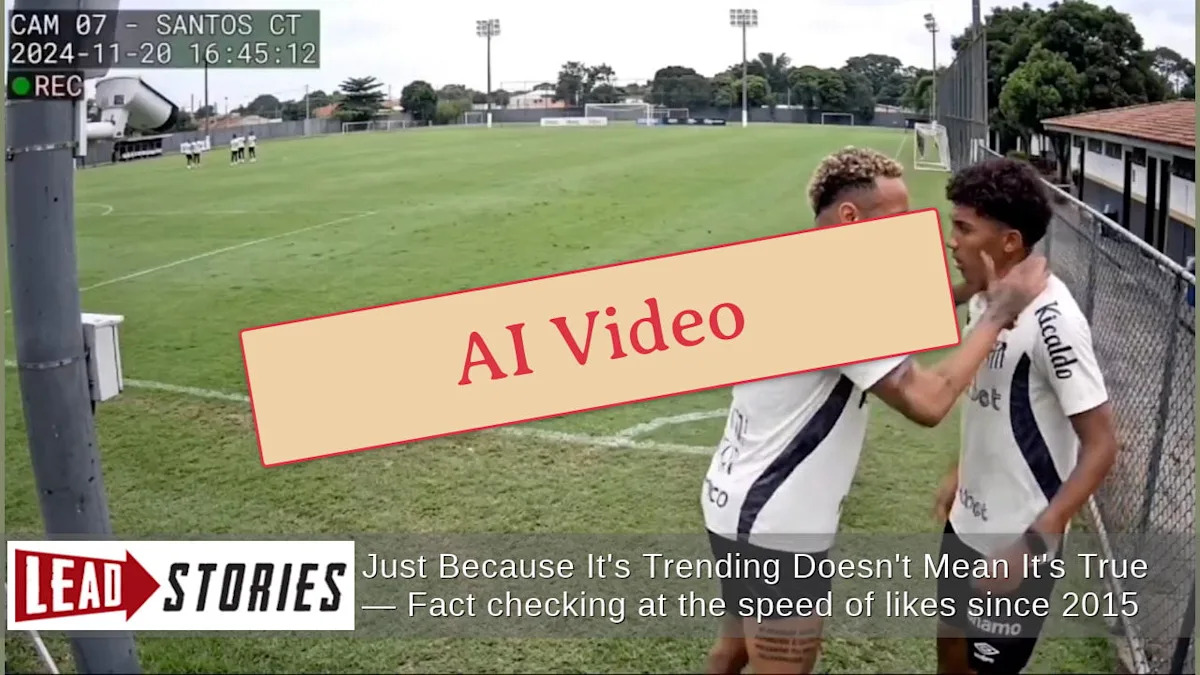
The 12-second clip, which first appeared on X (formerly Twitter) on May 5, 2026, purports to show security camera footage of Neymar assaulting Robinho Júnior during a Santos FC training session. The Arabic caption accompanying the video translates to: “Video of #Neymar’s assault on #Robinho’s son during #Santos training.”
Digital forensics experts quickly identified multiple inconsistencies that expose the video as an AI fabrication. The timestamp displayed in the top left corner of the footage shows November 20, 2024 – a date when Neymar wasn’t even with Santos FC. Official records confirm Neymar only rejoined his former club on January 28, 2025, after a 12-year absence, as reported by the Associated Press.
“This is a classic example of synthetic media being used to create divisive content,” said Dr. Elena Martinez, a digital media analyst at the São Paulo Institute of Technology. “The timing discrepancy alone should raise immediate red flags for viewers.”
Further technical analysis revealed additional telltale signs of AI manipulation. Throughout the entire 12-second clip, the timestamp remains frozen instead of advancing as it would in genuine security footage. Close examination of the video shows numerous visual anomalies characteristic of AI-generated content.
At the nine-second mark, the symbols on the shirt worn by the figure portrayed as Neymar appear as indecipherable glyphs rather than actual letters in any language. Even more revealing is a moment at the ten-second mark when the character meant to be Robinho Júnior appears to walk directly through a fence – a physical impossibility that betrays the video’s artificial nature.
The Hive Moderation AI detection tool, an industry-standard platform for identifying synthetic media, assessed the clip with 83.3% certainty as being AI-generated.
Santos FC released a statement condemning the fabrication: “We are disturbed by the proliferation of false content involving our players. Such manipulations damage reputations and undermine public trust in legitimate media.”
The incident highlights the growing challenge of AI-generated deepfakes in sports media. Soccer, with its passionate global fanbase and high-profile personalities, has become particularly vulnerable to such manipulations.
“What makes this example especially concerning is the cross-cultural element,” noted Carlos Duarte, a sports communication researcher at the University of Brasília. “The video originated with Arabic text targeting Portuguese-speaking athletes, potentially exploiting language barriers to spread misinformation across different fan communities.”
The Brazilian Football Confederation has announced plans to implement new verification protocols for training footage and is working with social media platforms to expedite the removal of confirmed fakes.
This incident comes amid a surge in AI-generated content across sports journalism. According to the International Sports Media Association, reported cases of fabricated athlete confrontations increased by 175% in the first quarter of 2026 compared to the same period last year.
Cybersecurity experts warn that as generative AI technology becomes more sophisticated, distinguishing between authentic and synthetic media will require increasing vigilance from both media organizations and consumers.
“The Santos fake demonstrates how AI can now create contextually plausible scenarios involving real public figures,” said Martinez. “The technology has progressed beyond obvious glitches to more subtle inconsistencies that require careful analysis to detect.”
Fans are advised to verify information through official team channels and established news outlets before sharing potentially manipulated content on social media.
Fact Checker
Verify the accuracy of this article using The Disinformation Commission analysis and real-time sources.

7 Comments
It’s disheartening to see how sophisticated AI-generated fakes have become. But I’m glad the experts were able to thoroughly investigate this video and expose it as an artificial fabrication.
Interesting that the timestamp on the video footage is clearly incorrect, indicating this is a fabricated clip. Kudos to the authorities and experts for quickly identifying the inconsistencies and exposing it as an AI-generated fake.
Yes, attention to detail like that timestamp discrepancy is crucial for spotting synthetic media. Glad the experts were able to analyze it thoroughly and debunk the false claim.
It’s troubling to see how easily misinformation can spread on social media these days. Fact-checking and digital forensics are so important to combat the rise of AI-generated fake content.
Absolutely. We all need to be vigilant consumers of online information and not blindly accept content at face value, no matter how convincing it may seem.
This is a concerning example of how AI-generated fake videos can be used to spread misinformation and sow division. It’s important that we all approach online content with a critical eye and verify information before sharing it.
This is a great example of why we need robust systems and expertise to identify AI-fabricated media. Kudos to the authorities for swiftly verifying the facts and shutting down this misleading narrative.