


Listen to the article
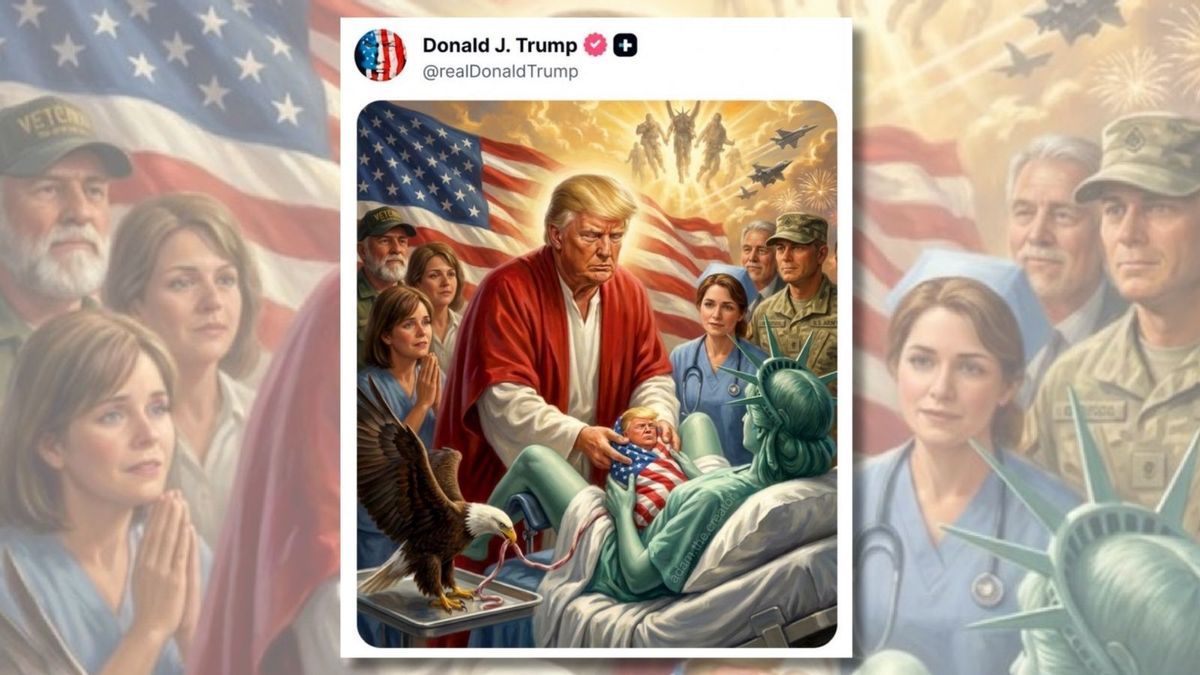
A viral social media post showing former President Donald Trump as a Jesus-like figure delivering a “baby Trump” from the Statue of Liberty has been confirmed as fake, despite its widespread circulation online in May 2026.
The image, which appeared to be a screenshot from Trump’s Truth Social account, shows the former president in white robes resembling traditional depictions of Jesus Christ, seemingly delivering a baby version of himself from a pregnant Statue of Liberty. The digitally created image quickly spread across multiple social media platforms, prompting questions about its authenticity.
Upon closer examination, fact-checkers identified a faint watermark on the image belonging to Instagram user “adam.the.creator,” the online identity of digital content creator Adam Padilla. This account has previously been associated with similar AI-generated and manipulated images that have gone viral online.
A thorough search of Trump’s Truth Social and X (formerly Twitter) accounts revealed no evidence that the former president ever shared this particular image. Archives of deleted posts likewise showed no trace of the controversial content. Had Trump actually posted such a provocative image, it would likely have generated significant media coverage beyond social media shares.
Padilla’s Instagram and Facebook accounts feature numerous examples of manipulated imagery, AI-generated content, and what his Facebook profile explicitly describes as “Daily memes and fake products from the mind of Adam Padilla.” Fact-checkers have previously debunked other fabricated images created by the same content creator.
While this specific image is confirmed to be fake, Trump has demonstrated a pattern of sharing similarly provocative AI-generated imagery in the past. In April 2026, he posted and then deleted an image depicting himself in Christ-like garments. When questioned by reporters, Trump claimed he thought the image portrayed him as a doctor rather than as Jesus.
In an earlier incident from May 2025, fact-checkers confirmed that Trump did post an AI-generated image of himself dressed as the Pope on his Truth Social account, further contributing to the blurring lines between authentic and manipulated imagery in political discourse.
The rapid spread of this fake image highlights growing concerns about the role of artificial intelligence in creating convincing but fabricated content that can quickly circulate through social media channels. The increasing sophistication of AI-generated imagery makes verification more challenging for average social media users.
Digital literacy experts point to this incident as part of a troubling trend where manipulated images featuring political figures can rapidly gain traction, regardless of their authenticity. The phenomenon is particularly relevant as the U.S. approaches another highly contentious election cycle, where the distinction between real and fake content may become increasingly important.
Social media platforms continue to struggle with developing effective policies to address AI-generated content that falsely depicts public figures in provocative or misleading scenarios, especially when such content achieves viral status before fact-checkers can intervene.
For consumers of online content, experts recommend looking for telltale signs of manipulation, such as watermarks, unusual lighting, or anatomical inconsistencies, and verifying controversial posts through official accounts or reputable news sources before sharing.
Fact Checker
Verify the accuracy of this article using The Disinformation Commission analysis and real-time sources.

11 Comments
While the image is attention-grabbing, I’m glad the fact-checkers were able to trace it back to a digital creator rather than an official Trump post. Misleading visuals like this can be damaging if taken as real.
Interesting fact check on this viral image. It’s important to verify the authenticity of online content, especially anything involving public figures. Digital manipulation can be quite convincing these days.
Agreed. The faint watermark and lack of evidence on Trump’s social media accounts suggest this was likely a digitally created image, not an official post.
Interesting to see the digital watermark and lack of evidence on Trump’s accounts confirming this as a fake image. Diligent fact-checking is crucial to maintain trust in online information.
It’s worrying to see how convincing AI-generated imagery can be these days. This case highlights the importance of critical thinking and fact-checking before sharing or believing online content.
Absolutely. With the rapid advancement of AI, manipulated media will likely become an even bigger challenge in the future. Staying vigilant is key.
This kind of misleading AI-generated content is concerning. It can spread quickly online and sow disinformation. Fact-checking is crucial to counter the spread of false or manipulated imagery.
Absolutely. We need to be vigilant about verifying the origins and authenticity of viral media, especially anything related to political figures.
Glad the authenticity of this viral image was investigated and debunked. Fact-checking is essential to combat the spread of misinformation, especially around high-profile political figures.
This case shows how quickly AI-generated and manipulated content can spread online. It’s a good reminder to always verify the source and authenticity of viral media before sharing or believing it.
Agreed. Fact-checking should be a reflex, not an afterthought, when it comes to potentially misleading online content.