


Listen to the article
Trump Gas Price Post Proven Fake: Social Media Hoax Debunked
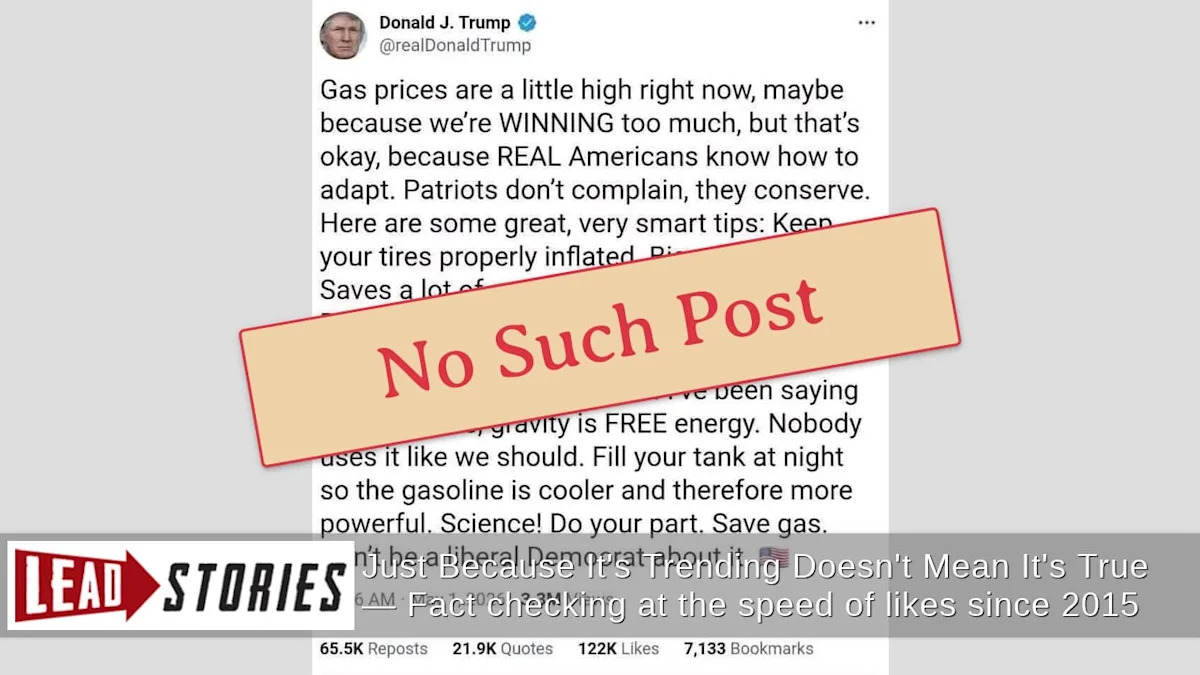
A fabricated social media post claiming that former President Donald Trump suggested Americans should “drive downhill” to “adapt” to high gas prices has been conclusively debunked as false.
The manufactured post, which circulated on X (formerly Twitter) beginning May 4, 2026, contained what appeared to be a screenshot of Trump making the outlandish recommendation. However, a thorough review of Trump’s verified social media accounts revealed no evidence of such a statement.
Fact-checkers identified several telltale signs exposing the post as counterfeit. Most notably, the fake screenshot displayed a blue verification checkmark next to Trump’s handle, whereas his authentic X accounts consistently show a gray checkmark – a critical discrepancy that immediately flags the content as inauthentic.
The fabricated nature of the post is further supported by the complete absence of any credible media coverage. A comprehensive search across Google News for the specific language used in the alleged statement yielded only a single result, which itself did not validate the post’s authenticity.
This type of digital misinformation represents a growing challenge in the political landscape, where fabricated content designed to appear legitimate can quickly spread across social platforms. The timing of such content is particularly significant as gas prices remain a politically sensitive issue in the United States.
Energy policy has long been a cornerstone of political discourse, with fuel costs directly affecting millions of American households. During his presidency, Trump frequently highlighted energy independence and lower gas prices as key accomplishments of his administration. Since leaving office, he has continued to criticize subsequent policies he claims have led to increased energy costs for consumers.
Digital literacy experts note that verification symbols, such as checkmarks on social media platforms, are often mimicked in fake posts to lend an air of legitimacy. However, careful observers can spot inconsistencies in formatting, verification symbols, or language patterns that don’t align with a public figure’s typical communication style.
The proliferation of such falsified content underscores the importance of media literacy and verification skills for social media users. Political misinformation typically intensifies during election cycles, when public interest in candidates’ positions on economic issues like fuel prices peaks.
Social media platforms have implemented various measures to combat misinformation, including improved verification systems and fact-checking partnerships. However, sophisticated digital forgeries continue to challenge these safeguards.
When encountering provocative political statements online, experts recommend checking multiple reliable sources before accepting or sharing the content. Official accounts, reputable news organizations, and dedicated fact-checking websites can help users distinguish authentic statements from fabrications.
The “drive downhill” hoax follows a pattern of fabricated quotes attributed to political figures designed to either ridicule them or create controversy. These manipulated statements often contain outlandish suggestions that would be implausible for any serious political figure to propose.
As digital communication continues to evolve, the responsibility for verifying information increasingly falls to individual users. Critical evaluation of sources, attention to verification indicators, and healthy skepticism toward inflammatory content remain the most effective defenses against the spread of digital misinformation.
Fact Checker
Verify the accuracy of this article using The Disinformation Commission analysis and real-time sources.

8 Comments
Good to see this fabricated post about Trump’s supposed fuel-saving advice has been conclusively debunked. It’s crucial to rely on verified information from credible sources.
Agreed. Social media hoaxes like this undermine public trust, so it’s crucial that outlets take the time to properly verify claims before reporting on them.
The lack of credible media coverage on this supposed Trump statement is a clear red flag. Thorough investigation is crucial to uphold journalistic standards.
Interesting fact check. It’s concerning how easily fake content can spread on social media these days. Fact-checking is so important to combat misinformation.
Glad to see this false claim was quickly shot down. Fact-checking is essential for maintaining the integrity of political discourse, especially around high-profile figures.
This serves as a good reminder to always be skeptical of sensational social media posts, no matter the source. Verified information from reputable outlets is key.
This highlights the need for greater digital literacy and critical thinking when it comes to evaluating content online. Simple verification checks can go a long way in identifying misinformation.
Well said. In the age of constant information overload, it’s more important than ever for people to develop skills to discern fact from fiction.