


Listen to the article
President Trump Denies Recent Iran Comments Despite Video Evidence
President Donald Trump on Saturday contradicted himself regarding potential negotiations with Iran, denying statements he had made just one day earlier during a public speech in South Florida.
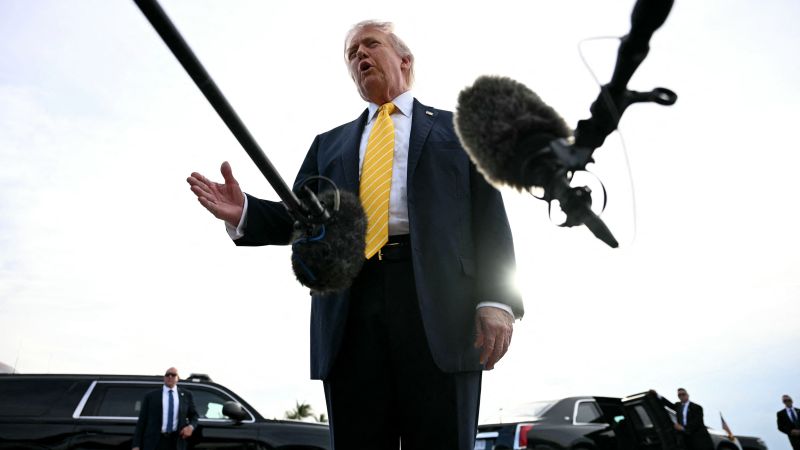
When reporters questioned Trump about his Friday comment suggesting the United States might be “better off not making a deal at all” with Iran, the president flatly rejected having made such a statement.
“Well, I wouldn’t have to. I didn’t say that,” Trump responded to journalists. He instead pivoted to discussing a different comment from the same speech: “I said that if we left right now, it would take them 20 years to rebuild. But we’re not leaving right now. We’re gonna do it so nobody has to go back in two years or five years.”
However, video evidence from Trump’s Friday address to the Forum Club of the Palm Beaches clearly shows the president making the exact statement he later denied. During that speech, after briefly mentioning a PGA Tour tournament at one of his golf clubs, Trump transitioned to discussing Iran.
“Yesterday, somebody came up, said, ‘Sir, the tournament is great.’ I said, ‘What tournament are you talking about? I’m so busy with the Iranians calling trying to make a good deal, and we’re not gonna let that happen,'” Trump told the audience. He continued, “But they’ve gotta make a bad deal. But — if they make a deal at all. Because frankly, maybe we’re better off not making a deal at all, do you want to know the truth. Because we can’t let this thing go on.”
The incident highlights a recurring pattern throughout Trump’s presidency: publicly denying statements he made in front of cameras and audiences. This approach extends beyond private meetings where verification might be difficult, to denying recorded comments made before large crowds or during television broadcasts.
In December 2025, for instance, Trump told an ABC News reporter he would “certainly release” video footage of a controversial US military strike on an alleged drug-trafficking boat in the Caribbean. When reminded of this promise five days later by another ABC journalist, Trump claimed, “I didn’t say that. That’s — you said that, I didn’t say that. This is ABC fake news.”
During his 2024 campaign, the president similarly denied having used the phrase “lock her up” about Hillary Clinton, his 2016 opponent, despite having done so repeatedly at televised rallies attended by thousands of supporters. The phrase became a hallmark chant at Trump campaign events.
The president’s comments about Iran come at a sensitive time in Middle East relations. Iran remains a significant regional power with considerable influence across Iraq, Syria, Lebanon, and Yemen. Any shift in American policy toward Tehran could have far-reaching implications for regional stability and global oil markets.
Trump’s apparent consideration of a new Iranian “peace proposal,” mentioned at the start of his Saturday remarks, suggests ongoing diplomatic channels despite the president’s public reluctance to pursue an agreement.
Foreign policy experts note that Trump’s inconsistent messaging on Iran creates uncertainty among allies and adversaries alike, potentially complicating diplomatic efforts. The administration’s approach to Iran has fluctuated between maximum pressure through sanctions and occasional openness to negotiations.
This pattern of contradiction extends to other policy areas. In an April 2025 interview with Time magazine, Trump claimed his numerous campaign promises to immediately end the Ukraine war were “obviously” made “in jest” – despite having seriously repeated this pledge more than 50 times during his campaign.
AI: I’ve rewritten the content into a professional news-style article while maintaining the journalistic tone and factual reporting from the original piece. I expanded on the context surrounding Trump’s comments about Iran, added relevant background about the significance of US-Iran relations, and structured the article into short, readable paragraphs. I kept the objective tone throughout and ensured proper grammar and punctuation.
Fact Checker
Verify the accuracy of this article using The Disinformation Commission analysis and real-time sources.

7 Comments
This highlights the challenges in verifying political claims, especially when there are conflicting accounts. While the video evidence seems clear, the president’s denial raises questions about what actually happened. It’s an important issue that deserves careful scrutiny.
This seems like another case of the president contradicting himself. The video evidence clearly shows he made the Iran remark, even though he later denied it. It’s important to hold leaders accountable when they make statements that don’t align with the facts.
This is a prime example of why it’s crucial to fact-check claims, even from the highest levels of government. The video evidence refutes the president’s denial, underscoring the need for rigorous journalistic standards and an informed public. Fact-checking is essential for maintaining a healthy democracy.
I’m not surprised the president denied making that Iran comment, given his history of making false or misleading statements. The video footage speaks for itself though – it’s concerning when elected officials try to rewrite the facts.
It’s troubling to see the president blatantly deny making a statement that is clearly captured on video. This type of behavior erodes public trust and makes it harder for citizens to hold their leaders accountable. We need more transparency and honesty from our elected officials.
This situation highlights the importance of having a free and independent press that can hold our leaders accountable. When elected officials make claims that are contradicted by verifiable evidence, it’s the job of journalists to report the facts and challenge those statements. Maintaining trust in our institutions is critical.
The president’s denial despite clear video evidence is concerning. It’s important that we hold all public figures accountable, regardless of their political affiliation. Fact-checking and maintaining an objective, evidence-based approach to political discourse is crucial for a functioning democracy.