


Listen to the article
False Claims Circulate About President Marcos During Korean State Visit
A misleading Facebook post accusing Philippine President Ferdinand Marcos Jr. and First Lady Liza Araneta-Marcos of disrespecting the national anthem during an official state visit has gained significant traction on social media, despite being demonstrably false.
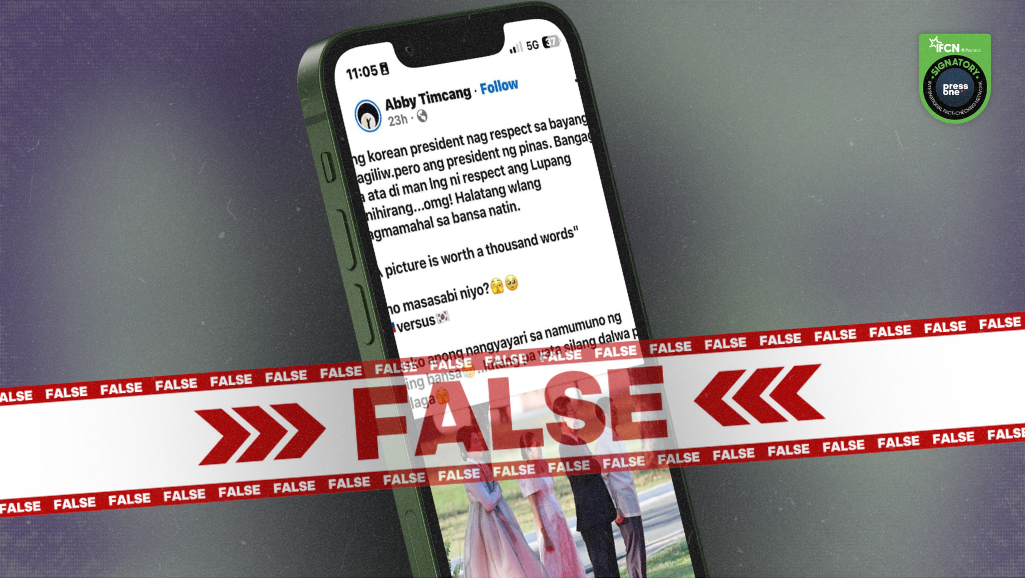
The post, which has amassed over 97,000 reactions, 8,000 comments, and 6,000 shares since being uploaded on March 4, features a screenshot from Radio Television Malacañang’s (RTVM) official livestream of South Korean President Lee Jae-myung’s state visit to Malacañan Palace on March 3.
The caption accompanying the image falsely claims, “The Korean president respected the Bayang Magiliw, but the president of the Philippines, I think he is foolish, he didn’t even respect [the] Lupang Hinirang…omg! It’s obvious that he doesn’t love our country.”
However, fact-checking reveals the post misrepresents the context of the image. The screenshot was taken during the playing of the South Korean national anthem, not the Philippine national anthem. This explains why President Lee and his wife are shown saluting while President Marcos and the First Lady are standing at attention—following diplomatic protocol during the ceremony.
Review of the complete RTVM livestream confirms that President Marcos and the First Lady did properly salute during the playing of “Lupang Hinirang,” the Philippine national anthem, in accordance with customary protocol for such diplomatic functions.
The misleading post appeared just one day after President Lee’s arrival in the Philippines for his state visit, which marked a significant diplomatic milestone. This was the first presidential state visit since the Philippines-South Korea Free Trade Agreement came into effect on December 31, 2024—a pact expected to strengthen economic ties between the two Pacific allies.
South Korea remains one of the Philippines’ most important trade partners in Asia, with bilateral trade valued at approximately $15 billion in 2023. The state visit included discussions on enhancing cooperation in defense, technology transfer, infrastructure development, and cultural exchanges.
The viral nature of the post highlights ongoing challenges with misinformation on social media platforms in the Philippines, particularly content targeting political figures. Facebook user “Abby Timcang,” who shared the misleading post, has over 9,000 followers, giving the false claim substantial reach across Filipino social media networks.
This incident occurs against a backdrop of increasing concern about political misinformation in the Philippines, which has one of the highest social media usage rates globally. According to recent studies from the Reuters Institute and Oxford University, the Philippines continues to struggle with coordinated disinformation campaigns and politically motivated false content, particularly around major diplomatic events and political milestones.
Media literacy experts recommend that social media users verify information through official government channels and reputable news organizations before sharing potentially inflammatory content. The Presidential Communications Office has previously urged citizens to rely on official livestreams and communications for accurate information about state events.
The misleading post about the national anthem incident demonstrates how easily out-of-context images can be manipulated to create false narratives, particularly when they align with existing political viewpoints or trigger emotional responses related to national symbols.
Fact-checking organizations continue to monitor social media for similar misleading content surrounding high-profile diplomatic engagements as the Philippines strengthens its international partnerships across the Asia-Pacific region.
Fact Checker
Verify the accuracy of this article using The Disinformation Commission analysis and real-time sources.

7 Comments
Good to see the facts confirmed. It’s disappointing when false narratives gain traction on social media. Fact-checking efforts like this help combat the spread of misinformation.
Appreciate the diligence in debunking this misleading claim. Maintaining proper protocol and etiquette is crucial during high-level diplomatic visits. Glad the leaders upheld the expected courtesies.
This clarifies the situation well. It’s easy for misinformation to spread online, so it’s good to see the facts laid out. Glad the national anthems were properly respected during the diplomatic event.
Interesting fact-check on the recent state visit. It’s important to have the full context before jumping to conclusions about any perceived disrespect. I appreciate the thorough investigation into the details.
Appreciate the objective analysis here. Proper protocol during diplomatic visits is important, and it’s good to see the details confirmed.
This is a great example of responsible fact-checking. Clearing up misinformation and providing the full context is valuable, especially for politically-charged topics.
This type of thorough fact-checking is really valuable. It’s easy for partial information or out-of-context screenshots to be misconstrued online. Glad the full details were investigated here.