


Listen to the article
False Claims Circulate About Karen National Union Protecting Scam Operations
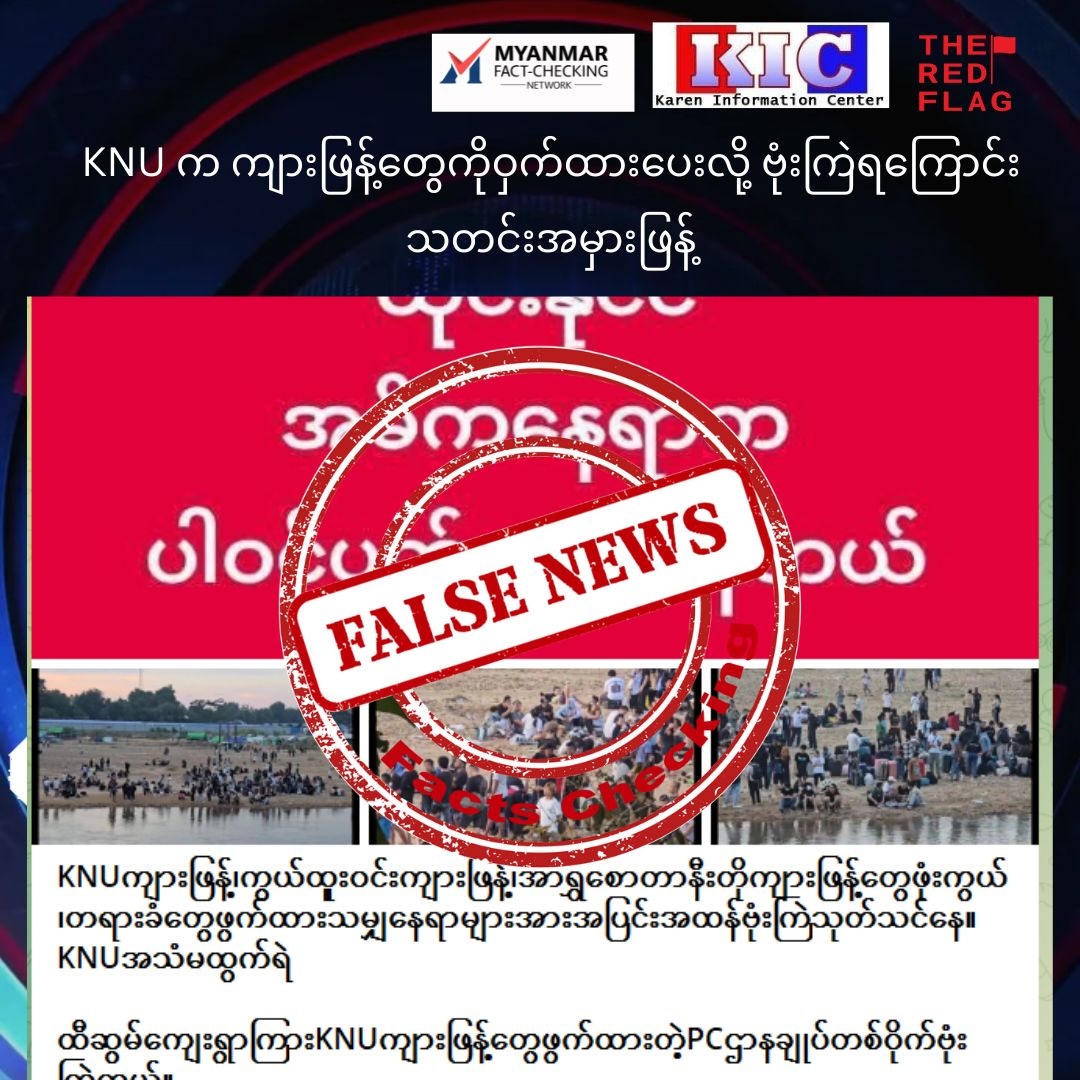
Misinformation regarding the ongoing conflict in Karen State spread rapidly across social media platforms last week, falsely claiming that Myanmar’s military junta had bombed Lay Kay Kaw Town in Myawaddy Township because the Karen National Union (KNU) was allegedly harboring telecommunications scam operations.
The Karen Information Center (KIC), a member of the Myanmar Fact-Checking Network, has thoroughly investigated these claims and determined them to be entirely fabricated.
The false narrative began circulating on November 27 when a Facebook account named “Ayeyarwady May” posted allegations that the junta was conducting airstrikes specifically to target fraudulent businesses, known locally as “Zhapian” operations, that were supposedly linked to the KNU. The post featured three photographs showing people gathered near the Thaungyin (Moei) River, which forms the natural border between Thailand and Myanmar.
This misinformation quickly spread to pro-junta channels on Telegram, where it received significant engagement, garnering over 3,000 views and approximately 100 reactions.
Fact-checkers conducted reverse image searches on the photographs accompanying these posts, revealing that they actually depicted Zhapian workers who had fled to the riverbank due to the junta’s military offensive against resistance forces in the area. These individuals were stranded there because Thai authorities had not yet granted them permission to cross into Thailand. The images had originally been published by Thai news outlet Amarin News earlier that same day.
Several reputable local media organizations, including Than Lwin Times, Network Media Group, Mizzima, and KIC, have documented the situation of these stranded workers who were unable to cross into Thailand after fleeing the military’s offensive.
The actual sequence of events differs significantly from the junta-aligned narrative. On November 21, the KNU and allied groups unexpectedly discovered a secret telecommunications scam compound near Min Let Pan Village in Myawaddy Township. According to Myanmar Now, this compound had been operating under the protection of the Democratic Karen Benevolent Army (DKBA), which is aligned with the military junta.
Following this discovery, the KNU began detaining workers, systematically collecting evidence of the fraudulent operations, and coordinating with relevant authorities. On November 25, the KNU publicly announced that it had taken control of the scam compound and was conducting follow-up operations while seeking international cooperation to combat such criminal activities.
It was after this announcement that the junta intensified its ground assaults, artillery shelling, and airstrikes targeting the area – not because the KNU was protecting scam operations, but because it had exposed and shut down one.
BBC, The Irrawaddy, People’s Spring, and KIC have all reported on the escalation of military attacks following the KNU’s public disclosure of the scam operation’s existence and the evidence they had gathered.
The KNU has been transparent in its actions, releasing a series of updates detailing conditions inside the scam compound, including information about the workforce, operational methods, and coordination efforts with Thai authorities. These detailed reports further undermine the baseless claims that KNU leaders were protecting the criminal networks.
This case illustrates a concerning pattern of deliberate misinformation surrounding the conflict in Myanmar. While the junta did indeed carry out airstrikes in the Min Let Pan area, the context and motivation for these attacks were deliberately misrepresented to mislead the public and potentially discredit the KNU, one of Myanmar’s oldest ethnic armed organizations fighting against military rule.
In an information landscape increasingly clouded by misinformation, the Myanmar Fact-Checking Network encourages social media users to verify information with reliable fact-checking organizations before sharing potentially false content. The organization maintains an active website and Facebook page where citizens can request verification of questionable claims circulating in Myanmar’s complex and often opaque information environment.
Fact Checker
Verify the accuracy of this article using The Disinformation Commission analysis and real-time sources.

8 Comments
This report underscores the need for caution when evaluating social media claims, especially related to sensitive political and military issues. Fact-based journalism is crucial.
It’s troubling to see false narratives spreading so rapidly, even around serious events like airstrikes. Rigorous fact-checking is essential to counter the spread of misinformation.
This report highlights the importance of scrutinizing social media narratives, especially during times of political unrest. Spreading unverified claims can exacerbate tensions.
Absolutely. Thorough investigations by local media outlets are crucial for separating fact from fiction in these situations.
Fascinating to see these claims about the Myanmar junta’s actions debunked. It’s important to have reliable fact-checking on complex regional conflicts like this one.
The Karen National Union’s alleged role in sheltering telecommunications scams is a concerning allegation, but it’s good to see it was thoroughly debunked. Fact-checking is essential.
I appreciate the diligent efforts of the Myanmar Fact-Checking Network to verify the details around this incident. Transparency is key during complex conflicts.
Agreed. Cutting through misinformation with reliable information is vital for maintaining public trust and understanding.