


Listen to the article
Walmart Removes Nazi Symbolism T-Shirt After Social Media Outcry
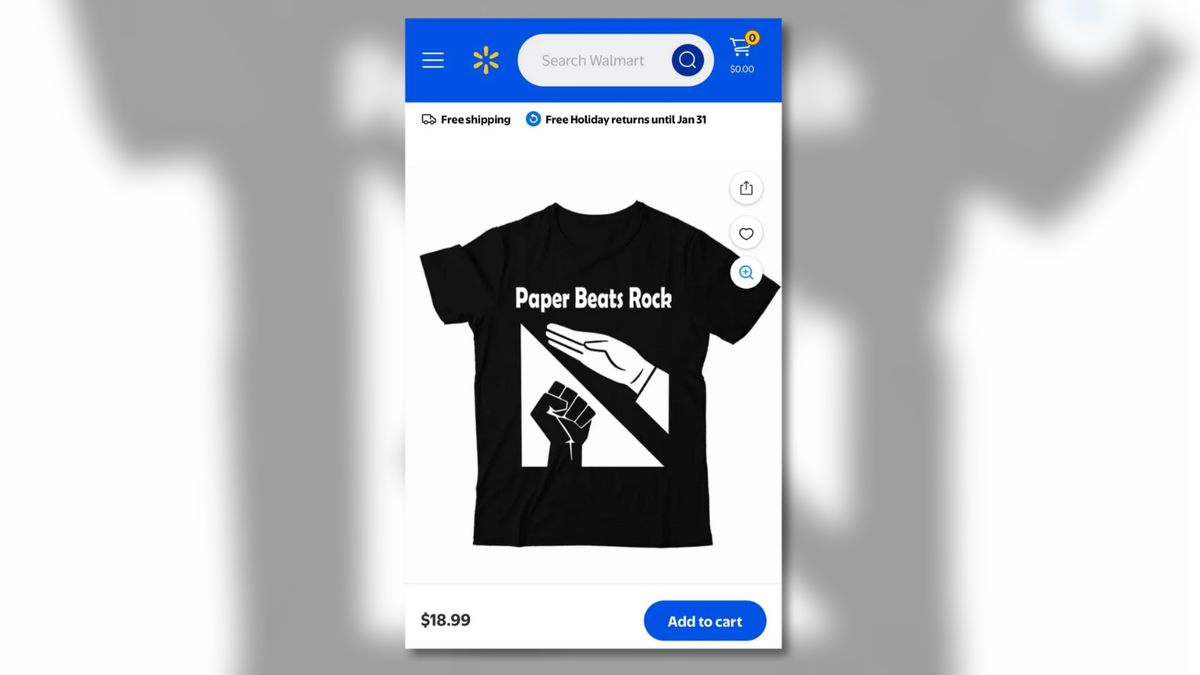
Multiple third-party sellers on Walmart.com were discovered listing a shirt featuring Nazi symbolism in November 2025, prompting swift backlash across social media platforms and eventual removal of the offensive merchandise.
The controversial shirt depicted a Nazi salute positioned above a raised fist with the caption “paper beats rock” – a disturbing play on the children’s game referencing the supremacy of fascism over social justice movements. The imagery represents an explicit violation of Walmart’s prohibited products policy, which bans items associated with Nazism and those promoting intolerance based on race, ethnicity, or other protected characteristics.
After users began widely sharing images of the listing online, a grassroots reporting campaign quickly emerged. Social media communities, particularly on platforms like Reddit, mobilized to report the offensive merchandise to Walmart directly. The r/MarchAgainstNazis subreddit organized efforts by sharing the retailer’s contact information and online reporting forms to expedite removal of the listings.
By November 10, all instances of the shirt had been removed from Walmart’s online marketplace. A Walmart spokesperson confirmed to Left Coast Right Watch, a publication covering politics and extremism, that “the items in question were listed by a third-party seller and have been removed from our site for violating our prohibited products policy.”
The shirt’s symbolism intentionally juxtaposed two politically charged gestures. The “paper” referenced the notorious Nazi salute, performed by extending the right arm upward at an angle with the palm facing down. The “rock” symbolized the raised fist most prominently associated with the Black Power movement, though it has been adopted by various activist groups across the political spectrum throughout history.
The caption “paper beats rock” implied that Nazism or fascism would triumph over social justice and civil rights movements – a message clearly intended to promote hateful ideology.
This incident highlights ongoing challenges faced by major retailers who operate third-party marketplaces on their platforms. While companies like Walmart have established policies prohibiting hateful merchandise, their massive online ecosystems can be difficult to monitor comprehensively, allowing prohibited items to occasionally appear for sale.
This isn’t the first time Walmart has faced controversy over far-right merchandise appearing on its platform. In September 2024, the retailer removed shirts associated with Skrewdriver, a white nationalist band, after similar public outcry.
The Nazi salute has been a particularly sensitive symbol in recent months. Earlier in 2025, tech billionaire Elon Musk stirred controversy at President Trump’s inauguration rally when he made a gesture some observers compared to the fascist salute, though interpretations of his intent varied widely.
Walmart has not publicly addressed how the offensive merchandise initially made it through their vetting process or what measures they might implement to prevent similar incidents in the future. As of publication time, the company had not responded to inquiries about their third-party seller vetting procedures or content moderation systems.
The incident demonstrates both the ongoing challenge of moderating vast online marketplaces and the effectiveness of coordinated social media campaigns in quickly identifying and reporting prohibited content. It also reflects the heightened sensitivity around extremist symbolism in the current political climate, where such imagery can rapidly trigger widespread backlash.
For major retailers, the incident serves as a reminder of the brand damage that can occur when their platforms are used to distribute offensive or hateful merchandise, even when listed by third-party sellers rather than the company itself.
Fact Checker
Verify the accuracy of this article using The Disinformation Commission analysis and real-time sources.

9 Comments
While it’s positive that Walmart removed this offensive merchandise, the fact that it was listed at all points to deeper issues around content moderation and vetting of third-party sellers. Retailers need to be proactive in weeding out hateful and extremist content.
This is a concerning incident that no retailer should ever allow. Promoting Nazi imagery and ideology is never acceptable, no matter the context. I’m glad Walmart took swift action to remove these offensive listings once alerted by the public.
It’s disturbing to see this kind of hateful merchandise being sold, even briefly, on a major platform. Kudos to the social media communities that mobilized quickly to report this and get it taken down. We must remain vigilant against the normalization of extremism.
Absolutely. Retailers have a responsibility to thoroughly vet their third-party sellers and listings to prevent the spread of hateful, dangerous content like this. Proactive monitoring and removal policies are critical.
While I’m glad Walmart removed this shirt, the fact that it was listed in the first place is very concerning. We need stronger safeguards to prevent the sale of Nazi-related merchandise across all e-commerce platforms. This kind of content should never make it to market.
I agree. Retailers need to do more to screen for and preemptively block this type of content before it ever reaches their sites. Robust content moderation and clear policies banning hate symbols are essential.
This incident highlights the ongoing challenges of policing user-generated content and third-party listings on e-commerce sites. While Walmart acted quickly, the initial lapse is worrying. Improved AI-powered moderation and human review processes are needed to stay ahead of hateful actors.
This is a very concerning incident that underscores the ongoing battle against the spread of hateful ideologies, even in unexpected places like mainstream retail platforms. Kudos to the public for the quick response, but stronger preventative measures are clearly needed.
Seeing Nazi imagery being used in this way, even briefly, is deeply disturbing. I’m glad the public outcry led to a swift response, but this shows how vigilant we must remain to counter the normalization of extremism, even in unexpected places.