


Listen to the article
As Lexington residents prepare to choose their next mayor, a heated exchange has emerged between candidates over a significant decision regarding the future location of city hall.
During a recent debate, incumbent Mayor Jane Thompson defended her administration’s plan to relocate city hall to a newly developed downtown area, while challenger Robert Mercer criticized the decision as fiscally irresponsible and lacking transparency.
“The current facility has outlived its useful life,” Thompson said during the forum hosted by the Lexington Chamber of Commerce. “Our analysis shows renovation costs would exceed $12 million, while the new location offers better access for citizens and will serve as an anchor for downtown revitalization.”
Mercer countered that the projected $18 million price tag for the new building represents wasteful spending at a time when residents are concerned about rising property taxes. “We’re talking about millions in taxpayer dollars for a vanity project when our infrastructure needs urgent attention,” he said.
The controversy stems from a city council vote in June that approved the purchase of three acres of land in the developing River District for the new municipal complex. The measure passed 4-3 along faction lines that have defined local politics in recent years.
City records show the current city hall, built in 1974, requires significant repairs to its HVAC system and roof, along with accessibility upgrades to meet modern standards. A consultant’s report commissioned in 2021 estimated renovation costs between $9.8 million and $12.3 million, depending on the scope of work.
Thompson points to potential economic benefits of the relocation, citing studies from similar-sized municipalities that experienced increased commercial activity following the placement of government buildings in strategic development zones. “This isn’t just about a building—it’s about creating a vibrant downtown core that attracts businesses and residents,” she said.
Local business leaders have largely supported the move. “Having city hall anchor the River District will bring foot traffic that small businesses need to thrive,” said Elena Martinez, owner of Riverside Café and board member of the Downtown Business Alliance.
However, community groups including the Taxpayers Association of Lexington have rallied behind Mercer’s position. “We’ve collected over 2,000 signatures from residents who want this decision reconsidered,” said association president William Fairchild. “People feel this was rushed through without adequate public input.”
The dispute has highlighted deeper divisions about Lexington’s growth trajectory. The city of 68,000 has seen its population increase by 15% over the past decade, creating tensions between development interests and residents concerned about maintaining the community’s character.
Urban planning experts note that municipal building decisions often carry outsized significance. “City halls are symbolic structures that represent local government’s relationship with citizens,” said Dr. Katherine Reynolds, professor of urban planning at State University. “Their location sends powerful messages about priorities and accessibility.”
Beyond the financial considerations, the candidates differ on timing. Thompson argues that construction costs will only increase if the project is delayed, while Mercer advocates pausing for additional community engagement.
“If elected, I will immediately call for a citizen advisory panel to review all options, including renovation of the existing building,” Mercer promised.
The city’s finance director, James Wilson, confirmed that funding for the project would come primarily from municipal bonds, with debt service adding approximately $1.2 million annually to the city’s budget over 20 years.
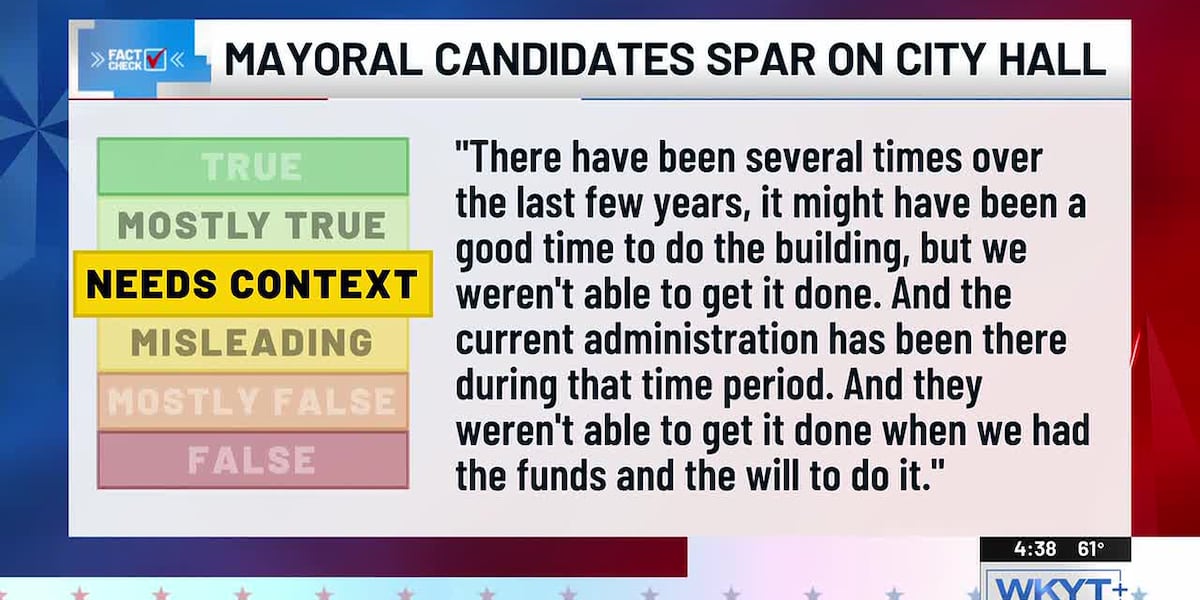
Fact-checking statements from both candidates reveals some discrepancies. Thompson’s claim that the current building is “beyond repair” overstates the consultant’s findings, which indicated renovation was feasible though costly. Meanwhile, Mercer’s assertion that the project would require “the largest tax increase in city history” is not supported by budget projections, which show the debt could be serviced without raising the tax rate.
As the November 5 election approaches, voters will weigh competing visions for Lexington’s future, with the city hall decision serving as a tangible representation of broader perspectives on growth, fiscal responsibility, and governance.
A recent poll conducted by the Lexington Tribune shows the race in a virtual tie, with 47% supporting Thompson, 45% backing Mercer, and 8% undecided.
Fact Checker
Verify the accuracy of this article using The Disinformation Commission analysis and real-time sources.

5 Comments
As someone who frequently visits city hall, I can appreciate the desire for improved accessibility and a more modern facility. However, the high price tag is concerning, and I share the challenger’s skepticism about whether this is the right priority given other infrastructure needs. I hope the candidates can find common ground on a fiscally responsible solution.
This debate highlights the challenge of balancing fiscal responsibility with strategic investments in a city’s infrastructure and development. I appreciate the mayor’s perspective on addressing the current facility’s limitations, but the challenger also raises valid concerns about the budget implications. Objective data on the long-term impacts would help clarify the best path forward.
The decision to relocate city hall is a complex one with arguments on both sides. While the incumbent mayor cites the need for better access and downtown revitalization, the challenger raises legitimate concerns over the price tag and whether it’s the best use of taxpayer funds. Transparency around the full costs and projected benefits would be important for residents to evaluate.
This is an interesting debate over the relocation of the city hall. Both sides seem to have valid points – the current facility may need costly renovations, but the new building could also be seen as an unnecessary expense. It would be helpful to see a detailed cost-benefit analysis to better understand the tradeoffs.
As a resident, I’m curious to learn more about the specific plans and projected outcomes for this city hall project. The costs seem high, but if it truly improves access and supports downtown redevelopment, it could be worthwhile. I hope the candidates can provide more detailed information to help citizens make an informed decision.