


Listen to the article
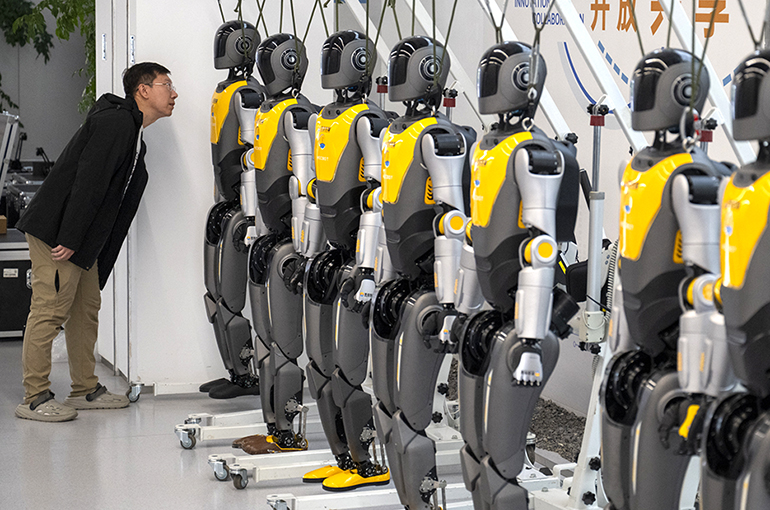
Chinese robotics firms are dismissing concerns about potential overcapacity in the nation’s burgeoning humanoid robot sector, following a cautionary report from Goldman Sachs that questioned the industry’s aggressive production plans against current market demand.
The Goldman Sachs report, which surveyed nine Chinese humanoid robot supply chain companies including Sanhua Intelligent Controls and Tuopu Group, noted that none had secured substantial orders or provided concrete timelines for mass production. Despite this, these companies are rapidly expanding their production capabilities, with estimated annual robot production ranging from 100,000 to 1 million units per company.
This expansion appears ambitious when measured against Goldman Sachs’ global humanoid robot shipment forecast of just 1.38 million units by 2035, raising red flags about potential overcapacity in the sector.
When approached by Yicai, a representative from Tuopu Group acknowledged the current lack of confirmed orders but defended their capacity planning. “Our production capacity planning is arranged based on the capacity guidance provided by major clients in North America,” the representative explained. Tuopu, a Ningbo-based automotive parts manufacturer, is establishing production lines for humanoid robot components across Thailand, Mexico, and the United States, with its Thailand facility alone targeting an annual production capacity of up to 1 million units.
“We can only prepare according to our clients’ requirements. Otherwise, we would face the situation of being unable to fulfill orders,” the Tuopu representative added, highlighting the supply chain’s need to be ready for potential surges in demand. “As for whether future orders will be below or exceed our capacity, currently, no one knows.”
Industry analysts interviewed by Yicai suggest that concerns about overcapacity may be premature. They point out that overcapacity typically becomes an issue in mature industries, whereas humanoid robotics remains in its developmental infancy. The proactive capacity planning by supply chain companies represents strategic positioning for an anticipated market that is still defining its technological pathways and applications.
The optimism surrounding humanoid robots extends well beyond China’s borders. Tesla CEO Elon Musk recently told shareholders that humanoid robots will become “the largest-scale product in history,” with a future market potentially reaching billions of units. Tesla itself plans to launch a production line next year with an annual capacity of 1 million humanoid robots, with ambitions to scale to 10 million units at a future Austin facility.
Chinese domestic forecasts are similarly bullish. The China Academy of Information and Communications Technology projects that the number of humanoid robots in use within China will exceed 100 million units by 2045, creating a market worth approximately CNY10 trillion (USD1.4 trillion).
Jiang Lei, chief scientist at the National and Local Co-Built Humanoid Robotics Innovation Center, offered additional perspective on the sector’s economic potential. According to Jiang, the value of the humanoid robot industry extends far beyond hardware manufacturing. “Embodied intelligence models will have to be developed for robots and a huge amount of data will be generated during their use,” he noted. These two aspects—AI models and data generation—may ultimately become the primary drivers of value in the industry.
As the sector continues to evolve, the gap between current production capacity and market demand will be closely watched by investors and industry observers alike. For now, Chinese manufacturers remain committed to building capacity in anticipation of what they believe will be explosive future demand for humanoid robots across global markets.
Fact Checker
Verify the accuracy of this article using The Disinformation Commission analysis and real-time sources.

10 Comments
It’s encouraging to see the industry defend their capacity planning, even in the face of caution from analysts. This suggests they have a strong grasp of their target markets and growth potential.
This highlights the challenge of balancing near-term realities with long-term projections in a rapidly advancing field like robotics. The industry’s confidence is notable, but the potential for overcapacity is a valid concern.
The potential for overcapacity is certainly something to monitor closely. However, the industry’s confidence in future demand from major clients suggests they see strong long-term prospects for humanoid robots.
You’re right, the industry’s insights into their client relationships provide an important counterpoint to the Goldman Sachs concerns. Time will tell how the market evolves.
It’s interesting to see the industry’s perspective on robot manufacturing capacity. While caution is warranted, a long-term view is also needed as robotics technology continues to advance rapidly.
That’s a fair point. Striking the right balance between near-term realities and future potential will be key for sustainable growth in this sector.
The industry’s insights into their client relationships provide valuable context that isn’t always captured in top-down market analyses. This underscores the importance of considering multiple perspectives on emerging technology sectors.
The industry’s perspective provides an interesting counterpoint to the Goldman Sachs report. It will be important to monitor this sector closely as the technology and market dynamics continue to evolve.
I’m curious to see how the humanoid robot market develops in the coming years. The rapid expansion in production capacity is bold, but may pay off if the industry’s forecasts for demand materialize.
Agreed, it’s a high-stakes bet. The industry seems optimistic, but caution is still warranted given the scale of the capacity increases versus current demand.