


Listen to the article
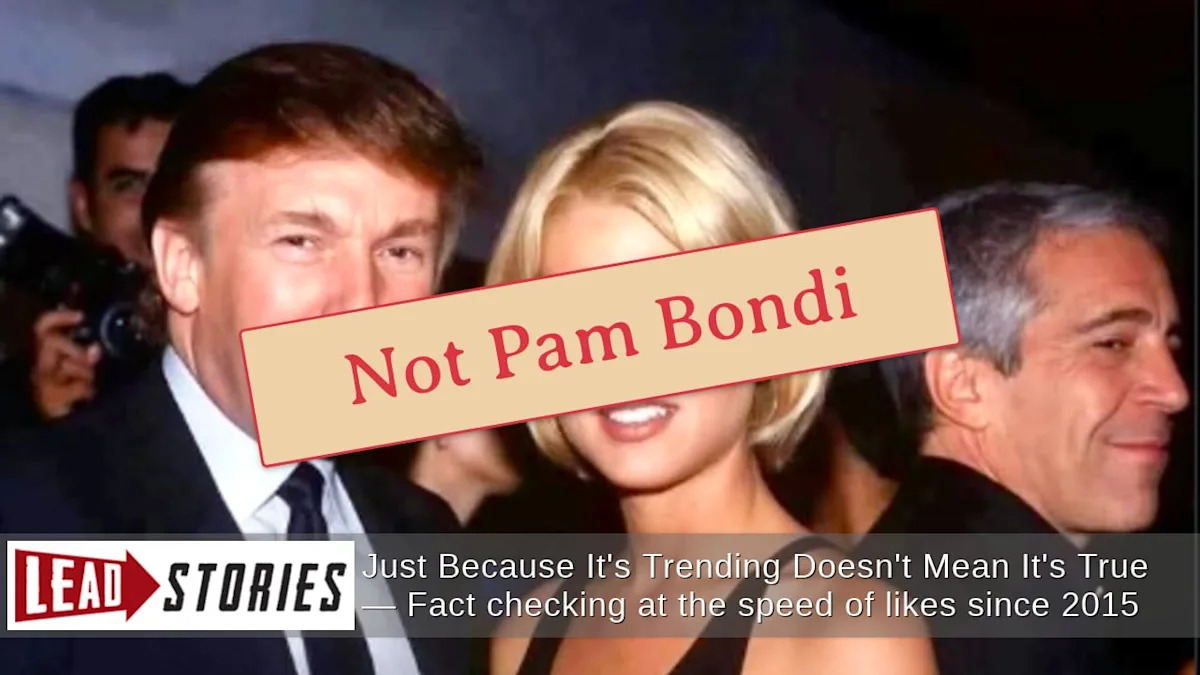
A viral photograph circulating on social media claiming to show former Attorney General Pam Bondi with Donald Trump and Jeffrey Epstein has been debunked. The widely shared image, which has gained traction across multiple platforms including Threads, does not feature Bondi but instead captures Belgian model Ingrid Seynhaeve alongside Trump and Epstein.
The misidentification appears to be part of a coordinated effort to suggest improper connections between Bondi and Epstein, the disgraced financier who died in prison while awaiting trial on sex trafficking charges. The posts, which began appearing on October 8, 2025, frequently include provocative captions such as “COMEY YOU ARE INDICTED AND THE CASE SHOULD BE DROPPED! CONFLICT OF INTEREST BONDI. NICE SHEER BLACK GOWN! TRUMP, BONDI, AND JEFFREY EPSTEIN.”
Verification of the image’s true subjects comes directly from Getty Images, which owns the rights to the photograph. According to Getty’s licensing information, the picture was taken by photographer Sonia Moskowitz at a Victoria’s Secret “Angels” party in New York City on April 28, 1997. The official caption clearly identifies the woman as Seynhaeve, not Bondi.
“American businessman and ex-president Donald Trump, Belgian model Ingrid Seynhaeve, and American businessman Jeffrey Epstein attend the Victoria’s Secret ‘Angels’ party on April 28, 1997 in New York City,” reads the Getty Images description.
This misattribution isn’t new in the political landscape, where photographs are frequently repurposed with false contexts to create damaging narratives about public figures. The timing of this particular misinformation coincides with heightened political tensions surrounding Bondi’s tenure as Attorney General in the Trump administration.
The misleading posts appear designed to imply that Bondi has a conflict of interest in matters relating to the indictment of former FBI Director James Comey. Comey faces charges of obstruction of justice and lying to Congress in a case that has drawn significant political attention. The false photo association attempts to suggest that Bondi’s actions as Attorney General are compromised by a supposed personal connection to Epstein.
Media experts note that such visual misinformation can be particularly effective because images tend to create stronger emotional responses than text alone. Dr. Claire Wardle, co-founder of the Information Futures Lab at Brown University, has previously observed that “when people see an image, they process it differently than text, and it can create false memories that are difficult to correct.”
The circulation of this misidentified photograph highlights ongoing challenges with misinformation in the digital age, where context can be easily manipulated and false narratives can rapidly gain traction across multiple platforms before fact-checkers can intervene.
This incident also underscores the importance of image verification in contemporary media consumption. Tools like reverse image searches and consulting original sources, such as photo agencies, can help users determine the authenticity and context of viral images.
The misidentification comes at a particularly sensitive time in American politics, as investigations into high-profile figures continue to capture public attention and fuel partisan debate. While the photograph itself is genuine, its mischaracterization represents a common tactic in political disinformation campaigns designed to create false associations between public figures and controversial individuals.
As this case demonstrates, even decades-old photographs can be weaponized in current political contexts, making media literacy and source verification increasingly important skills for navigating today’s information environment.
Fact Checker
Verify the accuracy of this article using The Disinformation Commission analysis and real-time sources.

7 Comments
The misidentification of the woman in the photo is a cautionary tale. We should always strive to verify information before sharing it, no matter how compelling the narrative may seem. Kudos to the fact-checkers for their thorough investigation.
This is a good reminder to be cautious about unverified claims, especially those involving public figures. Fact-checking is crucial to avoid perpetuating false narratives. Kudos to the disinformation commission for setting the record straight.
Agreed. Fact-checking is essential in the digital age when misinformation can spread so quickly. It’s heartening to see diligent work being done to combat the spread of false claims.
It’s concerning to see such coordinated efforts to spread misinformation, even about something as seemingly innocuous as a photograph. Fact-checking is essential to uphold the truth and maintain public trust. Well done to the team behind this investigation.
Absolutely. The proliferation of misinformation online is a serious issue that requires vigilant fact-checking. Kudos to the disinformation commission for their commitment to setting the record straight.
Interesting fact check. It’s important to verify the accuracy of viral images and not spread misinformation, even unintentionally. Careful examination of the source and details helps establish the truth in these cases.
This serves as a good reminder to be critical consumers of online content. Verifying the accuracy of viral images and claims is crucial to prevent the propagation of misinformation. Kudos to the disinformation commission for their diligent work.