


Listen to the article
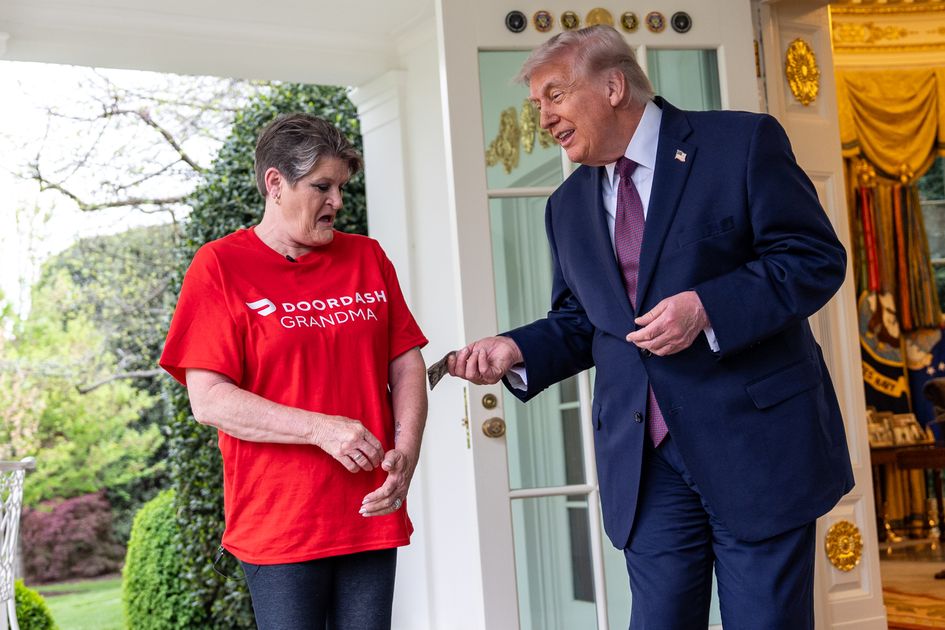
President Donald Trump celebrated tax cuts for tipped workers by ordering McDonald’s to the White House via DoorDash, highlighting a signature policy from his 2025 tax legislation.
Sharon Simmons, wearing a “DoorDash Grandma” T-shirt, delivered cheeseburgers and fries to the president two days before the April 15 tax deadline. Trump used the moment to promote what he called “the great, big, beautiful tax cut bill,” claiming it provided “tremendous amounts of money” in relief to Americans.
The One Big Beautiful Bill Act fulfilled several of Trump’s campaign promises, including tax breaks for tipped workers, overtime-eligible employees, Social Security recipients, and parents with 529 education savings accounts. The president is expected to highlight these achievements during an upcoming visit to Nevada.
While significant, the 2025 tax cuts rank as either the third-largest since 1980 or tied for sixth, depending on the measurement criteria – not the largest in U.S. history as Trump has claimed. Meanwhile, his administration’s efforts to address affordability concerns, particularly regarding gasoline prices, have made limited progress.
The legislation successfully delivered on Trump’s promise to cut taxes across all income levels, with higher-income households receiving proportionally larger benefits. This achievement earned Trump a “Promise Kept” designation on the MAGA-Meter promise-tracking initiative.
For tipped workers, who make up about 2.5% of the workforce but 5% of those in the bottom quarter of earners, the law created a significant tax break through 2028. The White House claims over 5.5 million Americans have benefited, with average tax deductions exceeding $7,100.
During the DoorDash delivery event, Trump suggested Simmons had received an $11,000 tax refund due to the legislation. Simmons later clarified on “Fox and Friends” that $11,000 represented her total tip earnings, not her tax savings, which she considered private. Tax policy experts note that even in the 24% tax bracket, the maximum savings on $11,000 of tips would be approximately $2,640.
Simmons, 58, told reporters she works about 48 hours weekly and previously participated in a DoorDash program delivering food to elderly people in Nevada. After local news coverage, the company asked her to advocate for the “no tax on tips” policy. While she testified before Congress in 2025, Simmons emphasized she doesn’t consider herself political, stating, “If there is any story I want published, it’s that we want people to listen to each other again.”
The legislation also addressed overtime pay, though with limitations. Trump promised to “end all taxes on overtime,” and while the law takes steps in that direction, the provision expires in 2028 and doesn’t benefit many workers, including supervisors, professionals, the self-employed, and independent contractors. The tax break applies specifically to overtime earned under the Fair Labor Standards Act, which mandates time-and-a-half pay for hours beyond 40 per week.
Regarding Social Security, Trump’s claims of eliminating taxes on benefits aren’t entirely accurate. The legislation provides an additional $6,000 tax deduction for Americans 65 and older, supplementing existing age-based deductions. Due to procedural constraints, lawmakers couldn’t completely eliminate taxes on Social Security benefits, instead creating significant but incomplete relief through alternative approaches.
According to the Tax Policy Center, approximately half of Social Security recipients have incomes too low to owe federal taxes and therefore don’t benefit from the deduction. The policy primarily benefits middle and upper-income seniors, with the largest savings (about $1,100 annually) going to those earning between $80,000 and $130,000. This provision also expires in 2028.
The legislation successfully expanded 529 education savings accounts to include homeschooling expenses, fulfilling another Trump campaign promise. Parents can now use these tax-advantaged accounts for curriculum, instructional materials, online education programs, tutoring, and educational therapies for students with disabilities.
Finally, the bill created a “baby bonus” payment as Trump had pledged. Children born between January 2025 and December 2028 receive $1,000 to launch a “Trump Account” from the U.S. Treasury, with parents able to make additional contributions.
While the administration has suggested these accounts could grow to six or seven figures, tax policy experts note these projections rely on optimistic assumptions about stock market performance, maximum annual contributions of $5,000, and don’t account for inflation or taxes.
Fact Checker
Verify the accuracy of this article using The Disinformation Commission analysis and real-time sources.

5 Comments
Delivering tax cuts and relief to Americans is certainly an important goal, but the details and comparisons to past legislation are crucial. It will be interesting to see how the public perceives the 2025 tax bill and its actual impacts once implemented.
While the tax cut legislation may have fulfilled some of Trump’s campaign promises, the article highlights the need to critically examine the details and impacts. It’s a complex topic, and I appreciate the effort to provide a balanced, fact-based assessment.
Interesting to see the details on Trump’s 2025 tax legislation. While the tax cuts may have provided some relief, it’s important to fact-check the claims around their magnitude compared to previous bills. Curious to learn more about the impacts on tipped workers, overtime pay, and Social Security.
The focus on tax breaks for specific groups like tipped workers and parents with 529 accounts is intriguing. I’d be curious to learn more about the rationale and potential benefits of these targeted measures. Fact-checking the claims around their scale is also important.
The efforts to address affordability concerns around gasoline prices are noteworthy, though it seems the progress has been limited so far. I wonder what other measures the administration is considering to tackle this challenge. It’s a complex issue with many factors at play.