


Listen to the article
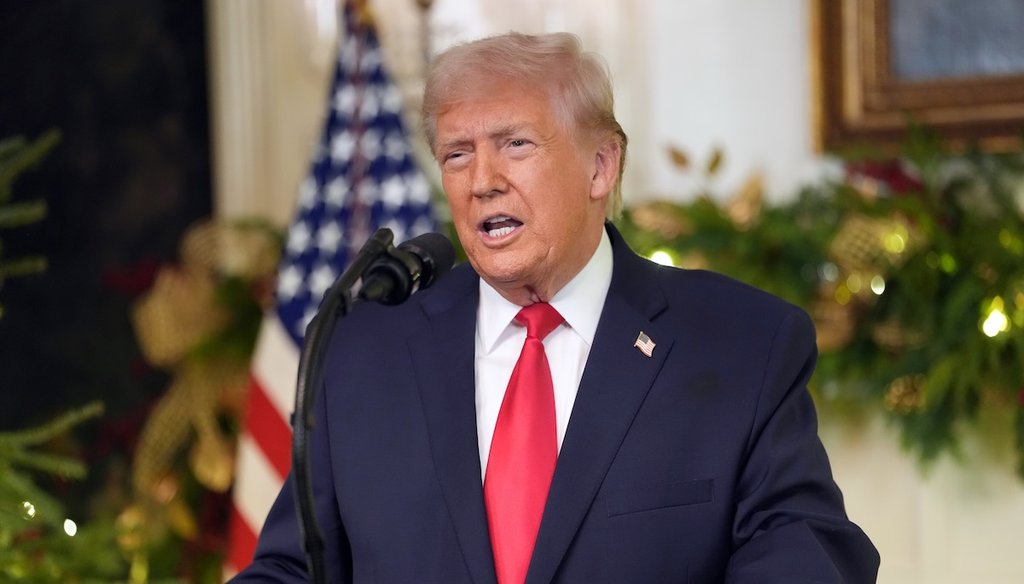
In a prime time White House address on December 17, President Donald Trump offered Americans an optimistic assessment of his administration’s first 11 months, describing historic improvements to American lives following what he characterized as years of immigration and economic turmoil.
During the 18-minute televised speech, Trump announced a new “warrior dividend” – $1,776 checks being sent to approximately 1.45 million U.S. military personnel. “The checks are already on the way,” Trump stated. “Nobody understood that one until about 30 minutes ago.”
However, Trump’s rosy portrayal stands in stark contrast to public sentiment. A December NPR/PBS News/Marist poll revealed just 36% of Americans approve of his economic management, with more than one-third reporting their personal finances had deteriorated over the past year. Consumer confidence remains near the lows reached during mid-2022, when inflation peaked around 9% under the Biden administration.
Fact-checkers have identified numerous inaccuracies in Trump’s address. He significantly exaggerated the amount of foreign investment attracted to the U.S., overstated tax cut benefits for older Americans, and repeated false claims about undocumented immigrants. His assertion that crime has reached record levels contradicts data showing violent crime rates were approximately twice as high in the early 1990s.
On the economy, Trump claimed “inflation has stopped, wages are up, prices are down.” In reality, inflation continued at 3% year-over-year in September – unchanged from when Trump took office in January and above the Federal Reserve’s 2% target. While wage gains have outpaced inflation during his term, prices have not declined as claimed.
Trump’s statement about slashing drug prices “by as much as 400, 500, and even 600%” defies mathematical possibility. A 100% reduction would mean consumers pay nothing for medications, while reductions beyond that percentage would require pharmaceutical companies to pay consumers to take their products – an economically unfeasible scenario.
The announced military “warrior dividend” raises questions about funding and authorization. At $1,776 per service member across 1.45 million personnel, the initiative would cost approximately $2.58 billion. Trump suggested tariff revenues would cover the expense, noting, “We made a lot more money than anybody thought.” The Tax Foundation projects Trump’s tariffs could generate $191 billion in 2026 if maintained.
However, expenditures of this magnitude typically require congressional appropriation, which appears not to have occurred if, as Trump claimed, “the checks are already on the way.” The White House did not immediately respond to media inquiries about the funding mechanism.
Looking ahead, Trump predicted “the largest tax refund season of all time” next spring. Tax policy experts agree refunds will likely increase due to provisions in the One Big Beautiful Bill Act affecting the 2025 tax year, including higher standard deductions, an expanded child tax credit, and new deductions for tips, overtime, car-loan interest, and older Americans.
The Tax Policy Center estimates an overall tax reduction of approximately $125 billion, averaging $650 per taxpayer. However, these benefits will be unevenly distributed, with high-income households receiving significantly larger benefits. Among the bottom fifth of income earners, only about 16% will receive tax cuts, compared to 91% of the top fifth, who will see reductions averaging $2,300.
The size of individual tax refunds will also depend on withholding patterns. As Garrett Watson, Tax Policy Foundation analysis director, explained, taxpayers who maintained previous withholding rates will “receive it all at once when they file their returns” instead of gradually benefiting through higher take-home pay throughout the year.
This address highlights the growing gap between presidential messaging and public perception as the administration attempts to reshape economic narratives heading into 2026.
Fact Checker
Verify the accuracy of this article using The Disinformation Commission analysis and real-time sources.

12 Comments
Interesting to see the specific inaccuracies identified, like exaggerating foreign investment and overstating tax cut benefits. Transparency and accuracy should be paramount, regardless of political affiliation.
Well said. It’s critical that the public has access to truthful information, even when it may contradict a politician’s claims. Fact-checking is a crucial safeguard for democracy.
I’m curious to see the specifics of the fact-check analysis. Inflation and the economy are major concerns for many Americans, so understanding the accuracy of the President’s claims is valuable.
Yes, it’s important to evaluate policy proposals and claims based on objective data, not just political messaging. A balanced, evidence-based assessment is essential.
Fact-checking claims on inflation, wages, and military spending is important. It’s crucial to analyze data objectively and not accept politicians’ statements at face value, no matter their party affiliation.
Agreed. Relying on authoritative and non-partisan sources is key to cutting through the partisan rhetoric and getting to the facts.
As someone with an interest in the energy and commodities sectors, I’m curious to see how this fact-check addresses any claims related to those industries. Objective analysis is key in these complex and often politicized areas.
Absolutely. Given the importance of energy and commodity markets, it’s vital that any assertions about their performance or outlook are thoroughly scrutinized and backed by credible data.
This fact-check highlights the importance of maintaining a critical eye, even toward statements made by high-level officials. Trusting but verifying should be the approach when it comes to claims about the economy and policy impacts.
Well stated. Fact-checking is an essential check on power and helps ensure the public has access to accurate, unbiased information to inform their views and decisions.
The divergence between the President’s portrayal and public sentiment on the economy is quite striking. Fact-checkers play a vital role in holding leaders accountable and informing the public.
Absolutely. It’s concerning when there’s a clear disconnect between the official narrative and the experiences of everyday Americans. Rigorous fact-checking helps bridge that gap.