


Listen to the article
The water footprint controversy surrounding India’s ethanol production has ignited a heated debate between industry representatives and environmental critics, with claims and counterclaims about the actual water consumption involved in producing the biofuel.
A figure of 10,790 liters of water needed to produce one liter of ethanol from rice has become the focal point of criticism targeting India’s ambitious ethanol blending program. The Grain Ethanol Manufacturers Association (GEMA) has strongly contested this statistic, calling it “factually misleading and devoid of context.”
According to GEMA, this figure inappropriately includes the total lifecycle water footprint of rice cultivation, including rainfall absorbed during growth, rather than reflecting the actual water consumption in ethanol production facilities. The industry group maintains that modern distilleries use only three to five liters of process water per liter of ethanol produced.
Experts acknowledge GEMA’s point has validity. The 10,000-liter figure, which was shared by Food Secretary Sanjeev Chopra at a global conference in Delhi last year, derives from virtual water accounting—a methodology that calculates all water a crop consumes during its growing cycle, including natural precipitation. This approach was designed as a tool for understanding agricultural water stress patterns, not industrial water consumption metrics.
However, the industry’s defense sidesteps more fundamental concerns about India’s ethanol program. The primary issue isn’t how much water distilleries directly consume, but rather the water intensity of growing the crops that feed these facilities.
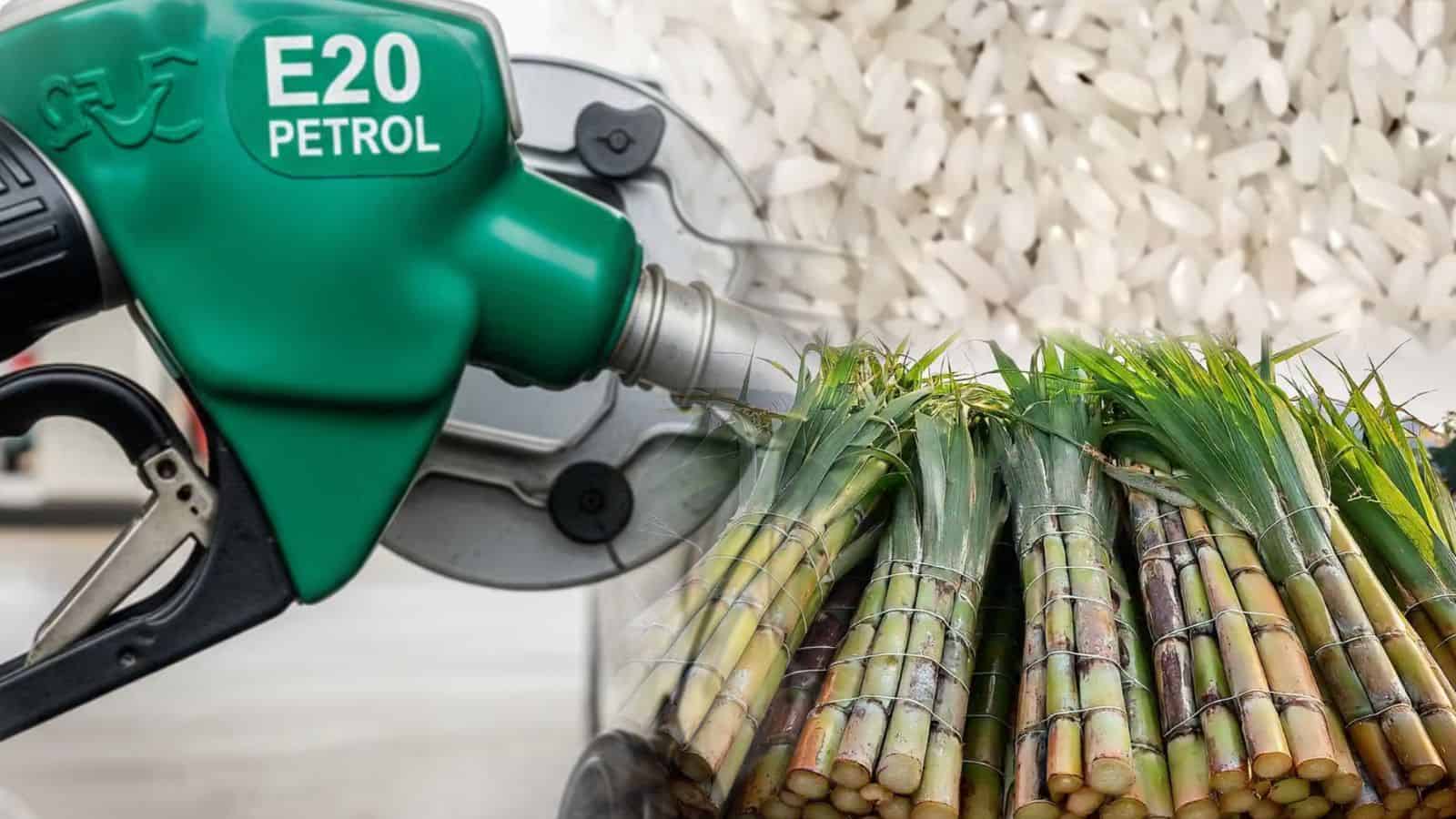
India’s ethanol program relies heavily on sugarcane and, increasingly, rice—the two most irrigation-intensive crops cultivated in the country. Growing one kilogram of rice requires an estimated 3,000 to 5,000 liters of water, most of which comes from groundwater resources rather than rainfall. For the 2024-25 period, the government has allocated 52 lakh tonnes of rice for ethanol production, with targets set to increase to 90 lakh tonnes the following year.
GEMA contends that the grain being used for ethanol production is surplus and damaged stock—primarily broken rice unsuitable for food consumption—meaning that “the water required to grow this grain has already been expended at the farm level.” This argument has merit when considering waste-to-energy efficiency.
However, recent policy shifts complicate this narrative. The government plans to reduce the proportion of broken rice in ration supplies from 25 percent to 10 percent, explicitly to direct more toward distilleries. This represents not the utilization of excess stock but a deliberate redirection of food resources, raising legitimate food security concerns.
The situation with sugarcane is even more problematic. Even GEMA acknowledges that maize has become the preferred feedstock for ethanol production over sugarcane, which contradicts their simultaneous characterization of sugarcane as “largely rain-fed.” Anjal Prakash, an author with the Intergovernmental Panel on Climate Change (IPCC), has noted that sugarcane cultivation has already placed significant stress on water tables in regions where most ethanol plants operate.
Swathi Seshadri of the Institute for Energy Economics and Financial Analysis points out that ethanol plants are strategically concentrated in cane-growing belts of Maharashtra and Uttar Pradesh—regions that already rank among India’s most groundwater-stressed areas—precisely because of proximity to raw materials.
GEMA president Dr. CK Jain argues that India’s water crisis stems from decades of agricultural mismanagement rather than the ethanol industry specifically. This perspective has validity only if the ethanol program isn’t actively incentivizing farmers to grow more water-intensive crops that exacerbate existing problems.
The economic benefits of India’s ethanol blending program are substantial and shouldn’t be dismissed. The initiative has reportedly saved over Rs 1.7 lakh crore in foreign exchange, reduced crude oil imports, and increased farmer incomes.
Nevertheless, these economic advantages don’t eliminate legitimate concerns about water sustainability. As India considers higher blending targets, policymakers must address fundamental questions about feedstock selection, cultivation locations, groundwater extraction rates, and the long-term environmental consequences of these choices.
Fact Checker
Verify the accuracy of this article using The Disinformation Commission analysis and real-time sources.

8 Comments
This is a complex issue with valid arguments on both sides. It’s important to look at the full lifecycle water impact, not just process water, but also agricultual irrigation. More transparency and nuance is needed to properly evaluate the tradeoffs around biofuel production.
Curious to learn more about the industry’s improvements in water efficiency. If they can demonstrate significant reductions in the water footprint, that could be an important step in advancing biofuel as a viable renewable energy option.
It’s good to see this issue getting fact-checked. Transparency and rigorous analysis will be key to finding the right balance between biofuel production and sustainable water management. I hope this debate leads to constructive solutions.
Balancing renewable energy goals with environmental impacts is challenging. I hope industry and regulators can work together to optimize ethanol production in a sustainable way that minimizes water use and other resource tradeoffs.
This is an important issue given India’s water scarcity challenges. I’m glad to see the industry pushing back on misleading statistics, but they need to provide robust, verifiable data to back up their claims about modern production methods.
This is a complex topic where reasonable people can disagree. I appreciate the industry group pushing back, but they need to back up their claims with credible data. More third-party, impartial research would help inform this important policy debate.
The water usage figures for ethanol production seem to vary widely depending on the methodology used. I’d be curious to see more detailed, impartial analysis comparing different production processes and regions to get a clearer picture of the actual water footprint.
Agreed, a more comprehensive, fact-based assessment would be helpful to move this debate forward constructively.