


Listen to the article
Iran Dismisses Claims of Special Invitation to President Prabowo for Regional Mediation
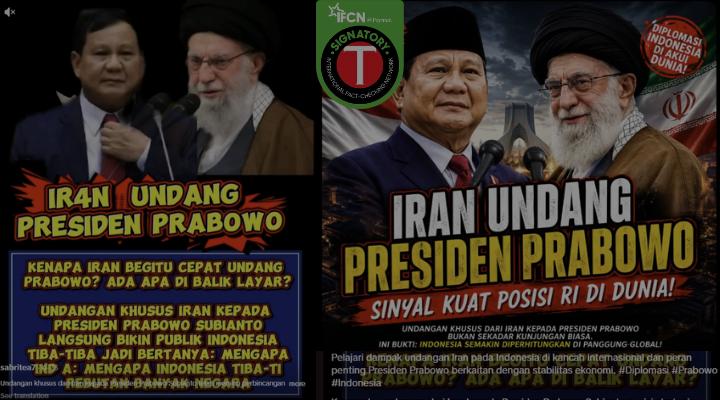
Social media posts circulating since April 24, 2026, have falsely claimed that Iranian leadership extended a special invitation to Indonesian President Prabowo Subianto to mediate dialogue between Iran, the United States, and Israel. These claims, which feature images of President Prabowo alongside the late Ayatollah Ali Khamenei, suggest Indonesia has gained significant diplomatic stature due to its economic stability and neutral foreign policy approach.
In response to these widespread claims, Tempo conducted a thorough verification process, consulting directly with the Embassy of the Islamic Republic of Iran in Indonesia. The investigation revealed no evidence of any formal invitation for Indonesia to serve as mediator in the ongoing regional tensions.
According to diplomatic sources, Pakistan—not Indonesia—has been serving as the primary mediator in recent peace talks between the United States and Iran. Pakistan’s involvement began after demonstrating consistent efforts to promote a ceasefire in the volatile region. Their diplomatic initiative has included direct engagement with Tehran to encourage de-escalation and a return to negotiations.
Pakistan’s mediation efforts culminated in talks held in Islamabad on April 12, which lasted nearly 21 hours but ended without concrete agreements. Diplomatic channels remain open as officials explore possibilities for a second round of negotiations.
While Indonesia has not been formally invited to mediate, President Prabowo did express willingness to play a diplomatic role in the conflict earlier this year. In March, he publicly offered to facilitate dialogue between the conflicting parties, a gesture that Iranian officials acknowledged with appreciation.
Ali Pahlevani Rad, Iran’s Assistant Ambassador to Indonesia, commented on the situation, stating, “Iran views Indonesia as an independent country with great potential to play a crucial role in restoring peace in the region.” However, he emphasized that effective mediation would require “concrete steps to restore peace and end the United States and Israel’s aggression against Iran.”
The assistant ambassador further noted that supporting peace efforts means “standing on the right side of history, an approach that Indonesia has consistently adopted since its independence in 1945, in defending truth and justice.” This statement, delivered on May 4, 2026, reflects Iran’s diplomatic positioning rather than confirmation of a formal mediation request.
Tehran has consistently maintained its preference for diplomatic solutions to achieve national security objectives while urging the United States to respect its sovereignty and cease hostilities that have destabilized the Middle East.
The confusion may stem from a separate diplomatic exchange that occurred in 2025 when Iran did invite President Prabowo to visit Tehran. This invitation, presented by Iranian Ambassador Mohammad Boroujerdi during celebrations marking 75 years of diplomatic relations between the two nations, was focused on strengthening bilateral ties rather than soliciting Indonesia’s help as a regional mediator. While President Prabowo reportedly expressed interest in visiting Iran at that time, no official visit has materialized.
The timing of these false claims is particularly sensitive given the regional context. Ayatollah Ali Khamenei, featured in the misleading social media images, died following military strikes by the United States and Israel on February 28, 2026, further inflaming tensions in an already volatile region.
Indonesia, as the world’s most populous Muslim-majority nation, maintains diplomatic relations with both Iran and the United States, potentially positioning it as a neutral party in regional conflicts. However, despite Indonesia’s growing economic influence in Southeast Asia, no formal request for its diplomatic intervention has been confirmed by Iranian authorities.
After thorough investigation, Tempo’s fact-checking team has conclusively determined that claims regarding a special Iranian invitation to President Prabowo for mediating regional conflicts are false.
Fact Checker
Verify the accuracy of this article using The Disinformation Commission analysis and real-time sources.

8 Comments
I’m curious to learn more about Pakistan’s role as a mediator between the US and Iran. It’s an interesting development, given the complex regional dynamics at play. Diplomatic initiatives to de-escalate tensions are important, even if they don’t always get as much attention as the conflicts themselves.
Yes, Pakistan’s involvement is noteworthy. As a neighbor to both Iran and the US, they may be able to leverage relationships and regional influence to try and broker some progress, even if the path to a lasting resolution remains challenging.
This report highlights the importance of verifying information, especially when it comes to high-stakes diplomatic matters. While Indonesia’s neutral foreign policy approach is notable, it seems they were not directly involved in these particular US-Iran talks, contrary to the original claims. Kudos to Tempo for their investigative work.
Agreed. Sifting through rumors and misinformation to uncover the facts is crucial. The Disinformation Commission’s fact-checking efforts help uphold journalistic integrity and prevent the spread of falsehoods, which is valuable in today’s information landscape.
Interesting to see Iran dismiss the claims of an invitation to Indonesia. It’s important to verify information, especially on sensitive diplomatic matters, before spreading rumors online. This seems like a case of misinformation taking hold without factual basis.
Agreed. The report from Tempo about Pakistan being the main mediator in the US-Iran talks makes more sense. Iran likely wants to maintain its neutral position and not be seen as too closely aligned with any single country.
This highlights the importance of checking official sources and diplomatic channels when it comes to geopolitical news. Rumors and false claims can spread quickly on social media, but the facts seem to show Indonesia was not directly involved in these regional talks.
It’s good to see the Disinformation Commission fact-checking these claims about Iran and Indonesia. Maintaining accuracy and avoiding the spread of misinformation is crucial, especially on sensitive geopolitical issues. Verified information from diplomatic sources carries much more weight than social media rumors.