


Listen to the article
Iranian Desert Flooding Claims Unrelated to US Radar Destruction, Investigation Reveals
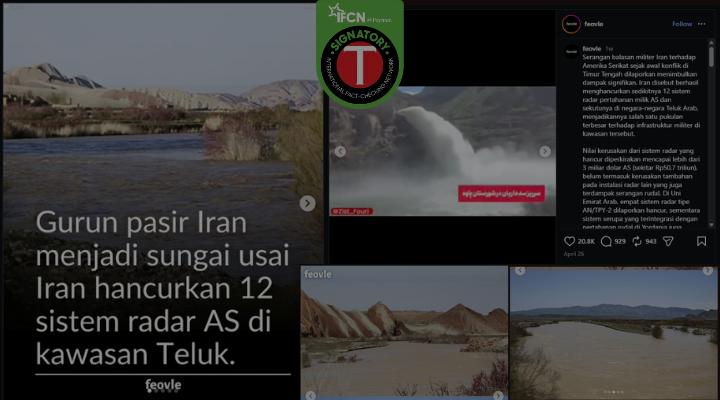
Viral images circulating across social media platforms falsely linking flooding in Iranian deserts to the alleged destruction of US radar systems have been debunked by fact-checkers. The misleading narrative, which spread rapidly on Instagram, Facebook, TikTok, X, and YouTube, claimed that Iran had destroyed 12 American defense radar stations across the Gulf region, including in the United Arab Emirates, Jordan, and Qatar, resulting in sudden weather changes.
An extensive investigation by Tempo revealed the claims lack factual basis. While Iran has experienced increased water levels in certain rivers, these changes are attributable to seasonal spring rainfall rather than military actions affecting weather patterns.
One widely shared image showed water rushing through a dam canal, which was verified as footage from the Daryan Dam on the Sirvan River in Iran’s Kermanshah Province. The Iranian Embassy in Bulgaria confirmed on April 1 that the overflow resulted from heavy rains following a seven-year drought period. Notably, official communications made no connection between the water levels and any military activities.
Additional images in circulation depicted the Qezel Ouzan River in northern Iran, which has recently seen increased water flow. Iranian state-controlled media outlets Fars and Isna Photo documented the river’s revival, explicitly attributing it to seasonal spring precipitation. Their reports highlighted the agricultural benefits of the increased water flow for rice paddies and farmlands along the riverbanks.
“Winter and spring rains have revived the Qezel Ouzan River, a vital agricultural artery flowing through several Iranian provinces, after years of declining water levels,” Fars reported in late April, without any mention of military strikes or radar systems.
Environmental experts note that the Qezel Ouzan River typically experiences cyclical changes, turning red and overflowing in early spring and summer due to snowmelt from the Persian Highlands. According to the Encyclopædia Iranica, the river’s highest water volume naturally occurs between April and May, while flow decreases during August and September.
Iran has faced significant drought conditions since 2020, affecting river flows throughout the region. Research by World Weather Attribution indicates countries in the Fertile Crescent region are experiencing similar water stress, with the crisis peaking in 2025 when several dams no longer received adequate water supplies.
Climate scientists attribute the ongoing water crisis to multiple factors, including increased evaporation rates, water-intensive agricultural practices, and unsustainable groundwater extraction. In response, the Iranian government adopted the National Climate Change Management Plan in October 2025 to strengthen water and agriculture management.
Interestingly, this isn’t the first time Iranian officials have made unusual claims about their weather patterns. Previous accusations by Iranian authorities suggested the United States and United Arab Emirates were “stealing clouds” from their territory. Researchers at the Center for Strategic and International Studies refuted these allegations in 2023, suggesting such claims might serve to deflect criticism from domestic resource management failures.
The Iranian Meteorological Organization similarly rejected claims made by an Iranian military general that Israel was stealing clouds, leading to an eventual retraction of the statement.
The persistence of misinformation linking military actions to weather phenomena highlights the challenges of verifying information in politically sensitive regions. Climate experts emphasize that weather patterns follow natural cycles and human-induced climate change, not military activities targeting radar installations.
As global social media continues to accelerate the spread of unverified claims, this case underscores the importance of critical analysis and fact-checking before accepting dramatic narratives about environmental changes.
Fact Checker
Verify the accuracy of this article using The Disinformation Commission analysis and real-time sources.

11 Comments
It’s concerning how quickly misinformation can spread on social media. I’m glad to see this report debunking the claims about US radar stations affecting Iran’s weather patterns. Rigorous fact-checking is crucial.
While the flooding in Iran is a serious issue, it’s clear these specific claims about US military involvement are unfounded. Fact-checkers play a valuable role in cutting through the noise and getting to the truth.
Interesting that these claims linking Iranian floods to US radar attacks lack credible evidence. It’s important to scrutinize viral narratives and rely on verified information from reliable sources.
Agreed. Fact-checking helps separate truth from misinformation, which is crucial for understanding complex geopolitical and environmental issues.
Kudos to the fact-checkers for their thorough work in debunking these unsubstantiated claims. It’s a good reminder to be wary of sensational narratives and to always seek out credible sources.
The detailed investigation into the origins of these misleading claims is commendable. Verifying information and correcting misinformation is crucial, especially around sensitive geopolitical and environmental topics.
Agreed. Responsible journalism that focuses on facts and evidence-based reporting is essential for maintaining public trust and informed discourse.
This is a good example of the importance of investigating claims, especially those that seem sensational or politically charged. Relying on official sources and verifiable evidence is the best way to separate fact from fiction.
I agree. Misinformation can have real-world consequences, so it’s vital that we scrutinize information and seek out authoritative, well-researched reporting.
The investigation sounds thorough – tracing the origins of misleading images and verifying the actual causes behind the increased water levels in Iran. Responsible journalism is key in an era of rampant online misinformation.
Absolutely. Fact-based reporting that calls out unsubstantiated claims is essential for maintaining public trust and informed discussions around important issues.