


Listen to the article
Viral Video of Italian PM Snubbing Netanyahu Revealed as AI-Generated Hoax
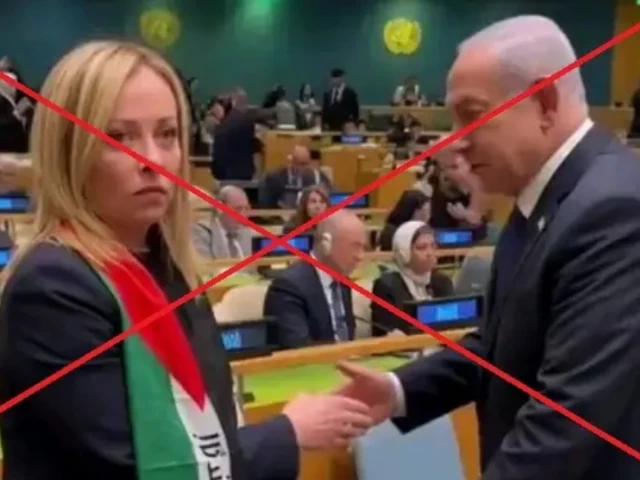
A viral video purportedly showing Italian Prime Minister Giorgia Meloni ignoring Israeli Prime Minister Benjamin Netanyahu at a United Nations General Assembly session has been debunked as an AI-generated fabrication. The deceptive footage, which began circulating on April 29, 2026, quickly amassed over a million views across social media platforms.
The video depicted Meloni wearing a Palestinian flag and seemingly refusing to engage with Netanyahu despite his attempts to speak with her. It was initially shared by a pro-Iranian account on X (formerly Twitter) with the caption “Brave lady,” garnering 553,700 views. The footage spread rapidly, with another user’s post of the same video reaching 507,300 views.
Forensic analysis of the footage revealed multiple telltale signs of artificial intelligence manipulation. Most notably, the Arabic writing displayed on the Palestinian scarf worn by Meloni in the video contains nonsensical text and symbols characteristic of AI-generated content. The inscriptions feature rough lines and meaningless characters rather than authentic Arabic script.
Multiple AI detection tools confirmed suspicions about the video’s authenticity. Deepware, a deepfake detection tool, flagged the footage as “suspicious,” while Hive moderation assessed it as 45.9 percent AI-generated. Additional tools, Truth Scan and Sora Detect, similarly identified significant levels of artificial creation at 48 percent and 40 percent respectively.
The timing of the hoax coincides with Italy’s delicate diplomatic positioning in the ongoing Middle East conflict. Under Meloni’s leadership, Italy has maintained a cautious, non-military stance while balancing its traditional alliance with Israel against growing concerns about regional instability.
Italy has recently demonstrated a measured approach to its relationship with Israel, notably suspending the renewal of a defense agreement amid concerns over conflict escalation. Rome has instead emphasized diplomatic solutions while supporting international efforts to secure global energy routes and protect maritime trade disrupted by regional tensions.
Researchers conducting the fact-check found no credible mainstream media reports of any such incident between the two leaders. Furthermore, the most recent session of the UN General Assembly occurred in September 2025, and while both leaders attended, no such encounter was documented.
This fabricated video emerges against the backdrop of increasingly sophisticated AI-generated misinformation targeting international relations and diplomatic exchanges. The rapid spread of the content highlights the growing challenge of distinguishing authentic footage from artificially created media, particularly regarding sensitive geopolitical subjects.
The original fact-check was conducted by iVerify Pakistan, a joint project between the Centre for Excellence in Journalism at the Institute of Business Administration (CEJ-IBA) and the United Nations Development Programme (UNDP).
Digital literacy experts continue to emphasize the importance of verifying content before sharing, particularly videos depicting inflammatory political interactions. As AI technology advances, the ability to create convincing fake videos of world leaders has become increasingly accessible, presenting new challenges for media consumers and fact-checkers alike.
The incident serves as a reminder of how easily misinformation can spread in the digital age, particularly when it aligns with existing political narratives or heightened tensions between nations.
Fact Checker
Verify the accuracy of this article using The Disinformation Commission analysis and real-time sources.

10 Comments
This case highlights the importance of digital literacy and critical thinking when consuming online content. AI-generated hoaxes can be incredibly convincing, so we must exercise caution.
It’s troubling to see how quickly misinformation can spread on social media. The ability of AI to generate such convincing yet false content is a real challenge that needs to be addressed.
This is a sobering example of the potential for AI to be misused to create disinformation. Robust fact-checking and media literacy are essential to combat the spread of these fabrications.
Interesting development. It’s concerning to see the spread of AI-generated misinformation, especially around sensitive political events. Rigorous fact-checking is essential to combat these deceptive tactics.
This highlights the importance of media literacy and verifying the authenticity of online content. AI-generated fabrications can be remarkably convincing, so we must remain vigilant and rely on authoritative sources.
Absolutely. Fact-checking is crucial to identify and debunk these kinds of manipulated videos. We need to be cautious about what we see and share online.
It’s concerning to see how quickly AI-generated misinformation can spread online. We must be vigilant and rely on reputable sources to separate truth from fiction.
Absolutely. Verifying the authenticity of online content is crucial, especially when it comes to sensitive political issues. Fact-checking is the best defense against these kinds of deceptions.
A timely reminder of the need for critical thinking and fact-checking when consuming online content. AI-generated hoaxes can be very difficult to spot, so we must be vigilant.
Agreed. This case shows how important it is to rely on authoritative and verifiable sources, rather than blindly accepting viral videos or social media claims.