


Listen to the article
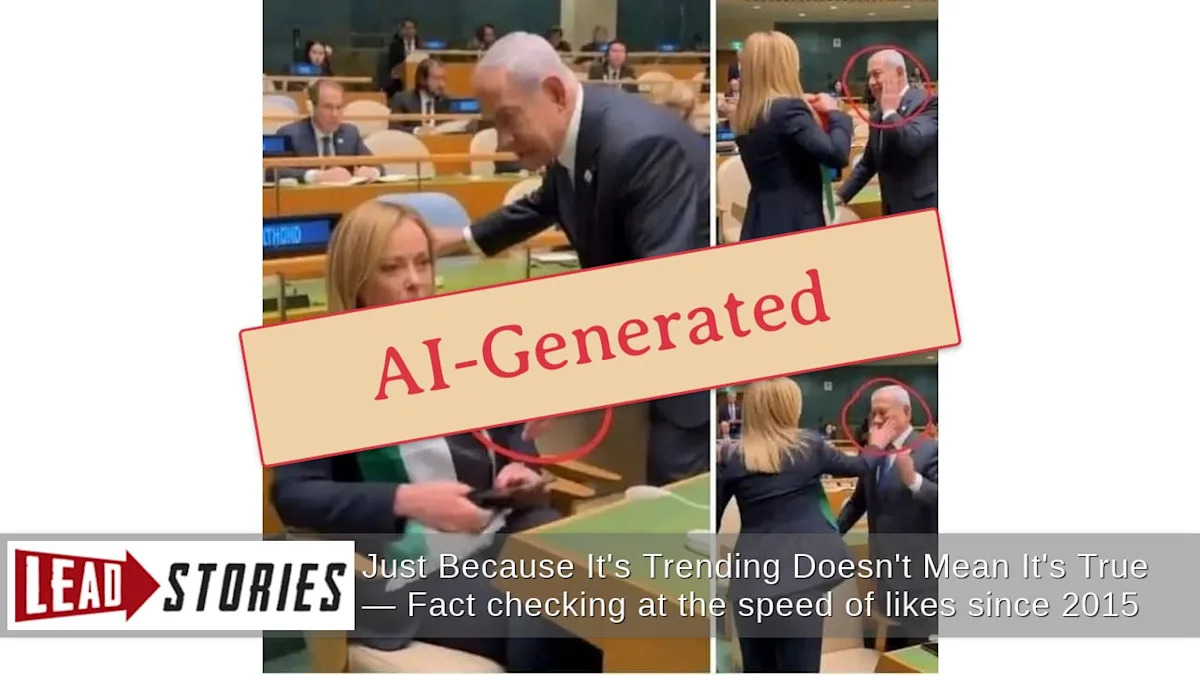
In a digital age where misinformation spreads rapidly across social media, a fabricated video purporting to show Italian Prime Minister Giorgia Meloni slapping Israeli Prime Minister Benjamin Netanyahu has gained significant traction online, despite being completely artificial.
The false claim circulated widely after user @Abdullah_Om3r03 posted a series of images on X (formerly Twitter) on April 29. The post featured what appeared to be screenshots showing Meloni wearing a Palestinian flag scarf and physically confronting Netanyahu. The caption contradictorily stated that Meloni “firmly refused to slap the Israeli Prime Minister for not taking down the Palestinian flag,” even as the images depicted the opposite.
Analysis of the footage reveals multiple telltale signs of AI generation. Text visible on screens in the background appears illegible or distorted—a common artifact in AI-created visuals. More glaringly, the Palestinian flag scarf worn by Meloni undergoes an impossible transformation during the scene, with the flag’s black stripe disappearing and the red triangle extending unnaturally.
The fabricated video also contains spatial inconsistencies typical of AI rendering, including a person who mysteriously appears in the background despite not being present in earlier frames. This figure also appears notably shorter than others in the scene.
This is not an isolated incident of fabricated content involving these leaders. Fact-checkers have previously debunked similar AI-generated videos depicting tense encounters between Meloni and Netanyahu. The phenomenon has expanded to include fabricated confrontations featuring other world leaders, including former U.S. President Donald Trump.
The timing of this misinformation coincides with a period of diplomatic adjustment between Italy and Israel. While Italy has historically maintained strong ties with Israel, Meloni recently announced that her country would not automatically renew its defense agreement with Israel—a decision that had already been communicated to Israeli officials.
The spread of such sophisticated fake content highlights the growing challenge of misinformation in international politics. As AI-generated media becomes increasingly realistic, distinguishing authentic footage from fabrications requires heightened vigilance and media literacy.
No credible news sources have reported any physical altercation between the two prime ministers, and the Italian government has not issued any statements suggesting diplomatic tensions of this nature with Israel.
The incident underscores how geopolitical tensions, particularly surrounding the Israeli-Palestinian conflict, can become fertile ground for misinformation campaigns. As AI tools become more accessible, political figures increasingly find themselves depicted in fabricated scenarios designed to inflame tensions or reinforce existing biases.
Media literacy experts recommend verifying information through multiple reliable sources before sharing content, particularly when the material appears sensational or aligns too perfectly with existing narratives. Scrutinizing visual details, checking for distortions in movement or inconsistencies in background elements, and verifying information through established news organizations remain essential practices in navigating today’s complex information landscape.
Fact Checker
Verify the accuracy of this article using The Disinformation Commission analysis and real-time sources.

10 Comments
This report serves as a timely reminder of the importance of critical thinking and media literacy. The ease with which AI-generated content can be created and disseminated is truly alarming. We must all do our part to verify information and call out falsehoods whenever we encounter them.
Well said. Maintaining a healthy skepticism and fact-checking habit is crucial in today’s information landscape. Kudos to the Disinformation Commission for their work in debunking these fabricated images.
It’s disappointing to see such blatantly fabricated content gain traction online. This kind of misinformation can have real-world consequences and undermine trust in our political institutions. I hope this serves as a wake-up call for the public to be more discerning about the sources and veracity of information they consume.
I agree. Fact-checking and critical thinking are essential skills in the digital age. We must remain vigilant and demand accountability from those who spread false narratives, whether intentionally or not.
The details in this report about the visual inconsistencies and transformation of the Palestinian flag scarf are very telling. It’s clear these images were generated by AI, not captured in reality. We need to be wary of the increasing prevalence of such synthetic media and the potential for it to sow discord.
Absolutely. The ability to create seemingly authentic but completely fabricated visuals is a worrying development. We must stay informed and equip ourselves with the tools to detect and debunk such disinformation.
This is a prime example of the dangers of unchecked misinformation in the digital age. The rapid spread of these AI-generated images, despite their clear inauthenticity, highlights the need for greater media literacy and fact-checking efforts. We must be vigilant in our consumption of online content to avoid falling victim to manipulation.
I agree. Fact-checking should be a reflex, not an afterthought. Platforms and policymakers also have a responsibility to implement robust measures to detect and limit the spread of synthetic media and other forms of misinformation.
This is a concerning case of AI-generated misinformation. It’s crucial to verify the authenticity of images and videos, especially those involving political figures, before sharing them. We should be vigilant in our media consumption and fact-checking to combat the spread of false narratives.
Absolutely. The morphing of the Palestinian flag scarf is a clear giveaway that these images were AI-generated. We need to be very cautious about the content we encounter online these days.