


Listen to the article
In the age of digital manipulation, a recent fact-checking investigation has revealed that AI-generated images falsely depicting political figures visiting an ailing Nepali YouTuber have gone viral on social media, misleading thousands of users.
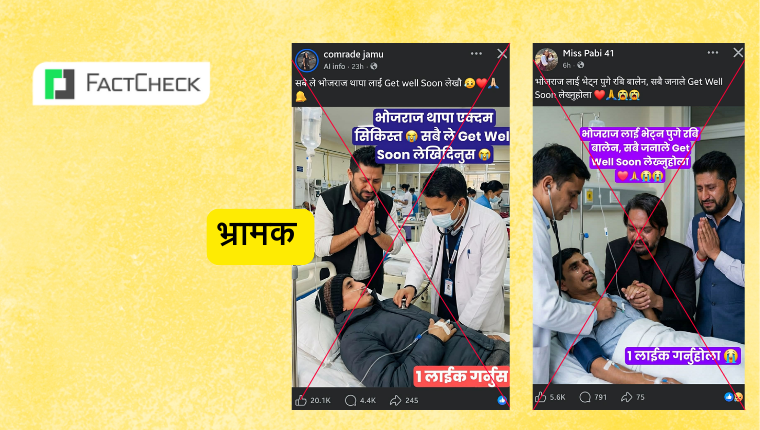
TechPana’s Fact Check Desk has confirmed that while popular YouTuber Bhojraj Thapa is indeed hospitalized, widely shared images showing Rastriya Swatantra Party (RSP) President Rabi Lamichhane and Kathmandu Mayor Balendra Shah (Balen) visiting him in tears are entirely fabricated.
The false narrative began spreading rapidly after a Facebook page named ‘comrade jamu’ published a post on Saturday evening showing Thapa on a hospital bed with an oxygen mask while Lamichhane stood beside him with folded hands and a sorrowful expression. The post, which urged followers to wish Thapa a speedy recovery, garnered over 20,000 likes and was shared hundreds of times.
Similar posts soon proliferated across Facebook. User ‘Narayan Bc’ shared another image in the ‘Bhojraj Thapa’ Facebook group showing the YouTuber in apparently critical condition. A page called ‘Miss Pabi 41’ posted images purporting to show both Lamichhane and Mayor Shah visiting Thapa together, with emotionally charged captions that generated thousands of reactions.
When subjected to analysis using AI detection tool Hive Moderation, the images were conclusively identified as artificial, with 96.9 to 99.9 percent certainty. Some images were likely created using Google’s Gemini AI, while others were generated with different tools such as VO3.
The investigation confirmed that Thapa is genuinely ill, based on posts from his official Facebook page and videos shared by his nephew, Sanam GC. However, these legitimate sources show Thapa in a notably less critical condition than portrayed in the AI-generated images. In authentic footage, Thapa appears conscious and able to drink from a glass, wearing casual clothes rather than hospital attire, and without the oxygen support depicted in the fabricated photos.
This incident highlights the growing challenge of AI-generated misinformation in Nepal’s social media landscape. The sophisticated quality of these fake images allowed them to deceive thousands of users who expressed genuine concern for Thapa and admiration for the politicians supposedly visiting him.
The false narrative was particularly effective because it built upon a kernel of truth – Thapa’s actual illness – while fabricating dramatic scenes featuring prominent public figures. The emotional nature of the content likely contributed to its rapid spread, with users eagerly sharing what appeared to be touching moments of political figures showing compassion.
This case serves as a cautionary example of how AI technology can be misused to create and spread false information that appears convincingly real. As image generation tools become increasingly accessible and sophisticated, distinguishing between authentic and fabricated visual content presents a growing challenge for social media users.
TechPana’s fact-checking initiative, which allows the public to submit content for verification, represents an important effort to combat such misinformation. The organization encourages readers to send potentially misleading social media posts through their website, social media platforms, or via email for professional fact-checking.
In an era where seeing is no longer necessarily believing, this incident underscores the importance of media literacy and critical evaluation of emotionally charged content before sharing it online.
Fact Checker
Verify the accuracy of this article using The Disinformation Commission analysis and real-time sources.

9 Comments
It’s disappointing to see people exploiting someone’s medical condition for their own agenda. I hope Bhojraj Thapa is able to recover and that the public remains vigilant against the spread of disinformation.
This is a concerning situation. It’s important to verify information, especially when it comes to someone’s health. Spreading unconfirmed or fabricated content can do more harm than good.
This incident highlights the importance of media literacy and critical thinking when it comes to evaluating the information we encounter online. We must all be more vigilant against the spread of misinformation.
It’s concerning to see how easily false narratives can gain traction on social media. I hope this serves as a wake-up call for the public to be more cautious and to verify information before sharing it.
While I’m relieved to hear that Bhojraj Thapa’s condition is not as severe as depicted, the viral spread of these fabricated images is troubling. We must be more discerning consumers of online content.
I appreciate the efforts of the fact-checking authorities in this case. Maintaining transparency and trust in the media is crucial, especially when it comes to sensitive personal matters.
Fact-checking is crucial in today’s digital landscape. I’m glad the authorities were able to investigate and confirm the true nature of this situation. Misinformation can have serious consequences.
I hope this case will inspire greater awareness and accountability around the creation and dissemination of false content. It’s a concerning trend that must be addressed head-on.
This incident serves as a stark reminder of the need for digital literacy and critical thinking. We must all be more discerning consumers of online content to prevent the spread of misinformation.