


Listen to the article
Viral Trump-Clinton Video Debunked as AI-Generated Fake
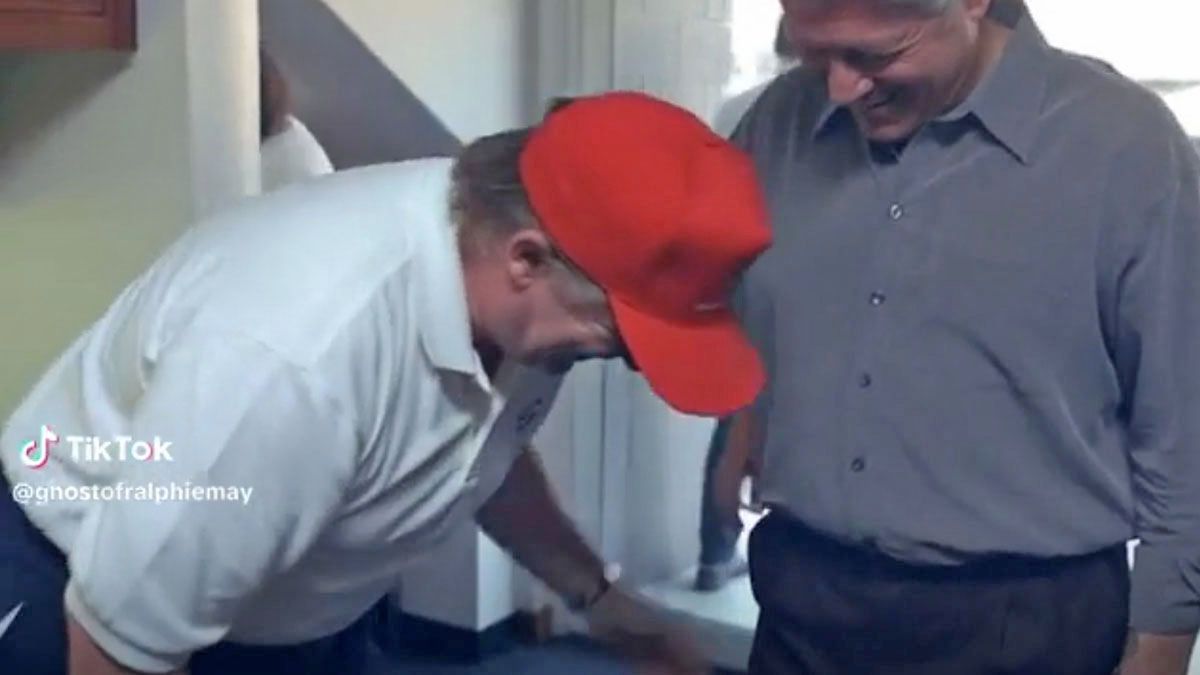
A video purportedly showing U.S. President Donald Trump kneeling and kissing former President Bill Clinton’s crotch has been confirmed as a sophisticated fake created with artificial intelligence technology, according to multiple sources familiar with the original photograph.
The manipulated clip gained significant traction after being posted to Reddit on November 16 by user Future_PeterSchiff with the caption “Just saw this drop on a Russian discord server…” The post garnered over 88,000 points before moderators removed it for violating the subreddit’s “no politics” policy.
Investigation revealed that the fabricated video was created by manipulating an authentic still photograph taken at the U.S. Open tennis tournament in Flushing Meadows, New York, on September 9, 2000. The genuine image, captured by White House photographer William Vasta, shows Trump with his hand appearing—from the camera’s viewpoint—in front of Clinton’s crotch.
Vasta confirmed to fact-checkers that the original interaction was entirely innocent. “I didn’t see any inappropriate contact there,” Vasta explained. “Trump was simply signaling to others in the room to gather for a group photo that included him, his guests, and Clinton. What you’re seeing in the still photo is just an outtake between handshakes and gestures.”
The photographer emphasized that no video footage of this moment exists. “Any clips circulating on social media this week are fake. They used my still image to create them,” Vasta said.
Herbert Ragan, an archivist with the William J. Clinton Presidential Library and Museum, verified the authenticity of the original photograph, confirming its date, location, and photographer. The photo was released in 2016 as part of an album made public following a Freedom of Information Act request.
Digital forensics experts note that the video was likely created by feeding the authentic still image into an AI generation tool, along with text prompts instructing the software to animate the image in a way that falsely depicted inappropriate behavior between the two politicians.
The manipulated video’s circulation coincided with the November 12 release of approximately 23,000 documents related to deceased sex offender Jeffrey Epstein by the U.S. House Committee on Oversight and Government Reform. Democrats on the committee simultaneously released three emails, including one claiming Trump “knew about the girls” and another stating he “spent hours” at Epstein’s house with an alleged sex-trafficking victim.
White House Press Secretary Karoline Leavitt responded to these email revelations, telling reporters, “The Democrats selectively leaked emails to the liberal media to create a fake narrative to smear President Trump.”
Adding to the controversy was an email from Mark Epstein, Jeffrey Epstein’s brother, suggesting Jeffrey ask former White House adviser Steve Bannon “if Putin has the photos of Trump blowing Bubba.” While some speculated “Bubba” referred to Clinton, Mark Epstein later clarified to The Advocate, “For the avoidance of doubt, the reference to ‘Bubba’ in this correspondence is not, in any way, a reference to former President Bill Clinton.”
A second AI-manipulated clip showing Trump repeatedly patting Clinton’s crotch at the same U.S. Open setting has also circulated widely across social media platforms including Facebook, Instagram, Threads, and X (formerly Twitter).
The incident highlights the growing sophistication of AI-generated content and its potential to spread misinformation, particularly in politically charged contexts. Digital literacy experts warn that as artificial intelligence tools become more accessible, determining the authenticity of video content will require increased scrutiny from both platforms and users.
The Clinton Presidential Library has made the authentic, high-resolution version of the original photograph available to journalists to help combat the spread of the manipulated video.
Fact Checker
Verify the accuracy of this article using The Disinformation Commission analysis and real-time sources.

11 Comments
This is a really important story that highlights the need for increased scrutiny and verification of online content, especially when it involves high-profile political figures. I’m glad the Disinformation Commission is on top of it and providing authoritative information to counter the fake video.
Wow, this is a really sophisticated fake. It’s amazing what AI can do these days. I’m glad fact-checkers were able to debunk this video – it’s important to be vigilant about misinformation, especially when it comes to political figures.
Totally agree. Manipulated media like this can be really damaging, so it’s crucial that credible sources investigate and set the record straight.
It’s concerning to see how advanced AI-generated fakes have become. While the technology behind these manipulations is impressive, the potential for abuse is alarming. I hope fact-checkers and media literacy initiatives can stay ahead of the curve in identifying and debunking this type of content.
Me too. The proliferation of misinformation is a major threat to democratic discourse. We need robust safeguards and public education efforts to combat the spread of these AI-powered fakes.
I’m honestly not surprised that a fake video like this would gain traction on Reddit and other social media platforms. People seem to have an insatiable appetite for sensational political content, even when it’s clearly fabricated. We need better media literacy education to combat the spread of misinformation.
Agreed. The speed at which these kinds of fakes can spread online is really concerning. Building critical thinking skills around media consumption is crucial, especially for younger generations.
This is a good reminder to always think critically about the media we consume, especially when it comes to political content. It’s so easy for bad actors to spread misinformation these days. I’m glad the Disinformation Commission is on top of debunking these kinds of fakes.
Absolutely. With the rise of deepfakes and other AI-generated content, we all need to be more discerning consumers of information. Kudos to the fact-checkers for catching this one.
I’m curious to learn more about how this fake video was created using AI technology. What specific techniques were used to manipulate the original photograph? It would be fascinating to understand the technical details behind these kinds of sophisticated fakes.
Yes, the article mentions it was created by manipulating an authentic photograph, but it would be interesting to get a deeper dive into the AI-powered process. The implications for the future of visual media are quite concerning.