


Listen to the article
Media Watchdog: Congressman’s False Claims on Virginia Redistricting Go Unchallenged in WDBJ7 Interview
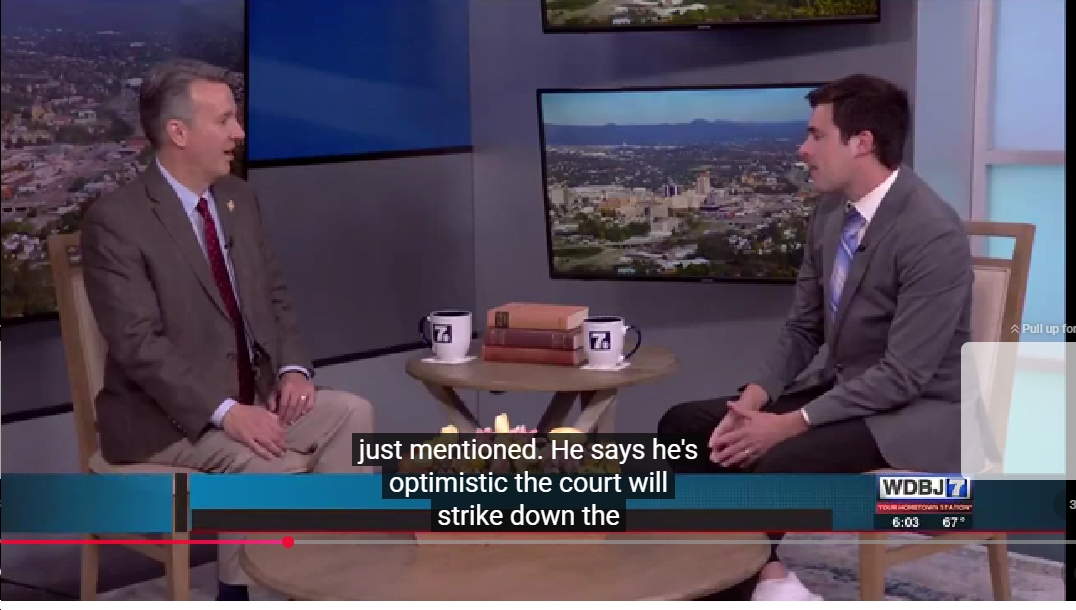
A recent interview between WDBJ7 and Republican Representative Ben Cline of Virginia’s 6th Congressional District has drawn sharp criticism for what journalism experts are calling a textbook example of inadequate political reporting.
The segment, which aired earlier this week, focused on the proposed redistricting of Virginia’s 6th Congressional District. While WDBJ7 correctly noted the district could be redrawn to include several colleges—Radford, Virginia Tech, UVA, JMU—along with Roanoke and Salem, the station failed to challenge Congressman Cline when he made demonstrably false statements about the new boundaries.
“It’s clear that the Democrats realized that they couldn’t beat me at the ballot box, so they wanted to chop the district that I currently represent up and parcel it out to so many Northern Virginia seats and try and beat me through an unconstitutional gerrymander,” Cline claimed during the interview.
This statement contains a significant geographical error that went uncorrected. According to official redistricting maps, the proposed new 6th District doesn’t extend into Northern Virginia at all. The northernmost point reaches only to Harrisonburg—approximately 100 miles southwest of what is traditionally considered Northern Virginia.
Chris Graham of the Augusta Free Press first highlighted the journalistic failure, writing: “Interviewers: your job isn’t to let politicians just say whatever they want to say. If Ben Cline tries to tell us that Harrisonburg is in Northern Virginia, it’s your job to say, ‘Excuse me, Mr. Congressman.'”
The proposed district would actually include parts or all of Albemarle, Fluvanna, Nelson, Amherst, Bedford, Botetourt, Roanoke, Montgomery, and Buckingham counties, along with cities like Charlottesville, Lynchburg, Roanoke, Salem, Staunton, and Waynesboro—none of which are considered part of Northern Virginia by any standard definition.
Instead of correcting this mischaracterization, WDBJ7 continued the interview without pushback, allowing Cline to claim the redistricting process “ignored Virginia’s constitution” and that “the wording on the ballot was misleading.” The station presented these statements as Cline’s beliefs without providing viewers with factual context or opposing viewpoints.
Media critics point to this as part of a troubling pattern in political journalism, where reporters prioritize maintaining access to politicians over challenging inaccurate statements.
The interview further drew criticism for its framing of national redistricting efforts. WDBJ7 stated that “redistricting is happening in both blue and red states across the country,” without providing important context about the Supreme Court’s recent decision limiting the Voting Rights Act or explaining the significant differences in how partisan gerrymandering is occurring across states.
After allowing Cline’s claims about redistricting to go unchallenged, the interviewer posed what critics call a “softball” question: “Do you feel confident that you guys will keep the house in November?” This gave Cline an unopposed platform to promote Republican messaging about border security legislation without any critical examination.
The controversy highlights ongoing debates about journalistic standards in political reporting. Media ethics experts emphasize that journalists have a responsibility to provide accurate context and to challenge false claims in real-time, particularly when the facts are readily available.
The redistricting process in Virginia continues to be contentious, with legal challenges and political maneuvering likely to continue. Meanwhile, this incident serves as a reminder of the crucial role media plays in either clarifying or confusing public understanding of complex political issues.
Voters in Virginia’s 6th District—wherever its boundaries ultimately fall—will head to the polls in November as part of the 2024 general election that will determine control of the House of Representatives, where Republicans currently hold a narrow majority.
Fact Checker
Verify the accuracy of this article using The Disinformation Commission analysis and real-time sources.

8 Comments
I’m curious to learn more about the full context and details of this interview. What were the specific false claims made by Congressman Cline, and how did they contradict the official redistricting maps? This situation highlights the importance of rigorous, impartial political reporting.
Agreed. If the reporter failed to correct Congressman Cline’s geographical error, that seems like a significant lapse in journalistic standards. Fact-checking and clarifying the true redistricting boundaries should have been a priority.
This seems like a concerning case of potential journalistic malpractice. It’s crucial for reporters to challenge and fact-check claims, especially from political representatives, to uphold journalistic integrity. Letting false statements go unchecked can spread disinformation and undermine public trust.
While I understand the desire for balanced coverage, there is a line where reporters must firmly challenge demonstrably false statements. Letting blatant misinformation go unchecked, especially on important issues like redistricting, is a disservice to the public. Journalists have a duty to report the facts accurately.
This situation highlights the ongoing challenges in political journalism and the need for greater accountability. Reporters must be diligent in verifying claims and pushing back on false narratives, even when interviewing elected officials. Upholding journalistic integrity should be the top priority.
This is a disappointing example of substandard political reporting. Journalists have a responsibility to hold public officials accountable and not allow blatantly false statements to go unchallenged, especially on important issues like redistricting. The public deserves better.
I appreciate the Media Watchdog organization calling attention to this issue. Maintaining high journalistic standards is crucial, especially when it comes to reporting on political matters that can directly impact constituents. This incident warrants further scrutiny and improvement.
Absolutely. Rigorous, objective reporting is essential for a healthy democracy. Failing to challenge clear factual errors undermines the public’s trust in the media and allows misinformation to spread unchecked.