


Listen to the article
Polish Disinformation Campaign Targets Ukrainian Integration Event at Kindergarten
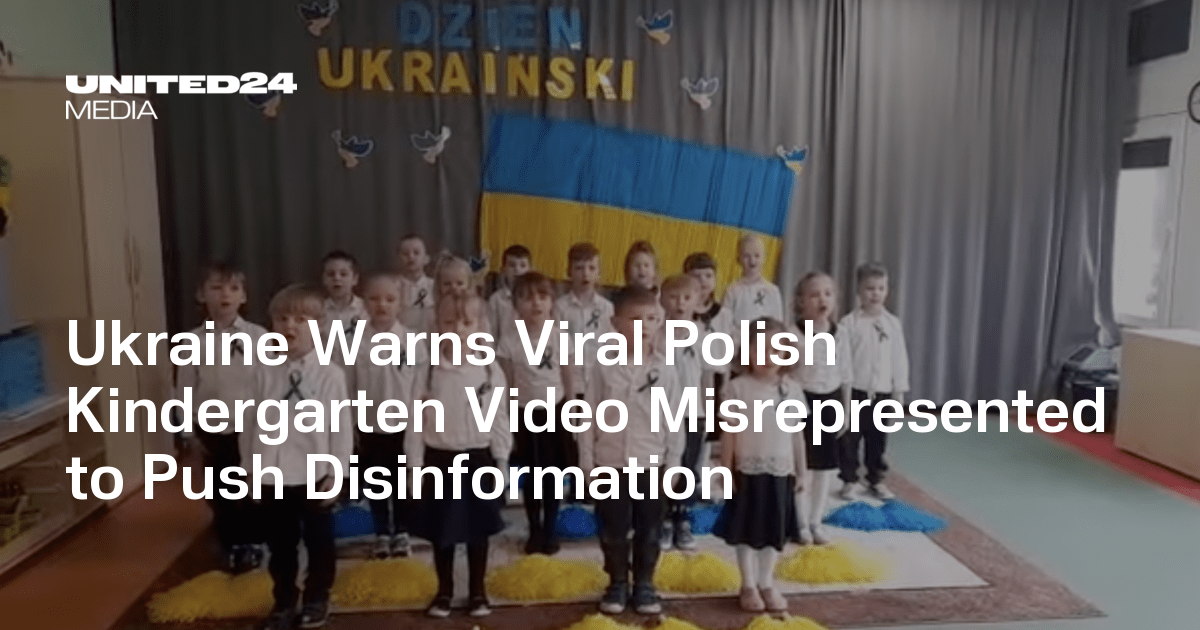
A video circulating widely in Poland that shows children singing Ukraine’s national anthem has become the center of a disinformation campaign, according to Ukraine’s Center for Countering Disinformation.
In a statement released on January 12, the center clarified that the footage being shared on social media was actually an archival recording from March 2023. The video was originally published on the official page of a municipal kindergarten in the Polish city of Słupsk, where it documented a themed “Ukraine Day” event.
Far from being a case of forced “Ukrainization” as some Polish politicians have claimed, the event was specifically designed to help integrate and support Ukrainian children whose families had sought refuge in Poland following Russia’s full-scale invasion in February 2022.
Polish fact-checking organization Demagog investigated the claims and spoke with a spokeswoman for Słupsk city hall, who categorically denied any coercion took place. “No child was forced to do anything,” the spokeswoman stated, explaining that parents were both informed and involved in the activities. The performance was entirely voluntary and intended as a symbolic gesture of solidarity with displaced Ukrainian families.
The controversy erupted when the nearly year-old recording began circulating again on January 6 after being shared by several Polish lawmakers, including Dariusz Matecki. These politicians presented the video as evidence of what they termed “Ukrainization” within Poland’s educational system—suggesting that Polish children were being compelled to adopt Ukrainian cultural practices.
Independent Polish media outlets quickly challenged this characterization, pointing out that there was no evidence supporting allegations of coercion and emphasizing that the recording was from early 2023, not a recent event as some social media posts implied.
This incident highlights the growing tensions in Polish-Ukrainian relations, which have generally been strong since Russia’s invasion but have faced strains in recent months. Poland has been one of Ukraine’s strongest supporters in Europe, hosting over 1.5 million Ukrainian refugees and serving as a critical logistics hub for Western military aid to Ukraine.
However, domestic political considerations in Poland have complicated the relationship. The rise of nationalist sentiment and concerns about the economic impact of Ukrainian refugees have provided fertile ground for disinformation campaigns aimed at stoking anti-Ukrainian sentiment.
Experts note that such disinformation efforts often align with Russian interests by attempting to drive wedges between Ukraine and its supporters. The timing of the video’s resurgence coincides with broader diplomatic tensions between Warsaw and Kyiv over various issues, including historical grievances and trade disputes.
The Polish-Ukrainian border has recently seen protests by Polish truckers and farmers who claim Ukrainian imports are undercutting their livelihoods. These economic frictions have created an environment where disinformation can more easily gain traction.
In a seemingly unrelated but potentially significant development, Polish prosecutors recently supported Ukraine’s request to extradite Russian archaeologist Alexander Butyagin, who is accused of conducting illegal excavations in Russian-occupied Crimea that allegedly damaged important cultural heritage sites. This case demonstrates that despite the challenges, Polish-Ukrainian cooperation continues in many areas, particularly regarding the enforcement of international law as it relates to Russia’s actions in Ukraine.
Media literacy experts emphasize that the kindergarten video incident demonstrates the importance of verifying the context and timing of social media content before drawing conclusions or sharing potentially misleading information.
As the war in Ukraine approaches its third year, both Ukrainian and Polish officials have called for vigilance against disinformation campaigns designed to undermine the coalition of countries supporting Ukraine’s defense against Russian aggression.
Fact Checker
Verify the accuracy of this article using The Disinformation Commission analysis and real-time sources.

13 Comments
Interesting situation with this viral video. It seems the Polish kindergarten event was meant to support Ukrainian refugee children, not force ‘Ukrainization’. Disinformation can be so misleading, glad the facts were clarified.
Agree, it’s important to get the full context rather than jump to conclusions. Fact-checking helps cut through the noise and misinformation.
It’s disturbing that some are trying to twist this kindergarten video for political gain. Kudos to the Ukrainian authorities for swiftly addressing the misinformation. Vigilance against disinformation is critical.
Absolutely. Fact-checking and setting the record straight is so important, especially when it comes to sensitive topics related to geopolitics and vulnerable populations like refugee children.
While it’s troubling to see disinformation attempts, it’s reassuring that fact-checking organizations are on the case to expose the truth. Transparency is key to countering these kinds of deceptive campaigns.
Disappointing to see this kindergarten event being exploited for political gain through disinformation. Kudos to the authorities for swiftly addressing the issue and setting the record straight.
It’s disheartening to see a innocent event like this being twisted for political gain through disinformation. Kudos to the Ukrainian authorities for their swift response in clarifying the facts.
Concerning to see how a simple video can be twisted and misused for disinformation campaigns. Kudos to the Ukrainian authorities for quickly addressing this and setting the record straight.
Yes, it’s a good reminder to be cautious about viral content and to always seek out authoritative sources for the facts, especially on sensitive political issues.
This highlights how easily information can be distorted and weaponized, even something as innocent as a kindergarten event. Glad the truth was uncovered through investigation.
This episode underscores the importance of responsible journalism and fact-checking. It’s concerning to see how easily information can be distorted, but also reassuring that there are efforts to counter such misinformation.
This is a cautionary tale about the dangers of viral content and the need for critical analysis. Kudos to the fact-checkers for getting to the bottom of this and exposing the truth.
Agreed. It’s a good reminder that we must always be skeptical of sensational claims, especially when they seem to fit a certain narrative. Verifying sources and context is crucial.