


Listen to the article
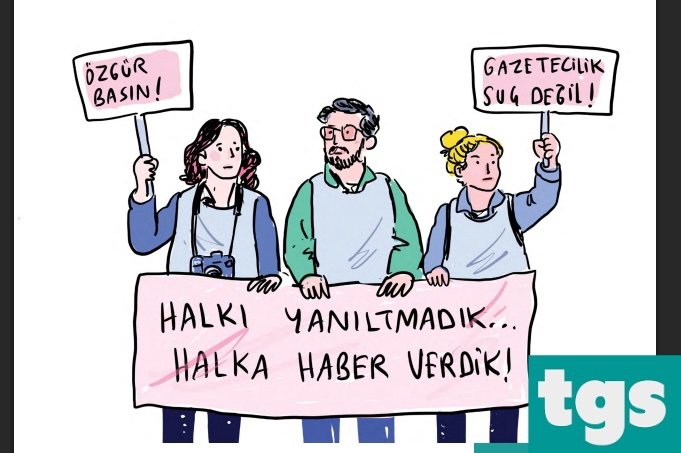
Turkey’s “disinformation law” has become a mechanism for press suppression, with over 300 journalists facing prosecution in the past year, according to an annual report released by the Turkish Journalists Union (TGS).
The report, which documents press freedom violations between April 2025 and April 2026, characterizes these incidents not as isolated cases but as part of what it terms “an institutionalized regime of repression” against media professionals.
“The principle of the rule of law has been replaced by the arbitrariness of those in power,” the union stated in its findings. It further emphasized that journalistic activities in Turkey continue to face “systematic criminal and administrative sanctions.”
Legal proceedings against journalists have resulted in significant punitive measures. Of 224 criminal cases involving journalists, including those carried over from previous years, 73 concluded with prison sentences totaling more than 53 years. Additionally, 15 journalists and four media organizations faced civil lawsuits, with courts awarding damages of approximately 102,500 Turkish lira ($2,300).
The detention statistics paint an equally concerning picture. Sixty-seven journalists were detained during the reporting period, with 19 jailed pending trial. Two were placed under house arrest, while 26 were released under judicial supervision conditions that often restrict their ability to work effectively.
At the center of many recent prosecutions is Article 217/A of the Turkish Penal Code, commonly referred to as the “disinformation law,” which criminalizes the “public dissemination of misleading information.” Enacted in 2022, this provision has been applied against 20 journalists during the reporting period, resulting in two arrests, one house arrest, and 14 releases under judicial supervision.
The TGS report highlights how the law’s application has expanded beyond journalists to target labor activists, environmentalists, opposition youth groups, retirees protesting economic conditions, and lawyers who criticize government policies.
Erinç Sağkan, who heads the Ankara Bar Association, is quoted in the report criticizing the law’s ambiguous language. According to Sağkan, this vagueness contradicts European human rights standards and poses a dual threat—undermining both press freedom and the public’s right to access information.
Physical safety remains a significant concern for Turkish media workers. The report documents that at least 34 journalists suffered physical assaults during the year, while 22 others faced threats or verbal abuse. Two media outlets were directly targeted in attacks.
Regulatory bodies have also played a role in media suppression. Turkey’s broadcast regulator, the Radio and Television Supreme Council (RTÜK), issued 21 administrative rulings with fines totaling 15.2 million lira (approximately $336,000). Opposition-aligned broadcasters including Tele1, Halk TV, and SZC TV received broadcast suspensions.
Digital censorship has intensified alongside traditional forms of media control. The TGS documented at least seven websites being completely blocked, 41 news URLs removed from access, eight content items deleted, and 21 accounts on X (formerly Twitter) having their access restricted within Turkey.
The report provides context on the media sector’s overall composition, noting that as of January 2026, Turkey had 90,293 registered workers in press, publishing, and journalism, with only 13.7 percent belonging to unions—a factor that may contribute to journalists’ vulnerability.
Turkey has long faced international criticism for its press freedom record. The country ranks among the world’s worst performers on global press freedom indices, with organizations like Reporters Without Borders and the Committee to Protect Journalists consistently expressing concerns about the deteriorating conditions for independent media.
The findings come amid broader concerns about democratic backsliding in Turkey, where President Erdoğan’s government has been accused of systematically undermining independent institutions and civil liberties following an attempted coup in 2016.
Fact Checker
Verify the accuracy of this article using The Disinformation Commission analysis and real-time sources.

25 Comments
If AISC keeps dropping, this becomes investable for me.
Good point. Watching costs and grades closely.
Nice to see insider buying—usually a good signal in this space.
Good point. Watching costs and grades closely.
Good point. Watching costs and grades closely.
Uranium names keep pushing higher—supply still tight into 2026.
Good point. Watching costs and grades closely.
Good point. Watching costs and grades closely.
The cost guidance is better than expected. If they deliver, the stock could rerate.
Uranium names keep pushing higher—supply still tight into 2026.
Good point. Watching costs and grades closely.
The cost guidance is better than expected. If they deliver, the stock could rerate.
Good point. Watching costs and grades closely.
Nice to see insider buying—usually a good signal in this space.
Good point. Watching costs and grades closely.
If AISC keeps dropping, this becomes investable for me.
Good point. Watching costs and grades closely.
Good point. Watching costs and grades closely.
Production mix shifting toward Disinformation might help margins if metals stay firm.
Good point. Watching costs and grades closely.
Exploration results look promising, but permitting will be the key risk.
Good point. Watching costs and grades closely.
Good point. Watching costs and grades closely.
Production mix shifting toward Disinformation might help margins if metals stay firm.
Good point. Watching costs and grades closely.