


Listen to the article
European Leaders Sound Alarm on Russia’s “Invisible Wars” at Belgrade Security Conference
Experts and political leaders gathered at the fourth Belgrade Security Conference warned that Europe faces an escalating battle against Russian hybrid threats, describing a multilayered conflict that extends beyond conventional warfare to target the “minds and hearts of Europeans.”
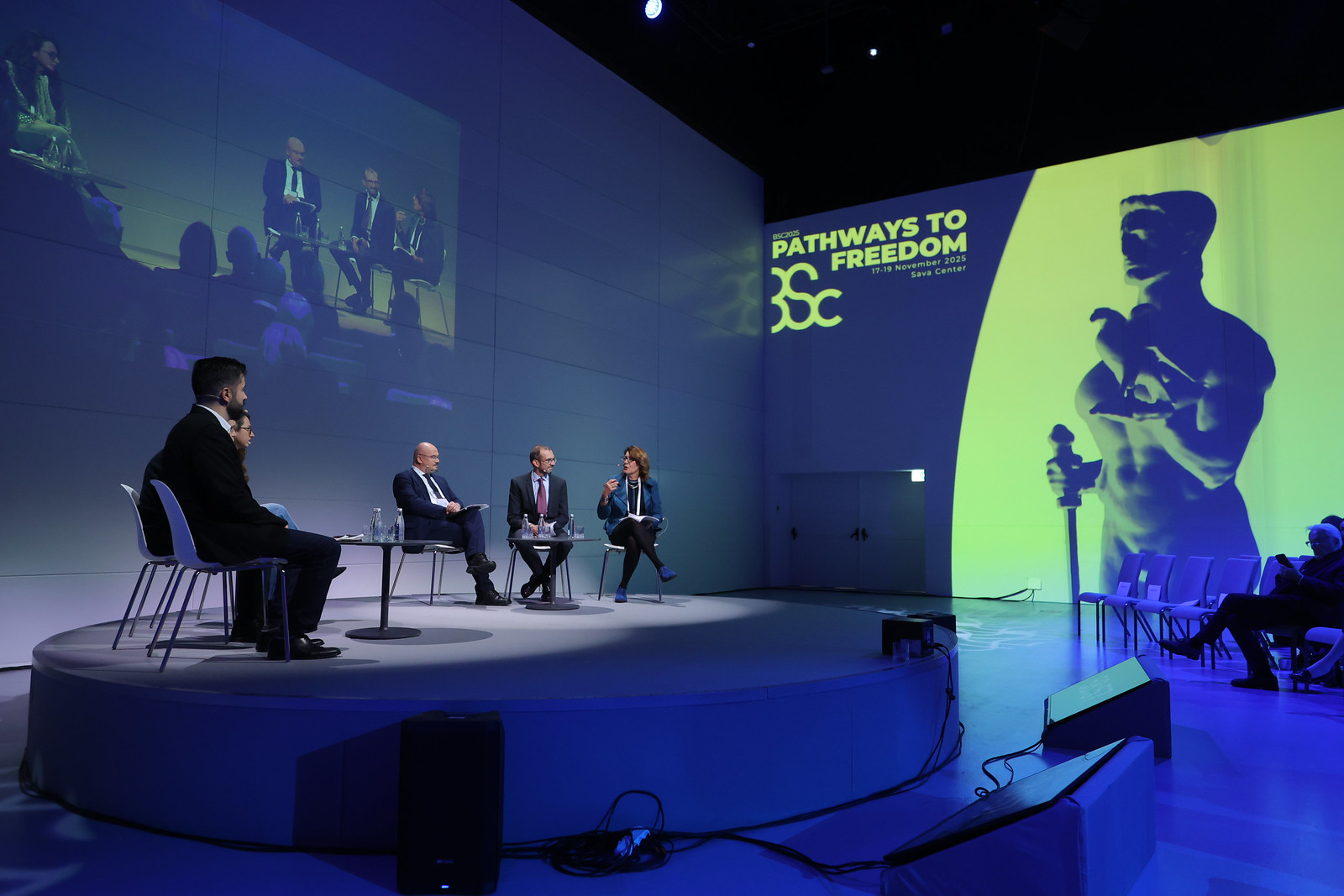
During the panel “Unarmed in the Unseen War: How to Counter Hybrid Threats in Europe,” speakers highlighted how Russia’s influence operations have intensified, particularly during election cycles across the continent, with Moldova serving as a recent case study.
Mihaela Sirițanu, public policy expert at Watchdog Moldova, detailed Russia’s interference in Moldova’s electoral process through “laundered money” and coercive methods. “We came out of it stronger and better, but the danger was significant,” she said, pointing to Russia’s tactical use of energy supplies as political leverage. Last year, Moscow temporarily cut gas deliveries to Moldova in apparent retaliation for the country’s growing alignment with the European Union.
Sirițanu acknowledged the EU’s increasing efforts to combat hybrid threats but emphasized the need for greater European unity. “The fight is not over yet,” she cautioned, noting that civil society organizations bear a disproportionate burden in countering disinformation. “Civil society can also feel fatigue if it is left alone,” she warned.
Former Bulgarian Prime Minister Kiril Petkov identified corruption as Russia’s most effective foreign influence tool. “Russia successfully exports corruption to penetrate power structures – the judiciary, the security system, the electoral processes, in countries like Bulgaria and Serbia,” Petkov asserted. He pointed to strategic Russian control of oil refineries in both countries as a deliberate move to block Western investment opportunities.
Even major Western European powers are not immune to these tactics, according to Thomas Röwekamp, Member of the German Bundestag and Chairman of the Defense Committee. “This is a challenge we face on a daily basis,” he said. “We are in a state between peace and war.”
Röwekamp called for stronger European defense capabilities, including enhanced intelligence sharing, which requires greater trust among European partners. While he welcomed the recently launched European Democracy Shield initiative, he characterized it as “a good start but not nearly enough.”
Frédéric Petit, Deputy Secretary General of the European Democratic Party and Member of the French Parliament, framed the struggle as transcending national boundaries. “In most countries, we are not on the front of these information wars,” he observed, adding that defending democracy “is larger than any one country or any one election.”
In a notable acknowledgment of Serbia’s democratic movements, Petit stated: “What young people in Serbia are doing now, and that is the fight against corruption and disinformation, is the defense not only of Serbia, but of the whole Europe. It is certain that in a few years the democrats in Serbia will have something to teach the European democrats.”
From Italy, Senator Enrico Borghi, President of the Institute of European Democrats, shared how his typically divided political landscape recently achieved consensus on addressing hybrid threats. “It is our common destiny, our ethical principles, that are at stake,” Borghi emphasized, highlighting the urgent need to regulate technology platforms that can amplify disinformation.
The conference discussions reflect growing European recognition that Russia’s hybrid warfare strategy extends beyond military domains into democratic institutions, information environments, and economic systems. These “invisible wars” represent a fundamental challenge to European security architecture, requiring coordinated responses across government, civil society, and the private sector.
As Russia continues to refine its hybrid warfare techniques, European leaders face mounting pressure to develop more sophisticated countermeasures while preserving democratic values and institutional integrity across the continent.
Fact Checker
Verify the accuracy of this article using The Disinformation Commission analysis and real-time sources.

20 Comments
The use of energy supplies as political leverage is a concerning development. Diversifying energy sources and reducing reliance on Russian gas seems crucial for European countries to mitigate this vulnerability.
Absolutely. Reducing dependence on Russian energy and building more robust energy infrastructure will be key to enhancing Europe’s strategic autonomy in the face of these hybrid threats.
Concerning to see Russia deploying such a wide array of influence tactics, from disinformation to economic leverage. Combating these hybrid threats will require a multifaceted, coordinated strategy from European nations and institutions.
Absolutely. Building societal resilience, enhancing information sharing, and developing deterrence capabilities will all be crucial elements of an effective response to Russia’s malign influence operations.
It’s alarming to see how Russia is weaponizing corruption to undermine democratic institutions across Europe. Bolstering transparency and accountability measures seems essential to counter these destabilizing influence operations.
Agreed. Strengthening democratic resilience through anti-corruption reforms, media literacy campaigns, and enhanced information sharing will be critical to push back against these hybrid threats.
This report highlights the insidious nature of Russia’s hybrid warfare tactics, which seek to undermine democratic processes and institutions through covert means. Countering these threats will require a sustained, comprehensive effort.
Agreed. Strengthening democratic institutions, enhancing cybersecurity, and improving public awareness and media literacy will all be essential components of a robust strategy to push back against Russia’s malign influence.
This report highlights the multifaceted nature of Russia’s hybrid warfare tactics. Tackling the challenge will require a comprehensive, coordinated response from European nations and institutions.
Absolutely. A unified, whole-of-society approach is needed to effectively counter Russia’s malign influence operations and protect the integrity of democratic processes across Europe.
The use of energy supplies as a political weapon is particularly concerning. Diversifying energy sources and reducing reliance on Russian gas should be a top priority for European nations seeking to enhance their strategic autonomy.
Absolutely. Investing in renewable energy, improving energy efficiency, and developing alternative supply chains will be crucial steps in mitigating this vulnerability and bolstering Europe’s resilience against Russian coercion.
The case of Moldova serves as a sobering example of how Russia seeks to manipulate elections and undermine democratic governance through financial influence and economic coercion. This underscores the urgent need for robust safeguards.
Agreed. Strengthening election security, financial transparency, and energy resilience should be top priorities for European policymakers in the face of these evolving hybrid threats.
Concerning to see Russia leverage corruption as a foreign influence tactic. Undermining democratic processes through disinformation and economic coercion is a worrying trend we must remain vigilant against.
Agreed, Russia’s hybrid warfare tactics pose a real threat to European security. Strengthening resilience and countering these malign activities should be a top priority.
Worrying to see how Russia is exploiting corruption and financial influence to undermine democratic institutions across Europe. Strengthening transparency, accountability, and anti-corruption measures will be essential to counter these hybrid threats.
Agreed. Enhancing financial intelligence, improving beneficial ownership registries, and cracking down on money laundering should all be key components of a comprehensive strategy to address the corrosive impact of Russian kleptocracy.
This report highlights the multifaceted nature of Russia’s hybrid warfare tactics, which go far beyond conventional military means. Tackling this challenge will require a coordinated, whole-of-society approach from European nations and institutions.
Absolutely. Strengthening societal resilience, improving information sharing, and developing deterrence capabilities will all be essential to counter Russia’s malign influence operations and protect the integrity of democratic processes.