


Listen to the article
Estonia Confronts Russian Disinformation Campaign Targeting Border City of Narva
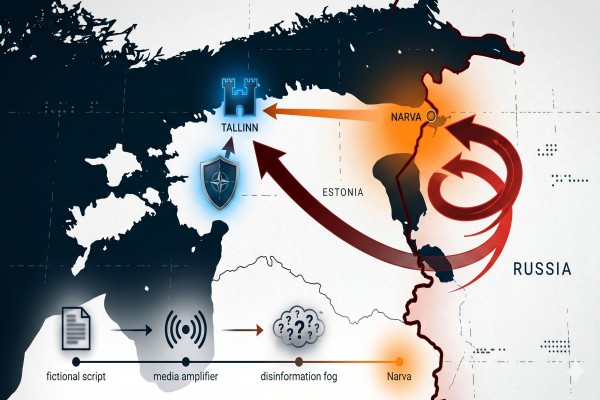
What began as fiction—a loosely constructed narrative circulating online about unrest in Estonia’s border regions—quickly evolved into a geopolitical challenge requiring real-world responses from Estonian authorities. The fabricated story about a separatist movement in the predominantly Russian-speaking city of Narva demonstrates how modern disinformation campaigns operate by blurring the boundaries between fabrication and plausibility.
According to detailed reporting by Politico, this false narrative gained significant traction by exploiting existing geopolitical anxieties and historical tensions. Narva, positioned directly on Estonia’s border with Russia, has long been viewed as a potential flashpoint given its demographic makeup and strategic location.
The mechanics behind the story’s dissemination followed established patterns documented by researchers tracking Russian disinformation operations. Networks of seemingly independent channels distributed the fabricated content, utilizing fake personas, staged videos, and coordinated amplification to create an impression of legitimacy.
What distinguished this case was the speed at which the fabricated narrative began influencing actual discourse. Despite prompt dismissal by Estonian authorities, the story triggered genuine concern among policymakers and security analysts. The fictitious scenario demanded consideration not because it was true, but because of the potential that others might believe it.
“This represents a fundamental shift in information warfare,” explained one European security analyst who requested anonymity due to the sensitive nature of their work. “The goal isn’t necessarily to convince everyone of a falsehood, but to create enough ambiguity and tension to weaken social trust and cohesion.”
Estonia is unfortunately well-acquainted with such tactics. The Baltic nation has weathered numerous information operations, including sophisticated cyberattacks and propaganda campaigns often traced back to Russia. These efforts typically target societal divisions, particularly those involving Estonia’s Russian-speaking minority, which comprises approximately 24 percent of the country’s population.
In this context, the fabricated Narva separatist movement fits a familiar pattern—one that echoes strategies deployed elsewhere in the region, where disinformation has been used to justify political or military interventions. The 2014 annexation of Crimea, which was preceded by similar disinformation narratives, remains a troubling precedent for Baltic states.
The incident demonstrates how disinformation can “bootstrap” itself into relevance. Beginning on fringe platforms, the narrative gradually migrated into mainstream awareness, making it increasingly difficult to dismiss despite its fictional origins. This process allows fabricated stories to exert influence disproportionate to their credibility.
Countering such threats requires more than simple fact-checking. By the time a story is debunked, its psychological and political impact may already be established. Estonian authorities have developed sophisticated early warning systems and public communication strategies, but the challenge remains formidable.
“One of the most difficult aspects of this type of disinformation is how it mimics organic discourse,” said Kristina Kallas, an Estonian political scientist familiar with information threats. “Networks of fake and real actors interact in ways that make detection increasingly difficult, especially in the early stages of dissemination.”
For Estonia, a NATO member sharing a 180-mile border with Russia, the stakes could not be higher. Any narrative suggesting internal instability—regardless of its veracity—carries implications for regional security and alliance dynamics.
The incident did, however, reveal Estonia’s considerable resilience. Officials and analysts quickly recognized the narrative as fabricated and communicated this assessment through official channels. This rapid response helped contain the story’s impact, though it continued circulating in certain online communities.
The episode serves as a stark reminder that in the digital age, the boundary between fiction and reality has become increasingly permeable. A story need not be true to matter; it simply needs to be plausible enough to generate uncertainty and concern.
As Estonia and other NATO members continue strengthening their defenses against information warfare, this incident highlights the evolving nature of the threat. Modern disinformation campaigns aim not merely to shape what people think, but to influence what they believe could happen—transforming imagination into uncertainty, and uncertainty into strategic vulnerability.
Fact Checker
Verify the accuracy of this article using The Disinformation Commission analysis and real-time sources.

8 Comments
This is a concerning development, but not entirely surprising given Russia’s history of leveraging disinformation to destabilize neighboring countries. Estonia’s approach of addressing the issue head-on and strengthening community ties seems like a prudent strategy.
This highlights the ongoing challenge of combating coordinated disinformation campaigns, especially those leveraging social media and exploiting existing tensions. Maintaining strong border security and fostering social cohesion will be crucial for Estonia in the face of these threats.
You’re right, Estonia will need to remain proactive and collaborative with international partners to effectively counter these tactics. Robust media literacy initiatives could also help build resilience within the population.
The mechanics of this disinformation campaign, with its use of fake personas and coordinated amplification, underscore the need for continued innovation in detection and response. Estonia’s experience could offer valuable lessons for other nations grappling with similar threats.
While disconcerting, I’m glad to see Estonian authorities taking this threat seriously and responding accordingly. Disinformation is a complex challenge, but a coordinated, fact-based approach can help mitigate the impact and prevent further escalation.
Concerning to see Russia spreading misinformation to sow discord in Estonia. It’s crucial that authorities remain vigilant and respond decisively to these tactics aimed at exploiting vulnerabilities. Fact-checking and transparency are key to countering such malign influence efforts.
Disinformation campaigns targeting border regions are particularly worrying, as they can exacerbate existing tensions and create openings for further aggression. Estonia’s vigilance and commitment to truth-telling are admirable in the face of these insidious tactics.
Absolutely. Building societal resilience through robust civic institutions, media literacy, and cross-cultural exchange will be crucial for Estonia as it works to safeguard its sovereignty and territorial integrity.