


Listen to the article
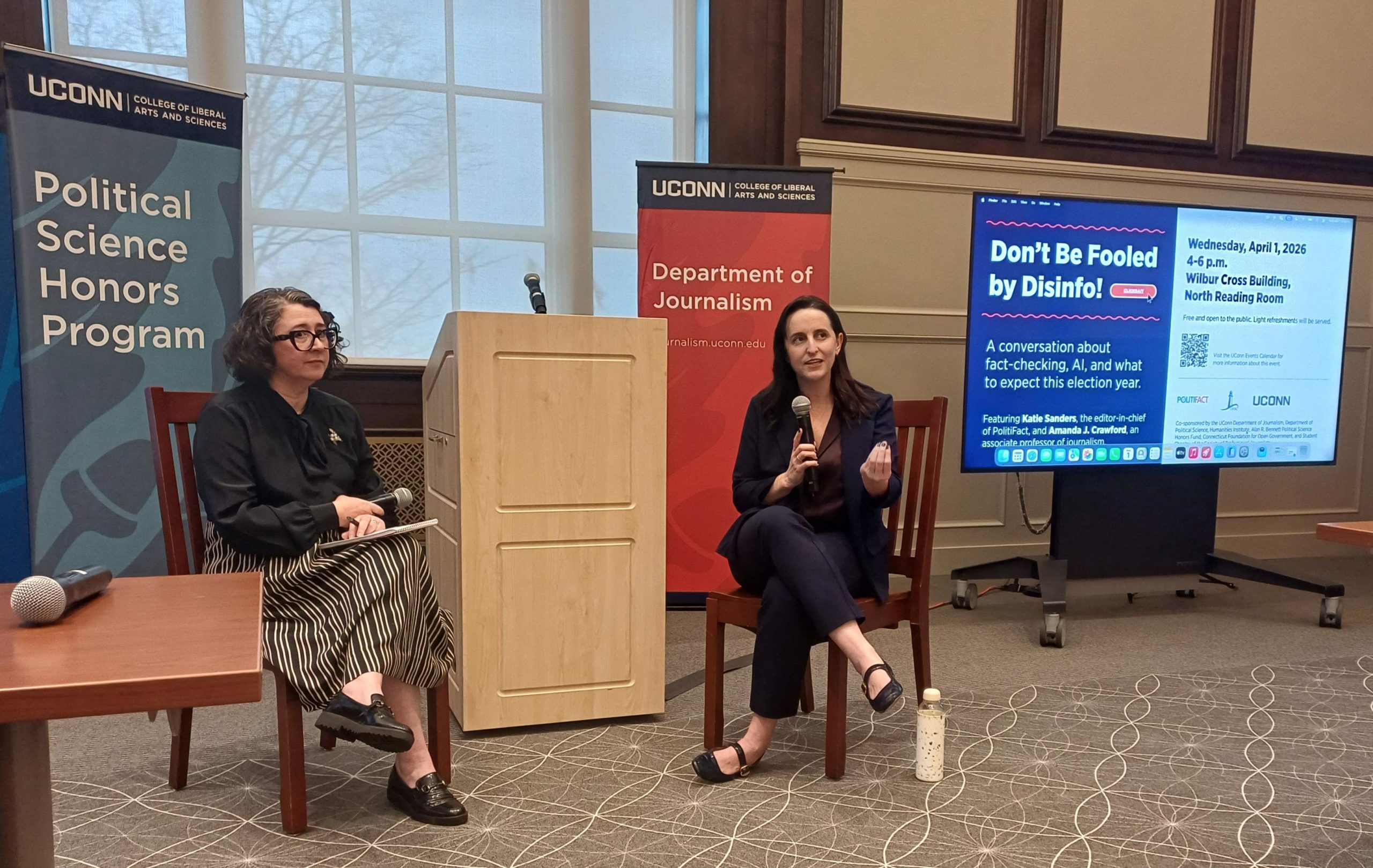
In an era where disinformation floods media channels, experts are urging increased vigilance among news consumers. A timely discussion on fact-checking and artificial intelligence took place at Wilbur Cross on April 1, bringing together journalism professionals to address the growing challenge of separating fact from fiction.
Katie Sanders, editor-in-chief of PolitiFact, a nonpartisan fact-checking website, joined Amanda J. Crawford, professor in the Department of Journalism at the University of Connecticut, to discuss deceptive media posts and methods consumers can employ to uncover truth in an increasingly complex information landscape.
Sanders highlighted a recent example of disinformation: the falsely reported death of Israeli Prime Minister Benjamin Netanyahu, which spread rapidly across multiple social media platforms. PolitiFact’s swift debunking of this claim became their most popular fact-check, demonstrating the public’s hunger for verification amid the chaos of misinformation.
“Transparency, rabid nonpartisanship, and publicly correcting mistakes are among our core principles,” Sanders explained. She emphasized that PolitiFact strives to scrutinize both political parties equally, maintaining journalistic integrity throughout their verification process.
The fact-checking process begins with source analysis, according to Sanders. This includes investigating who is behind posts, examining evidence supporting claims, and comparing information across multiple sources. For visual content, fact-checkers often employ reverse image search technology to verify a photo’s origins.
Crawford stressed the importance of applying critical thinking to all information encountered online. “When we see something that supports our preconceived bias, we are more likely to fall for it,” she warned. “We’re all at risk with being okay with disinformation if it supports our side.”
PolitiFact’s methodology relies on their “Truth-O-Meter,” a rating system that categorizes claims on a spectrum from “True” to “Pants on Fire”—the latter reserved for statements that are both inaccurate and deemed ridiculous allegations. Each fact-check undergoes rigorous review by three editors who challenge reporters to provide evidence for every assertion made in their analysis.
Despite the crucial importance of fact-checking, Crawford cautioned that there are instances when verification efforts can “backfire.” As a researcher specializing in misinformation and media coverage of mass shootings, she expressed concern about inadvertently amplifying little-known falsehoods through the fact-checking process itself, potentially giving them unwanted traction.
While the spread of false information on social media isn’t new, the increasing sophistication of generative AI has dramatically lowered barriers to creating convincing deception. Crawford cited seemingly innocuous AI-generated cat videos that many believe are real as a concerning indicator. “If we’re falling for benign fake cat videos, will we also believe consequential disinformation?” she questioned.
Sanders shared a more troubling example: PolitiFact recently investigated an AI-generated video showing a crying toddler touching the casket of his military father allegedly killed in Iran. The emotional video elicited widespread empathy from viewers who believed it depicted a real event, demonstrating how AI can manipulate emotions to spread misinformation.
Despite these concerns, Sanders noted that AI offers some benefits to fact-checkers. PolitiFact is experimenting with a “Jurisprudence Assistant” that generates recommended ratings by analyzing their archive of previous claim assessments. She emphasized that while this AI tool can provide additional information or help strengthen conclusions, PolitiFact does not use artificial intelligence to draft or edit stories.
For those new to fact-checking, Sanders suggested that AI tools like ChatGPT can serve as starting points for research, similar to search engines. However, she emphasized the need for caution, as these tools can generate fake sources and misleading information.
The discussion, sponsored by UConn, PolitiFact, and the Connecticut Foundation for Open Government, concluded with a clear message: stay vigilant and approach all information with healthy skepticism. As AI continues to evolve, the ability to discern fact from fiction becomes not just a journalistic skill but a civic necessity.
Fact Checker
Verify the accuracy of this article using The Disinformation Commission analysis and real-time sources.

20 Comments
The example of the false report about the Israeli PM’s death underscores how quickly misinformation can spread. It’s a stark reminder of the need for vigilance and fact-checking.
This article highlights an important example of how quickly false information can spread on social media. It’s a good reminder to always double-check sources before sharing news.
Absolutely. Fact-checking websites like PolitiFact play a vital role in debunking misinformation and restoring public trust in the media.
This is a timely and important discussion, particularly for those of us interested in mining, commodities, and energy news. Identifying and combating disinformation is crucial.
I agree. Having access to reliable, fact-based information is essential for making informed decisions in these sectors.
Curious to learn more about the specific methods and principles used by PolitiFact to maintain nonpartisanship and transparency. Fact-checking is an essential service.
Yes, I’d be interested in understanding their process as well. Ensuring accuracy and fairness is so important, especially for sensitive topics like politics and policy.
Disinformation is a serious issue that requires increased vigilance and fact-checking. Separating truth from fiction is crucial in today’s complex media landscape.
I agree, it’s important to rely on reputable, nonpartisan sources when verifying information. Transparency and accountability should be the top priorities.
Interesting to see the discussion on the use of AI and other tools to combat disinformation. I’m curious to learn more about how these technologies can be effectively deployed.
Yes, the application of AI and automation to fact-checking is a promising area. It will be important to ensure these tools are developed and used responsibly.
As someone who follows mining and commodities news, I’m cautious about trusting information from unverified sources. This article highlights the importance of rigorous fact-checking.
The rapid spread of the false report about the Israeli PM’s death is a concerning example of how disinformation can quickly gain traction. Vigilance is key.
Glad to see this issue being addressed. In the mining and energy sectors, having access to factual information is critical for making informed decisions.
Agreed. Reliable data and analysis are essential, especially for industries that can have significant economic and environmental impacts.
Kudos to PolitiFact for their commitment to nonpartisanship and transparency. Their work in debunking false claims is vital for preserving trust in the media.
Disinformation is a growing concern, and this article provides valuable insights on how to identify false information. I’ll be sure to apply these principles when reading news about mining and energy.
As someone who invests in mining and energy equities, I’m always cautious about the information I rely on. This article reinforces the need for thorough fact-checking, even from seemingly reputable sources.
Absolutely. Maintaining a skeptical and critical eye when consuming news, especially in specialized industries, is essential to making informed decisions.
As someone interested in mining and energy news, I appreciate the emphasis on using AI and other tools to identify false information. Reliable data is crucial in these industries.